The Principal-Agent Model
Christopher Makler
Stanford University Department of Economics
Econ 51: Lecture 17
Problems of asymmetric information
If people have hidden information,
(e.g. the quality of a used car for sale)
what mechanism can a designer establish
to get them to reveal that information?
If people can take hidden actions,
what mechanism can a designer establish
to get them to choose the action the designer wants them to take?
LAST TIME: ADVERSE SELECTION
TODAY & NEXT TUES: MORAL HAZARD
Principal: Someone who needs someone else to do something
Agent: The person who needs to do the thing
CEO / sales rep
Professor / student
Landowner / farmer
The principal's payoff depends on the actions of the agent
Can they incentivize the agent to do what they want?
Principal-Agent Model
I want to hire you to do a project.
- If you succeed, it’s worth \(Q^H = 400\) to me
- If you fail, it’s worth \(Q^L = 100\) to me
You choose whether to exert effort \((e)\):
- If you exert effort \((e = 1)\), you succeed with probability \(p = {2 \over 3}\)
- If you shirk \((e = 0)\), you succeed with probability \(p = {1 \over 3}\)
- Exerting effort costs \(c(e) = e\); that is, exerting effort costs \(c = 1\), while shirking costs \(c = 0\).
I can choose a wage stucture \(w\). Payoffs:
- Me (the principal) is Risk-Neutral: \(u_P(Q,w) = Q - w\)
- You (the agent) are Risk-Averse: \(u_A(w,e) = \sqrt{w} - c(e)\)
- If you reject the deal, you get a payoff of \(\underline u = 10\)
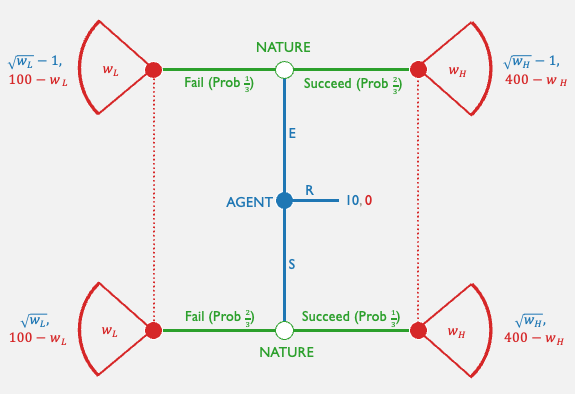
Note: "Nature" chooses whether the agent succeeds or fails; but the action the agent takes affects the probabilities
EXAMPLE 1
- Success: worth \(Q^H = 400\) to principal
- Failure: worth \(Q^L = 100\) to principal
- Payoff to principal: \(Q - w\)
- Effort: costs \(c=1\), succeed with probability \(p = {2 \over 3}\)
- Shirk: costs \(c=0\), succeed with probability \(p = {1 \over 3}\)
- Payoff to agent: \(\sqrt{w} - c\); outside option \(\underline u = 10\)
Benchmark Model: Contractible Effort
Suppose I can observe your effort.
If I write a contract to require shirking:
I can write a contract that specifies and effort level and a wage if you exert that effort.
If I write a contract to require effort:
\sqrt{w} - c(0) \ge \underline u
\sqrt{w} - c(1) \ge \underline u
\sqrt{w} - 0 \ge 10
w \ge 100
\sqrt{w} - 1 \ge 10
w \ge 121
- Success: worth \(Q^H = 400\) to principal
- Failure: worth \(Q^L = 100\) to principal
- Payoff to principal: \(Q - w\)
- Effort: costs \(c=1\), succeed with probability \(p = {2 \over 3}\)
- Shirk: costs \(c=0\), succeed with probability \(p = {1 \over 3}\)
- Payoff to agent: \(\sqrt{w} - c\); outside option \(\underline u = 10\)
Benchmark Model: Contractible Effort
Suppose I can observe your effort.
If I write a contract to require shirking:
I can write a contract that specifies and effort level and a wage if you exert that effort.
If I write a contract to require effort:
w = 100
w = 121
NOTE: WE WILL ASSUME THAT IF THE AGENT IS INDIFFERENT, THEY'LL CHOOSE WHAT THE PRINCIPAL WANTS
Expected value of project:
{1 \over 3} \times 400 + {2 \over 3} \times 100 = 200
Expected payoff: 200 - 100 = 100
Expected value of project:
{2 \over 3} \times 400 + {1 \over 3} \times 100 = 300
Expected payoff: 300 - 121 = 179
- Success: worth \(Q^H = 400\) to principal
- Failure: worth \(Q^L = 100\) to principal
- Payoff to principal: \(Q - w\)
- Effort: costs \(c=1\), succeed with probability \(p = {2 \over 3}\)
- Shirk: costs \(c=0\), succeed with probability \(p = {1 \over 3}\)
- Payoff to agent: \(\sqrt{w} - c\); outside option \(\underline u = 10\)
Unobservable Effort
Now suppose I cannot observe your effort; I can only observe whether or not you succeed.
I can write a contract that specifies a wage level if you succeed \((w_H)\), and one if you fail \((w_L)\).
- Success: worth \(Q^H = 400\) to principal
- Failure: worth \(Q^L = 100\) to principal
- Payoff to principal: \(Q - w\)
- Effort: costs \(c=1\), succeed with probability \(p = {2 \over 3}\)
- Shirk: costs \(c=0\), succeed with probability \(p = {1 \over 3}\)
- Payoff to agent: \(\sqrt{w} - c\); outside option \(\underline u = 10\)
If you shirk:
If you exert effort:
u_A(S) = {1 \over 3}\sqrt{w_H} + {2 \over 3}\sqrt{w_L}
u_P(S) = {1 \over 3}(400 - w_H) + {2 \over 3}(100 - w_L)
u_A(E) = {2 \over 3}\sqrt{w_H} + {1 \over 3}\sqrt{w_L} - 1
u_P(E) = {2 \over 3}(400 - w_H) + {1 \over 3}(100 - w_L)
If you reject the contract: \(u_A(R) = 10, u_P(R) = 0\)
INCENTIVE COMPATIBILITY CONSTRAINT
Exerting effort
should be better than not exerting effort
PARTICIPATION CONSTRAINT
Accepting the contract (and exerting effort)
should be better than rejecting the contract.
u_A(E) \ge u_A(S)
u_A(E) \ge u_A(R)
pollev.com/chrismakler

The incentive compatibility constraint is set so that...
If you shirk:
If you exert effort:
u_A(S) = {1 \over 3}\sqrt{w_H} + {2 \over 3}\sqrt{w_L}
u_A(E) = {2 \over 3}\sqrt{w_H} + {1 \over 3}\sqrt{w_L} - 1
If you reject the contract: \(u_A(R) = 10, u_P(R) = 0\)
INCENTIVE COMPATIBILITY CONSTRAINT
Exerting effort
should be better than not exerting effort
PARTICIPATION CONSTRAINT
Accepting the contract (and exerting effort)
should be better than rejecting the contract.
u_A(E) \ge u_A(S)
u_A(E) \ge u_A(R)
{2 \over 3}\sqrt{w_H} + {1 \over 3}\sqrt{w_L} - 1 \ge {1 \over 3}\sqrt{w_H} + {2 \over 3}\sqrt{w_L}
{2 \over 3}\sqrt{w_H} + {1 \over 3}\sqrt{w_L} - 1 \ge 10
{1 \over 3}\sqrt{w_H} - {1 \over 3}\sqrt{w_L} \ge 1
\sqrt{w_H} \ge 3 + \sqrt{w_L}
{2 \over 3}(3 + \sqrt{w_L}) + {1 \over 3}\sqrt{w_L} - 1 \ge 10
\sqrt{w_L} \ge 9
w_L \ge 81
\ge 12
w_H \ge 144
- Success: worth \(Q^H = 400\) to principal
- Failure: worth \(Q^L = 100\) to principal
- Payoff to principal: \(Q - w\)
- Effort: costs \(c=1\), succeed with probability \(p = {2 \over 3}\)
- Shirk: costs \(c=0\), succeed with probability \(p = {1 \over 3}\)
- Payoff to agent: \(\sqrt{w} - c\); outside option \(\underline u = 10\)
If you shirk:
If you exert effort:
u_A(S) = {1 \over 3}\sqrt{w_H} + {2 \over 3}\sqrt{w_L}
u_P(S) = {1 \over 3}(400 - w_H) + {2 \over 3}(100 - w_L)
u_A(E) = {2 \over 3}\sqrt{w_H} + {1 \over 3}\sqrt{w_L} - 1
u_P(E) = {2 \over 3}(400 - w_H) + {1 \over 3}(100 - w_L)
Potential contract: \(w_L = 81\), \(w_H = 144\)
What's the payoff to the principal?
u_P(E) = {2 \over 3}(400 - 144) + {1 \over 3}(100 - 81)
= {2 \over 3} \times 256 + {1 \over 3} \times 19
= 177
This is worse than the 179 when they could contract under perfect information;
but better than just accepting shirking and getting a payoff of 100.
Where does risk aversion come in?
- In this example: principal is risk neutral, agent is risk averse
- Offering a bonus encourages effort, but the agent doesn't like it because they don't like risk
- If the agent is extremely risk averse, the only possible contract would be a fixed salary (with no incentive to exert effort)
- If the agent approaches risk neutrality, the bonus can be bigger and bigger. In the extreme, the principal could offer the entire 300 ( = 400 - 100) as a bonus, effectively having the agent bear all the risk and all the reward for success.
Paul wants to hire Anna to I want to make his econ video go viral.
- If she succeeds, it’s worth \(V\) to Paul
- If she fails, it’s worth 0 to him
Anna chooses whether to exert effort \((e)\):
- If she exerts effort \((e = 1)\), she succeeds with probability \(p = {1 \over 2}\)
- If she shirks \((e = 0)\), she succeeds with probability \(p = {1 \over 4}\)
- Exerting effort costs \(c = 10\), while shirking costs \(c = 0\).
Paul can choose a wage stucture \(w\). Payoffs:
- Paul (the principal) is Risk-Neutral: \(u_P(V,w) = V - w\)
- Anna (the agent) is Risk-Averse: \(u_A(w,e) = \sqrt{w} - c(e)\)
- If Anna rejects the deal, she gets a payoff of \(\underline u = 20\)
Note: "Nature" chooses whether the agent succeeds or fails; but the action the agent takes affects the probabilities
EXAMPLE 2
Value to Paul:
- If successful, worth \(V\) to Paul
- If not, worth 0 to him
Anna chooses whether to exert effort \((e)\):
- With effort, succeeds w/ prob. \(p = {1 \over 2}\), costs \(c = 10\)
- Without effort, succeeds w/prob \(p = {1 \over 4}\), costs \(c = 0\)
- Outside option gives \(\underline u = 20\)
Payoffs to Paul
u_P = \begin{cases}V - w & \text{ if successful}\\-w & \text{ if not}\end{cases}
Payoffs to Anna
u_A = \begin{cases}\sqrt{w} - 10 & \text{ if exert effort}\\\sqrt{w} & \text{ if take constract and shirk}\\20 & \text{if reject contract}\end{cases}
CONTRACT 1: PAY A CONSTANT SALARY
Suppose Paul offers Anna a constant salary \(w\) regardless of whether she exerts effort, and regardless of whether or not she succeeds
(a) would she ever exert effort?
(b) what would the salary need to be?
(c) what would \(V\) need to be to make it worth it for Paul to hire her with this contract?
Value to Paul:
- If successful, worth \(V\) to Paul
- If not, worth 0 to him
Anna chooses whether to exert effort \((e)\):
- With effort, succeeds w/ prob. \(p = {1 \over 2}\), costs \(c = 10\)
- Without effort, succeeds w/prob \(p = {1 \over 4}\), costs \(c = 0\)
- Outside option gives \(\underline u = 20\)
Payoffs to Paul
u_P = \begin{cases}V - w & \text{ if successful}\\-w & \text{ if not}\end{cases}
Payoffs to Anna
u_A = \begin{cases}\sqrt{w} - 10 & \text{ if exert effort}\\\sqrt{w} & \text{ if take constract and shirk}\\20 & \text{if reject contract}\end{cases}
CONTRACT 2: PAY BASED ON EFFORT
Suppose Paul can observe Anna's effort, and can write a contract that specifies an effort level.
(a) how much would he need to pay in order for her to exert effort?
(b) how much would he need to pay if he didn't require effort?
(c) which is better for Paul? and how high would \(V\) need to be for this to be worth while?
Value to Paul:
- If successful, worth \(V\) to Paul
- If not, worth 0 to him
Anna chooses whether to exert effort \((e)\):
- With effort, succeeds w/ prob. \(p = {1 \over 2}\), costs \(c = 10\)
- Without effort, succeeds w/prob \(p = {1 \over 4}\), costs \(c = 0\)
- Outside option gives \(\underline u = 20\)
Payoffs to Paul
u_P = \begin{cases}V - w & \text{ if successful}\\-w & \text{ if not}\end{cases}
Payoffs to Anna
u_A = \begin{cases}\sqrt{w} - 10 & \text{ if exert effort}\\\sqrt{w} & \text{ if take constract and shirk}\\20 & \text{if reject contract}\end{cases}
CONTRACT 3: UNOBSERVABLE EFFORT
Suppose Paul cannot observe Anna's effort, and can write a contract specifying an amount if she is successful, and if she fails.
(a) what is the incentive compatibility constraint for her to exert effort?
(b) what is the participation constraint for her to accept the contract?
(c) how high would \(V\) need to be for this to be worth while?
CONTRACT 1:
NO EFFORT
w = 400
u_P(V) = \tfrac{1}{4}V - 400
CONTRACT 2:
PAY FOR EFFORT
w = 900
u_P(V) = \tfrac{1}{2}V - 900
CONTRACT 3: PAY MORE IF SUCCESSFUL
w_H = 2500
u_P(V) = \tfrac{1}{2}V - 1300
w_L = 100
1600
2000
3600
Econ 51 | 17 | The Principal-Agent Model
By Chris Makler
Econ 51 | 17 | The Principal-Agent Model
How to design a mechanism to get someone to behave a certain way, or to reveal their true preferences