
Understanding the world of AI
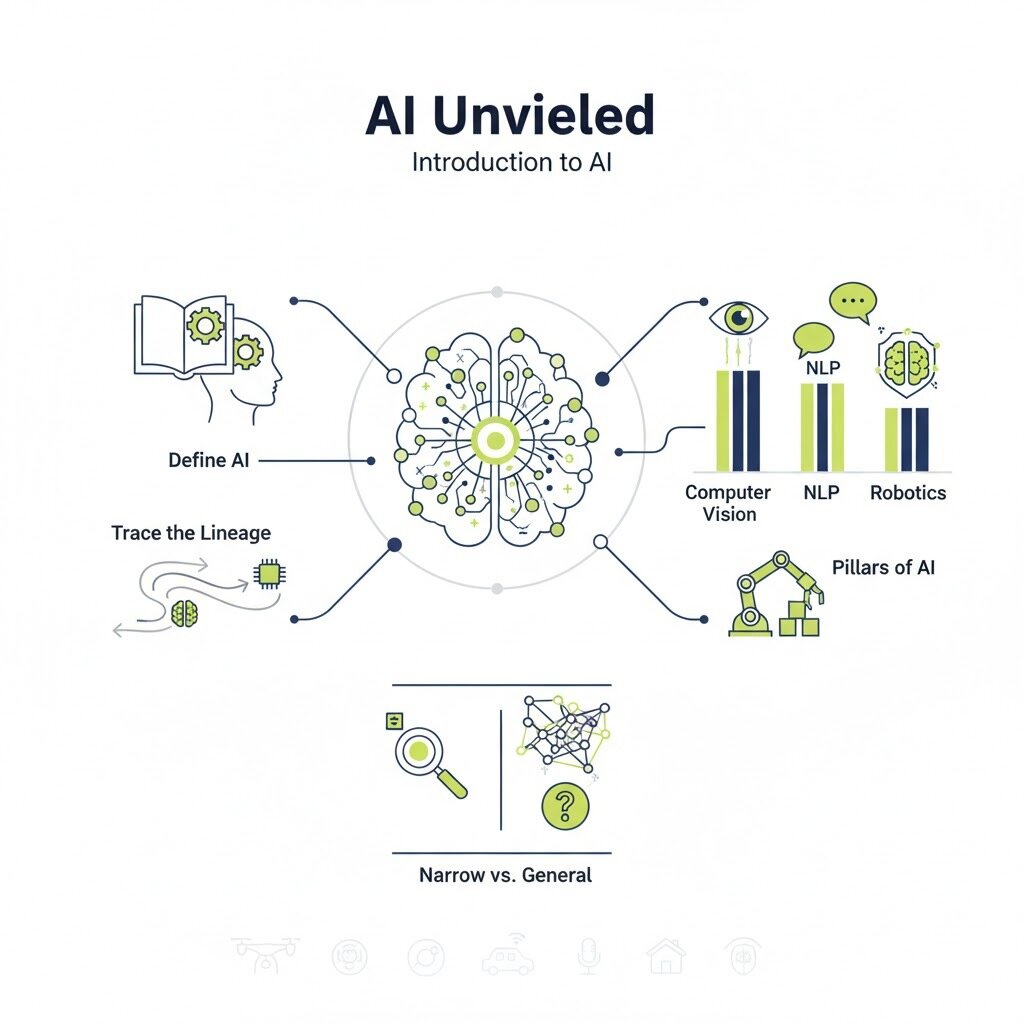
AI Unveiled: Introduction to AI


Learning Outcome
5
Understand how AI pillars combine to solve real-world problems.
4
Recognize key AI pillars like Computer Vision, NLP, and Robotics.
3
Distinguish between Narrow AI and future General AI.
2
Describe the progression from ML models to advanced AI systems.
1
Explain AI as a real, working system beyond hype and sci-fi.
Recall
What You Did

Predicted Prices
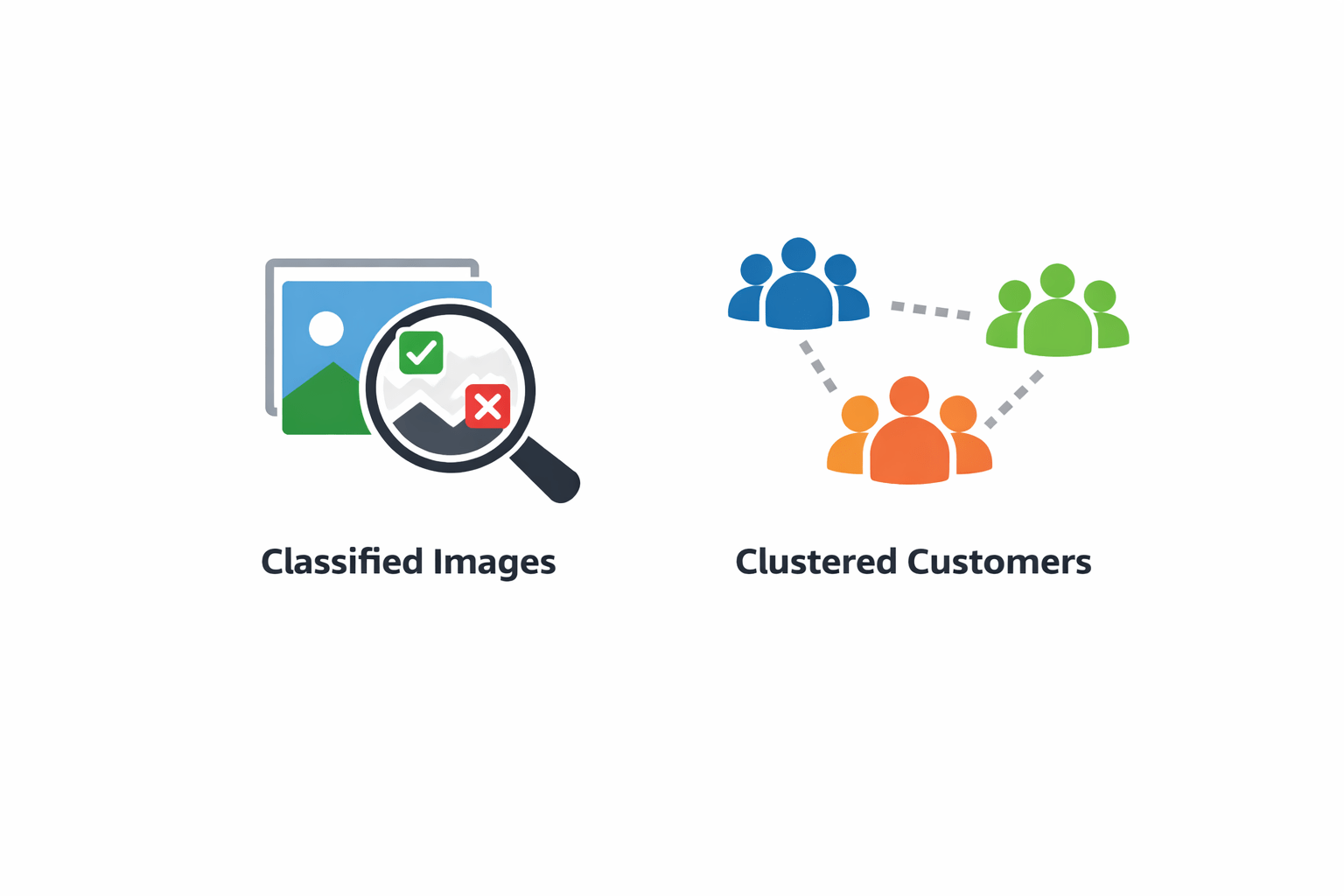
Clustered Customers
Classified Images
You trained models to find patterns in data.
🚗 Vehicle Graphic
Engine labeled → Machine Learning
Car body labeled → Artificial Intelligence
Recall
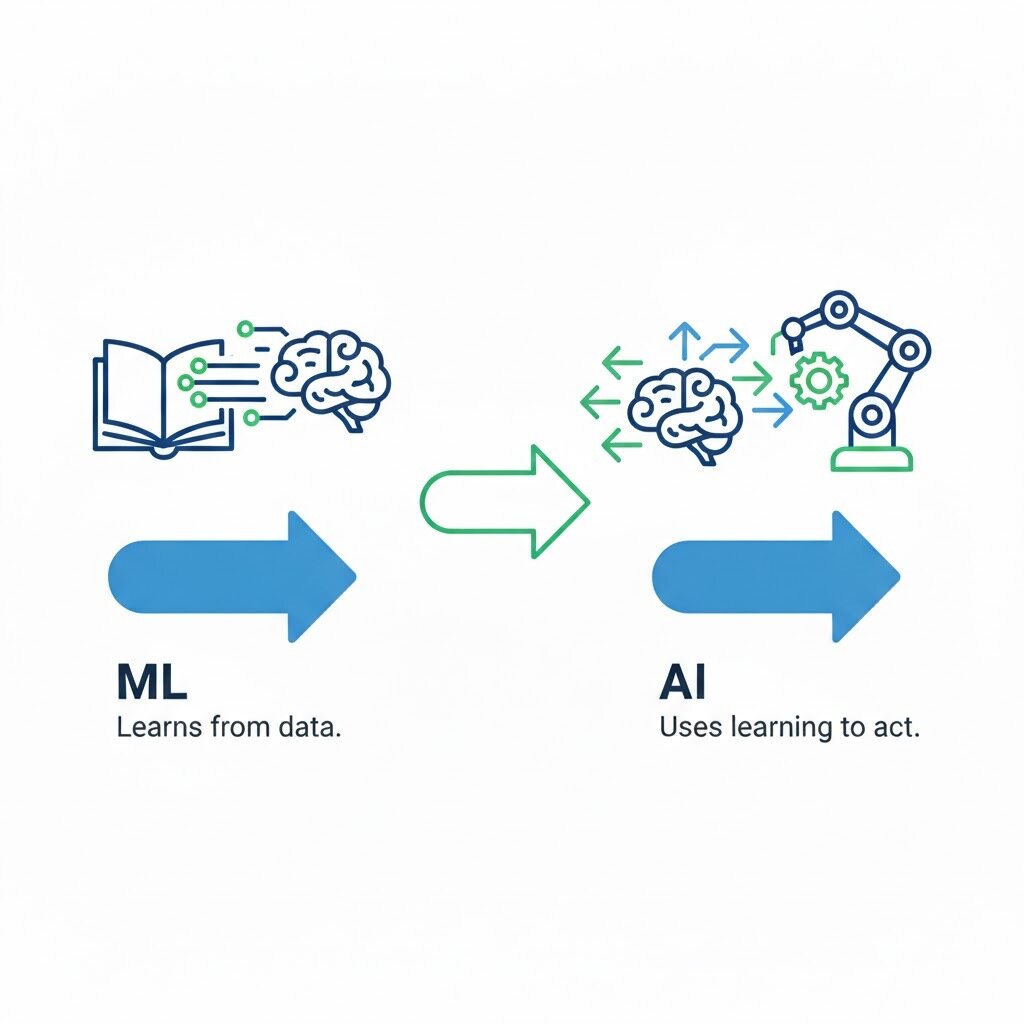
ML = Learns from data

ML predicts
AI = Uses learning to act
AI decides & acts
Analogy
Imagine controlling a robot using a giant rulebook.
What if it’s raining + dark + slippery + a dog crosses + signal is blinking?
If light is → Stop

If light is → Go

If child runs →

If child runs →

Traditional programming = Writing rules for every possible situation.
Analogy
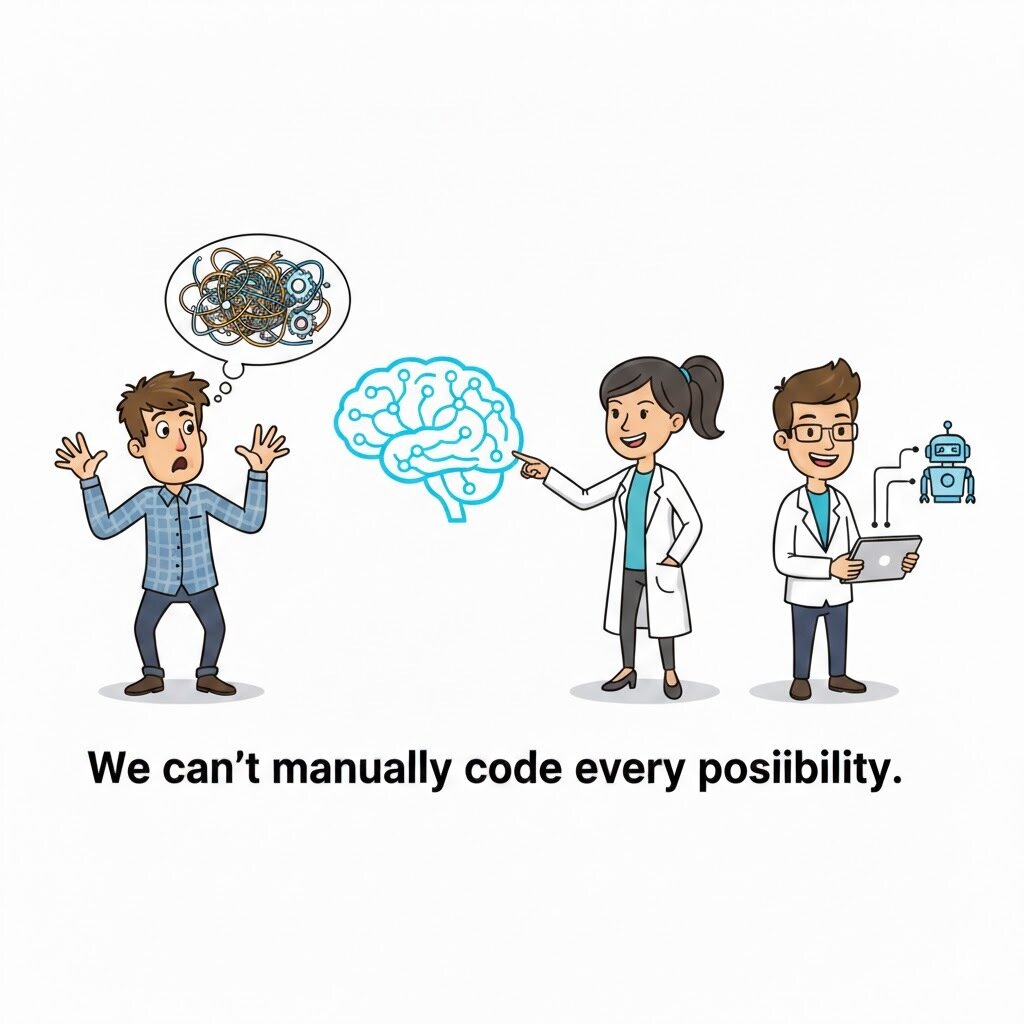
We can’t manually code every possibility.
Then we Shift – From Rulebook to Brain
Too Many Possibilities:
City streets are unpredictable:
- Different weather
- Different people
- Unexpected events
- Infinite combinations
Analogy
Instead of writing rules, we do something smarter:
We give the robot:
👀 Eyes (Computer Vision)
🧠 Learning ability (Machine Learning)
🤔 Decision-making logic
Now it learns from data:
- Sees thousands of traffic situations
- Understands patterns
- Makes decisions in real time
What AI Really Is
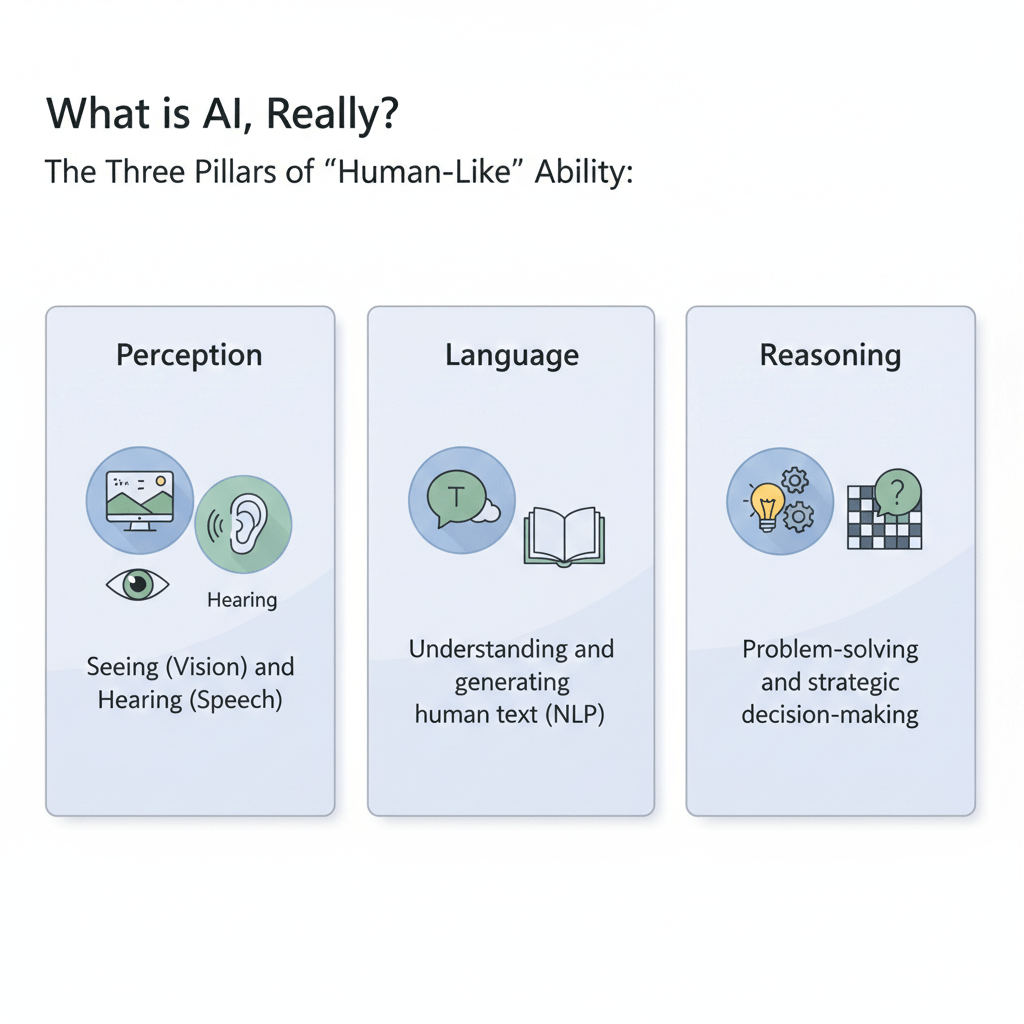
What is AI, Really?
Definition:
AI is a branch of computer science aimed at creating systems capable of performing tasks that traditionally required human cognition.
The Three Pillars of "Human-Like" Ability:
- Perception: Seeing (Vision) and Hearing (Speech).
- Language: Understanding and generating human text (NLP).
- Reasoning: Problem-solving and strategic decision-making.
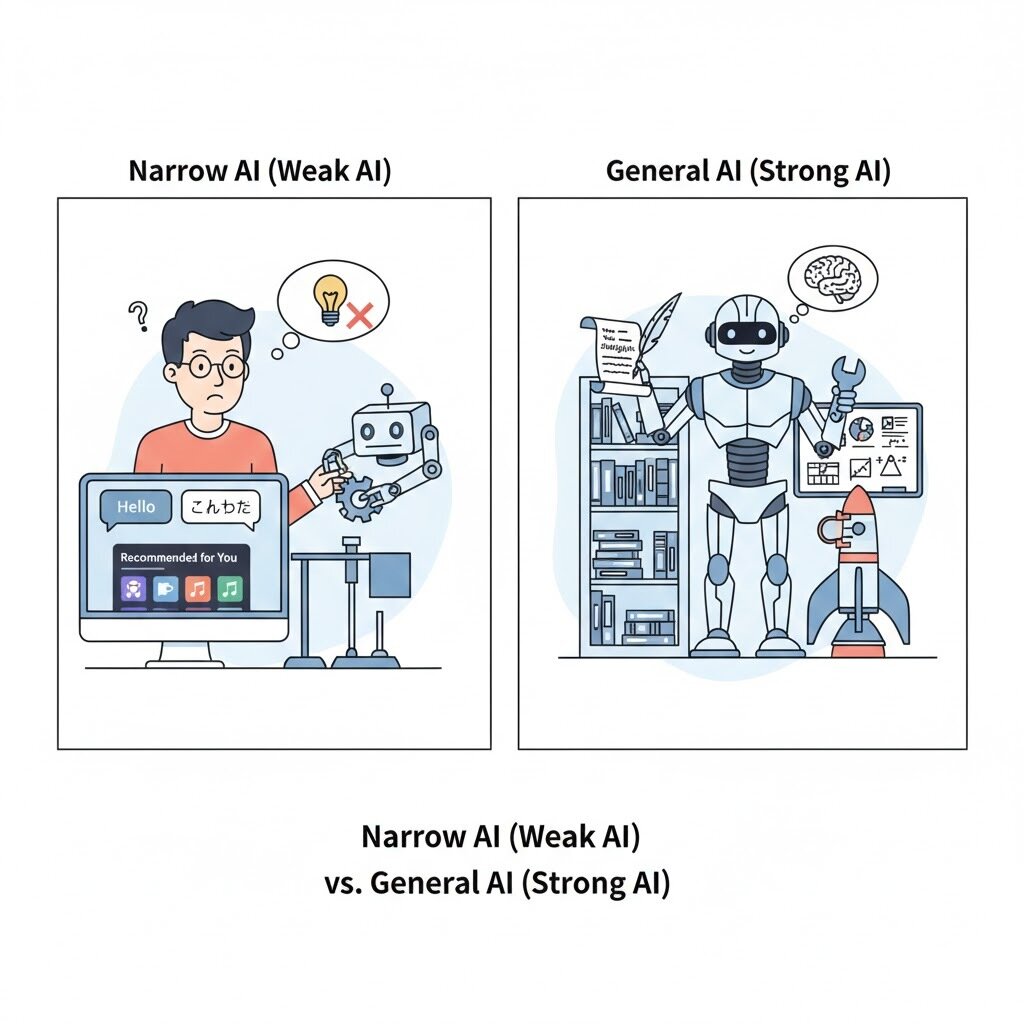
Narrow vs. General AI
Narrow AI (Weak AI):
- It is made to do one specific task very well.
- For example, Google Translate or Spotify’s recommendation system.
- It can perform smart actions, but it does not actually understand what it is doing.
General AI (Strong AI):
- It is a future idea of AI.
- It would be able to learn and solve any type of problem, like a human.
- For example, it could write poetry or fix a rocket engine.
The "Big Three" Domains of AI
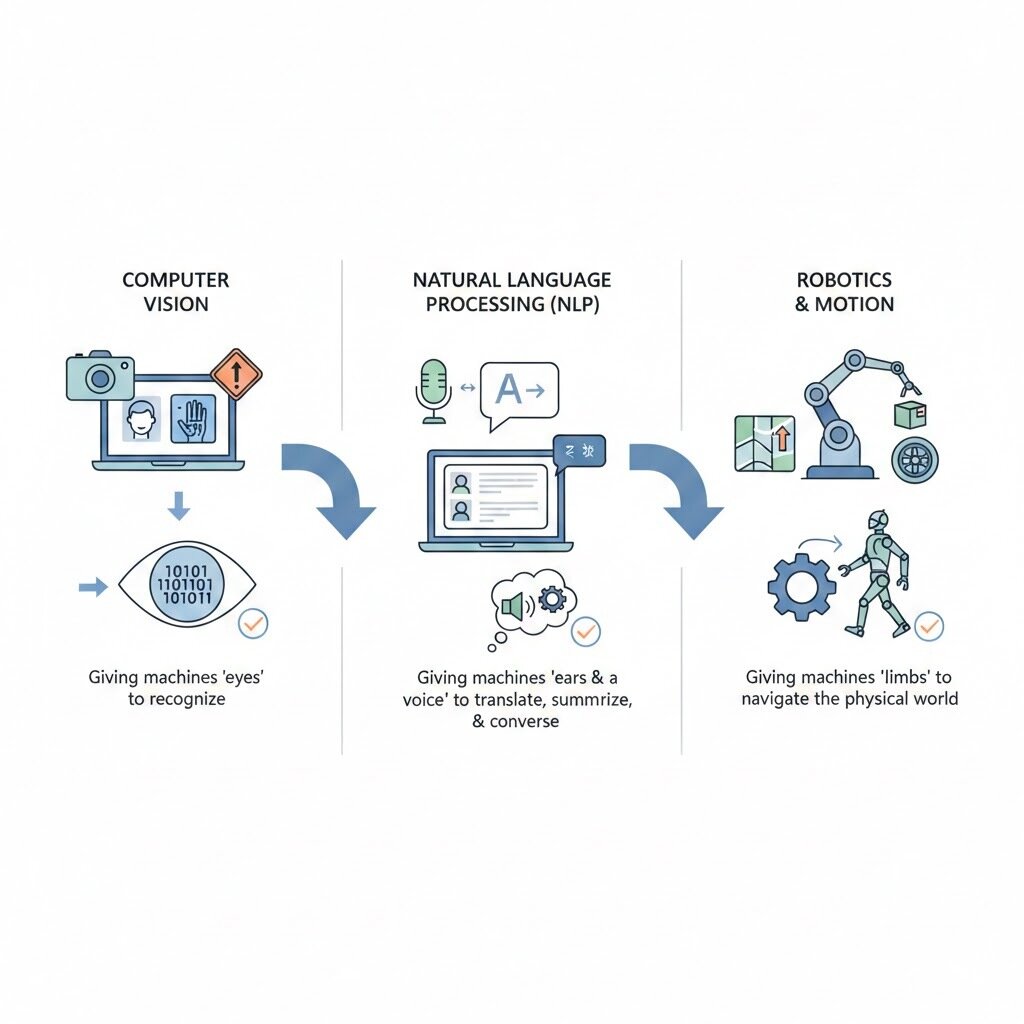
Computer Vision: Giving machines "eyes" to recognize faces, medical X-rays, or road signs.
Natural Language Processing (NLP): Giving machines "ears and a voice" to translate, summarize, and converse.
Robotics & Motion: Giving machines "limbs" to navigate the physical world.
Why is AI Exploding Right Now?
We are generating more data in a day than we did in the entire 19th century.
Modern GPUs can perform trillions of operations per second, making Deep Learning possible.
The shift from simple "Word-by-Word" processing to "Contextual" processing (like the Transformers you’ve seen).
Algorithmic Breakthroughs:
Algorithmic Breakthroughs:
Massive Data:
Massive Data:
Compute Power:
Compute Power:
Summary
5
ML knowledge is the foundation for building advanced AI systems.
4
Now, we are teaching machines to interact and respond intelligently.
3
Earlier, we trained machines mainly to identify and predict things.
2
ML helps machines learn from data instead of following fixed rules.
1
AI is the umbrella; ML is the heart.
Quiz
If Machine Learning is the process of learning from data, how would you define Artificial Intelligence in relation to it?
A. AI is an older, outdated version of ML.
B.AI is a specific algorithm used for spreadsheets.
C. AI is the broader goal of creating smart systems
D. There is no difference between the two.

Quiz
If Machine Learning is the process of learning from data, how would you define Artificial Intelligence in relation to it?
A. AI is an older, outdated version of ML.
B.AI is a specific algorithm used for spreadsheets.
C. AI is smart systems ML is a method to achieve it.
D. There is no difference between the two.