





Content ITV PRO
This is Itvedant Content department
Learning Outcome
4
exploring IIFE (Immediately Invoked Function Expression) and its uses
3
exploring higher order function and its uses
2
understand what is first class function
1
understand pure and impure functions
A pure function always produces the same output for the same input and has no side effects
function income(salary){
console.log(salary * 2);
}
income(20000);
CODE:
OUTPUT:
40000
A pure function always produces the same output for the same input and has no side effects
function income(salary){
console.log(salary * 2);
}
income(20000);
CODE:
OUTPUT:
40000
Pure Function
function income(salary){
console.log(salary * 2);
}
income(20000);
OUTPUT:
40000
A first-class function is a function that can be assigned to variables
const greet = function(name) {
console.log("Hello " + name);
};
greet("Student")
OUTPUT:
Hello Student
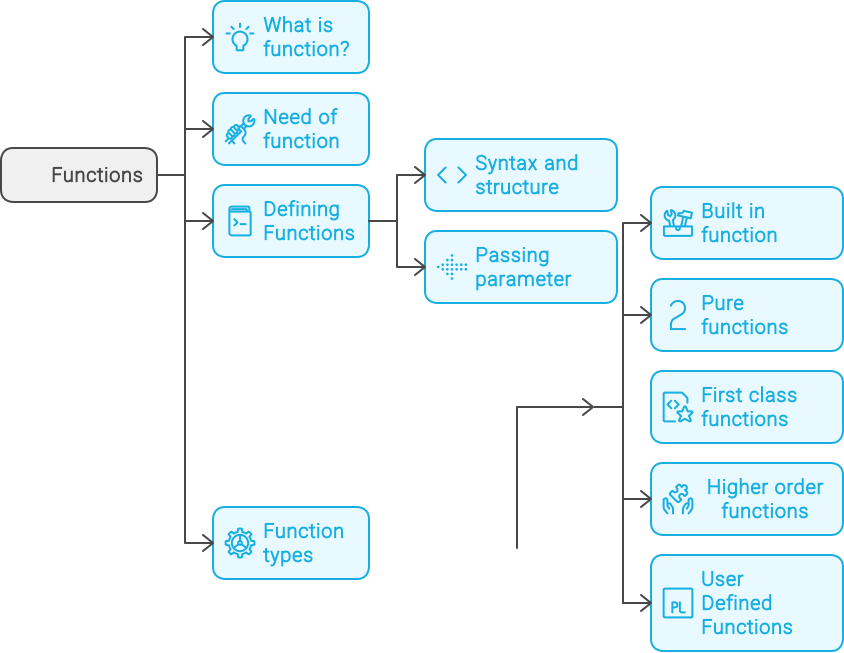
A higher-order function is a function that takes functions as arguments, returns a function, or both
function repeat(action, times) {
for (let i = 0; i < times; i++) {
action();
}
}
// A simple function to be passed as an argument
function sayHello() {
console.log("Hello!");
}
// Using the higher-order function
repeat(sayHello, 3);
Higher Order Function
Higher-order functions are specific functions that either take other functions as arguments or return them.
First Class Function
First-class functions describe the ability of functions to be treated like any other variable.
(function () {
console.log("Welcome to ITVEDANT!");
}) ();
CODE:
OUTPUT:
(function () {
console.log("Welcome to ITVEDANT!");
}) ();
This defines an unnamed function with code to execute
Quiz
Which of the following functions does NOT have a name?
A. Arrow function
B. Named function
C. Anonymous function
D. Constructor function
Quiz-Answer
A. Arrow function
B. Named function
C. Anonymous function
D. Constructor function
Which of the following functions does NOT have a name?
By Content ITV