Time-Resolving Sgr A* from LEO


Ref Bari (Brown University)
T-REX
T-REX
- Introduction
- Science Traceability Matrix
- Primary Science Objectives
- SWaPC Requirements
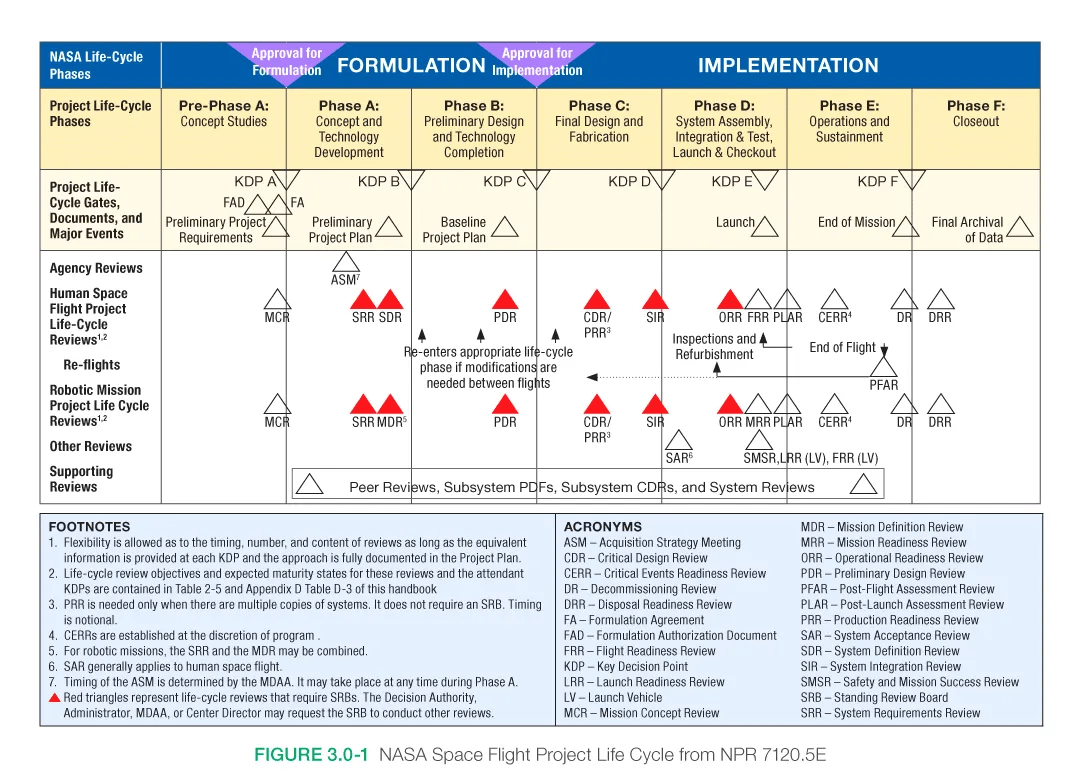
- NASA Mission Life Cycle
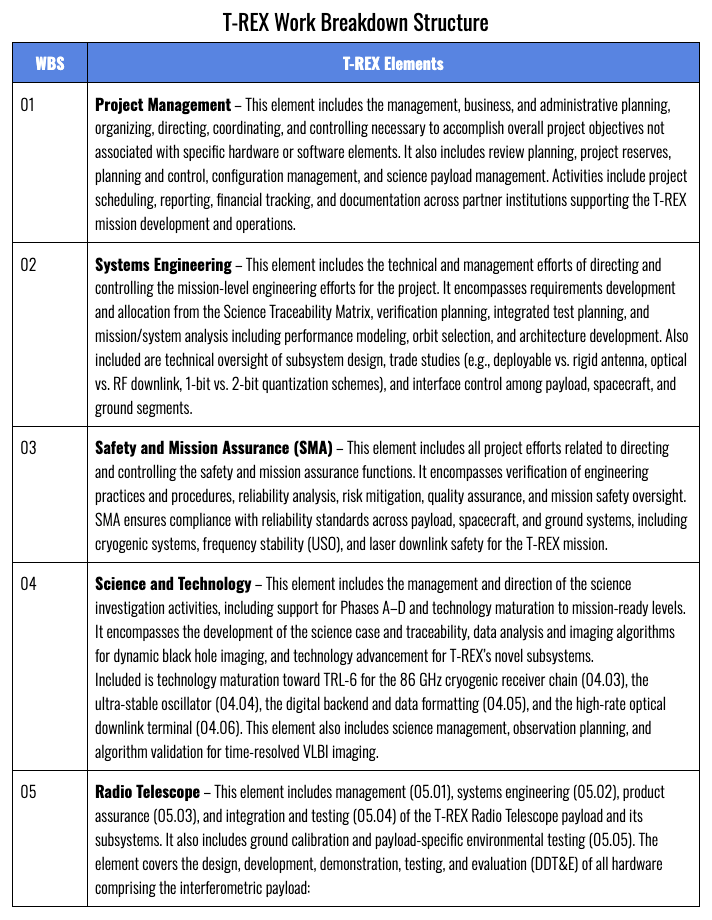
- Work Breakdown Structure (WBS)
- Critical Mission Parameters
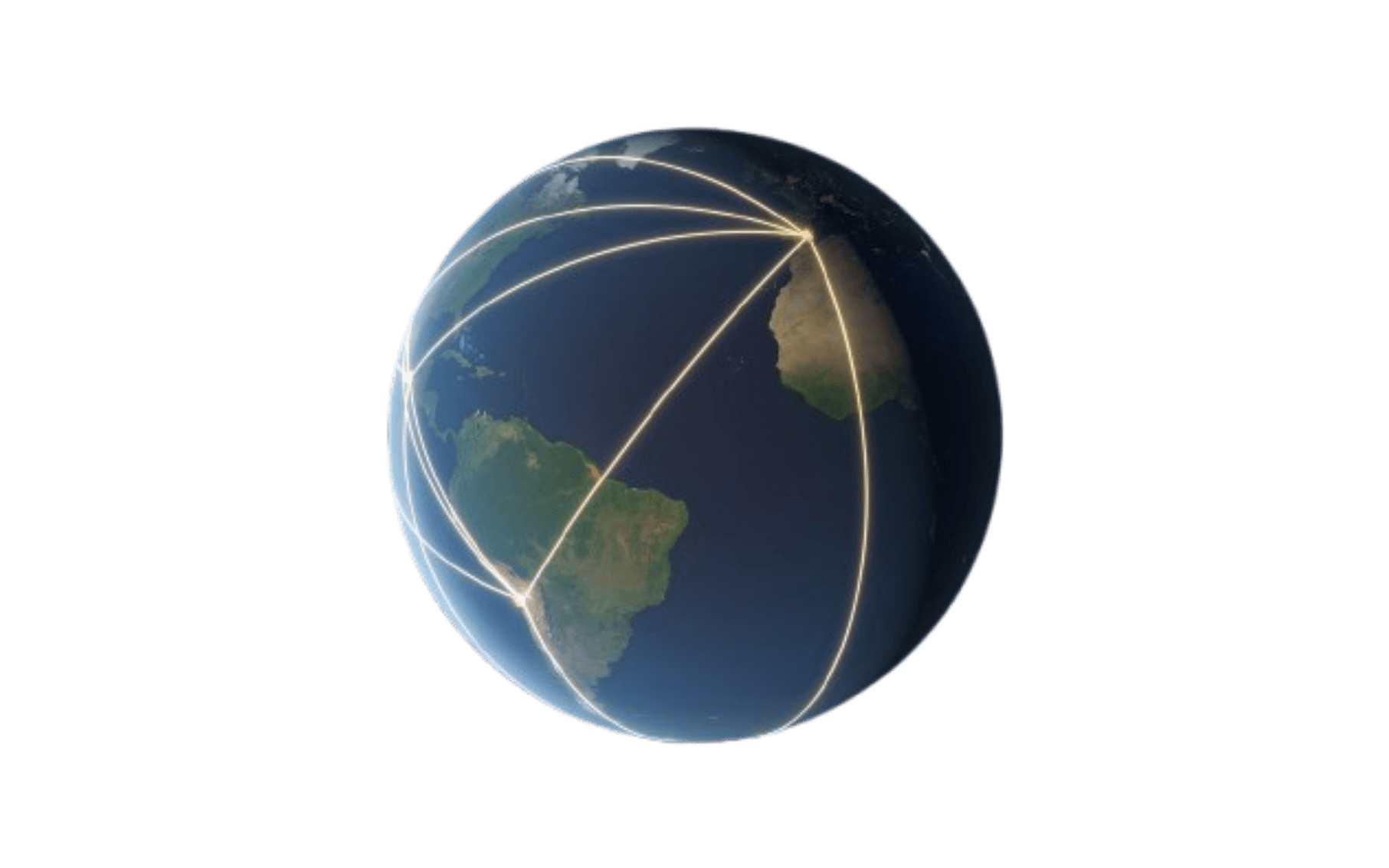
- Preliminary Concept of Operations
- Expected Data Products
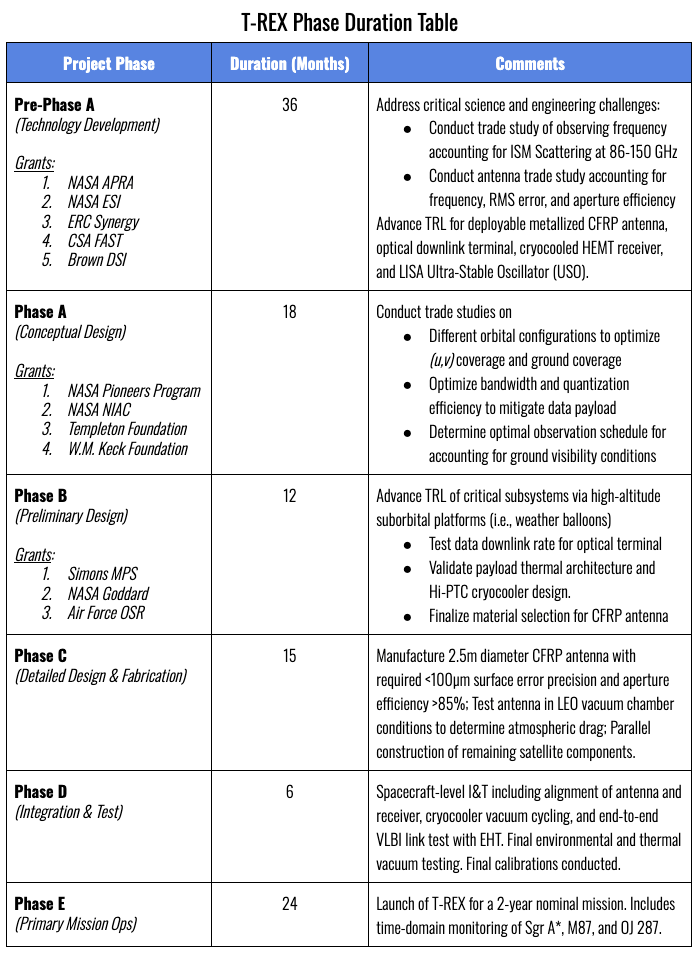
- Funding & Timeline
- Introduction
- Science Traceability Matrix
- Primary Science Objectives
- SWaPC Requirements
- NASA Mission Life Cycle
- Work Breakdown Structure (WBS)
- Critical Mission Parameters
- Preliminary Concept of Operations
- Expected Data Products
- Funding & Timeline
T-REX
Ref Bari
Physics MS, Brown
-
Radiation Reaction for Binary Black Hole Systems (under Prof. Brendan Keith, Brown)
-
Funded under NSF Neural DynAMO Grant
-
-
“Nitrogen Outgassing from Water Worlds” (R.Bari et. al., under review, The Astrophysical Journal 2025)
-
“Reflection from Relativistic Light Sails” (R. Bari, The Astronomical Journal 2024)
-
“Simulating the Action Principle in Optics” (R. Bari, The Physics Teacher 2023)
-
Spin Qubit CNN Researcher at the Meriles Condensed Matter Lab
-
“A Path Integral Derivation of Hawking Radiation” (MS Thesis)

Binary Black Holes
Physics MS, Brown
-
Analysis of Binary Black Holes via Neural Networks (Prof. Brendan Keith, Brown)


Spaceflight Heritage
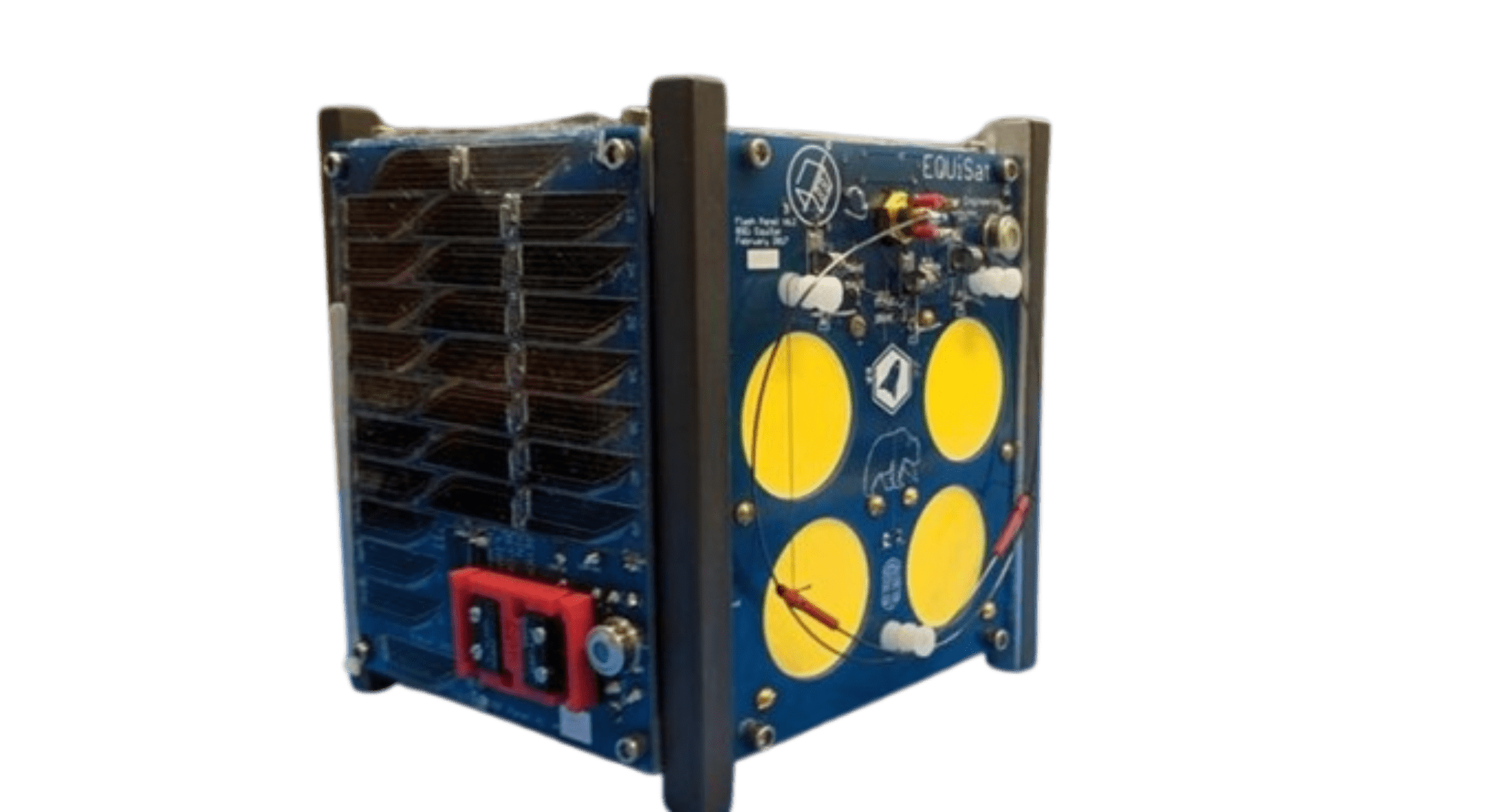
EQUiSat
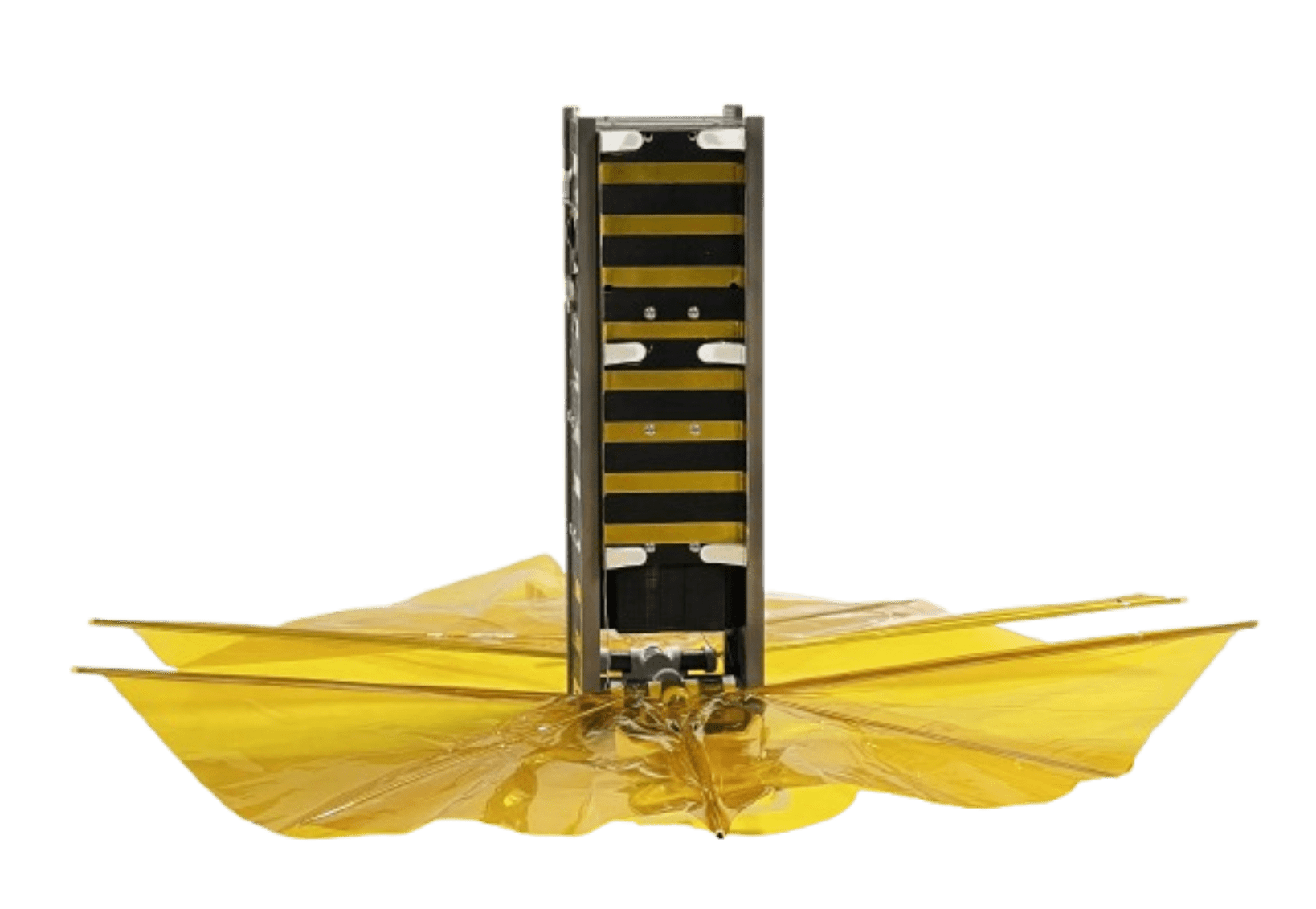
SBUDNIC
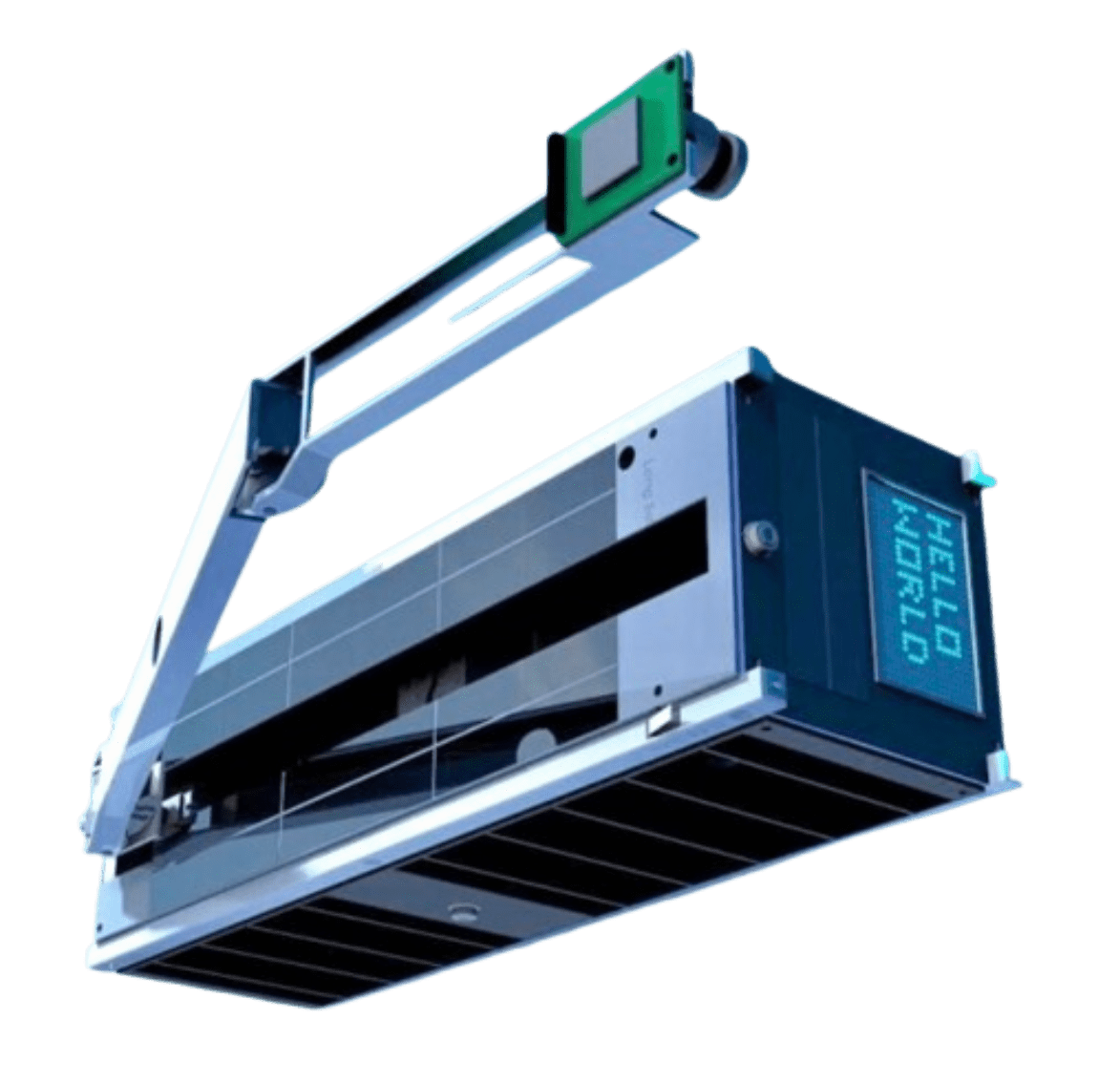
PVDX
Spaceflight Heritage
SBUDNIC
PVDX
- 1U CubeSat (1.3 kg, 10x10x10 cm)
- Payload: High-Power LED Array + LiFePO4 Batteries (<6 kg)
- ADCS: Passive Magnetic Atitude Control System
- Power Generated: 1.3W (Top+Bottom Panels) & .7W (Side)
-
Total Cost: $5000
- All components built in-house at Brown Engineering Lab
EQUiSat
- 3U CubeSat (3 kg, 30x10x10 cm)
- Payload: Ham Radio Transceiver, 2 Cameras, Arduino Nano
- ADCS: Spring-Loaded + Aerodynamic Drag Sail
- Power Generated: 1.3W (Top+Bottom Panels) & .7W (Side)
-
Total Cost: $10,000
- 3D-Printed Components at BDW
- 3U CubeSat (~6 kg, 30x10x10 cm)
- Payload: Perovskite Solar Panels + Robotic Arm + Digital Display
- ADCS: Magnetorquers
-
Total Cost: ~$30,000
- 3D-Printed Components at BDW
- CUBECOM S-Band Transceiver ($10,000)

Spaceflight Heritage
SBUDNIC
PVDX
EQUiSat
T-REX
Spaceflight Heritage
T-REX
Time Resolving Explorer Satellite
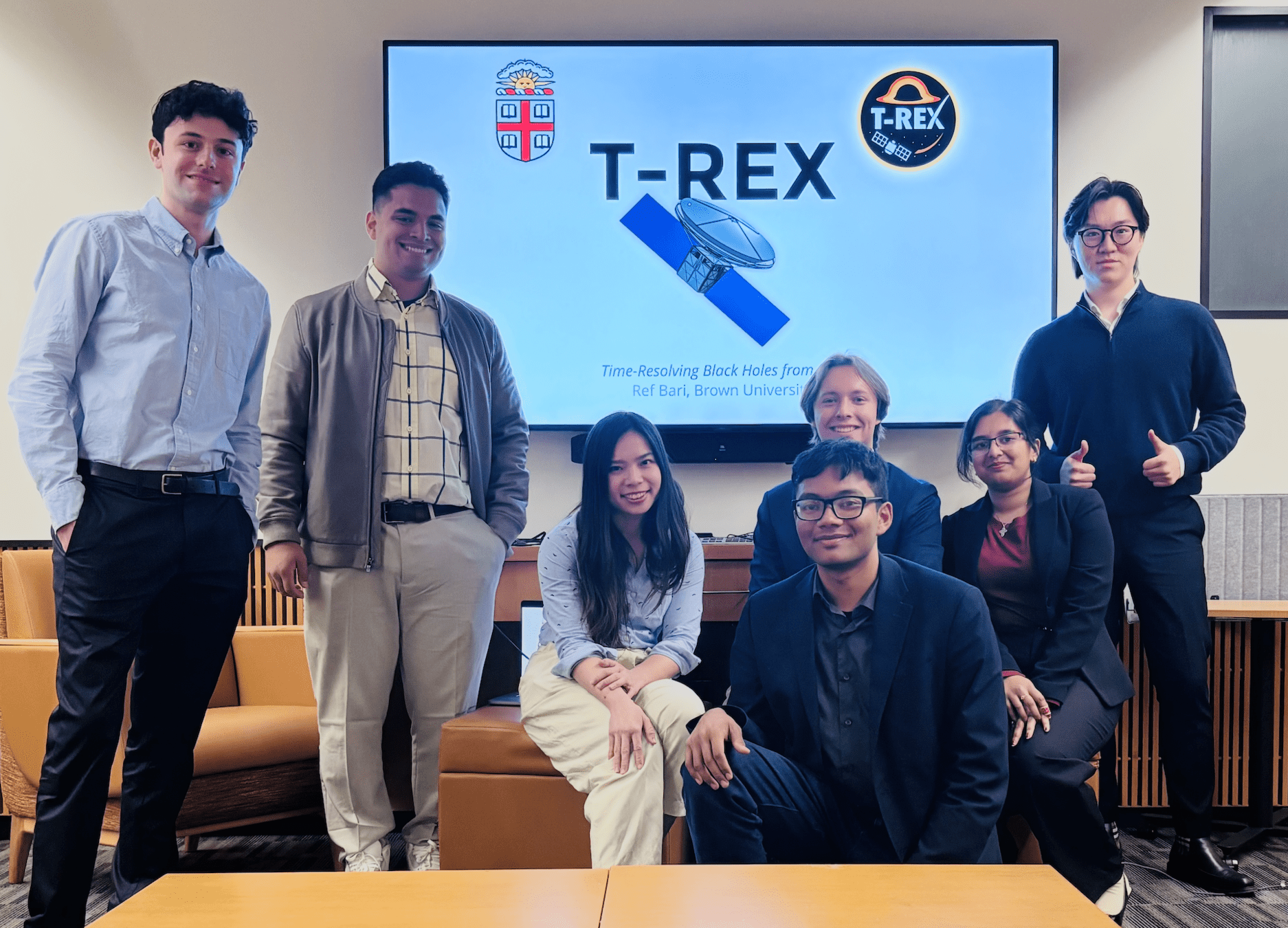
T-REX Team
- Introduction
- Science Traceability Matrix
- Primary Science Objectives
- SWaPC Requirements
- NASA Mission Life Cycle
- Work Breakdown Structure (WBS)
- Critical Mission Parameters
- Preliminary Concept of Operations
- Expected Data Products
- Funding & Timeline
T-REX
- Introduction
- Science Traceability Matrix
- Primary Science Objectives
- SWaPC Requirements
- NASA Mission Life Cycle
- Work Breakdown Structure (WBS)
- Critical Mission Parameters
- Preliminary Concept of Operations
- Expected Data Products
- Funding & Timeline
T-REX
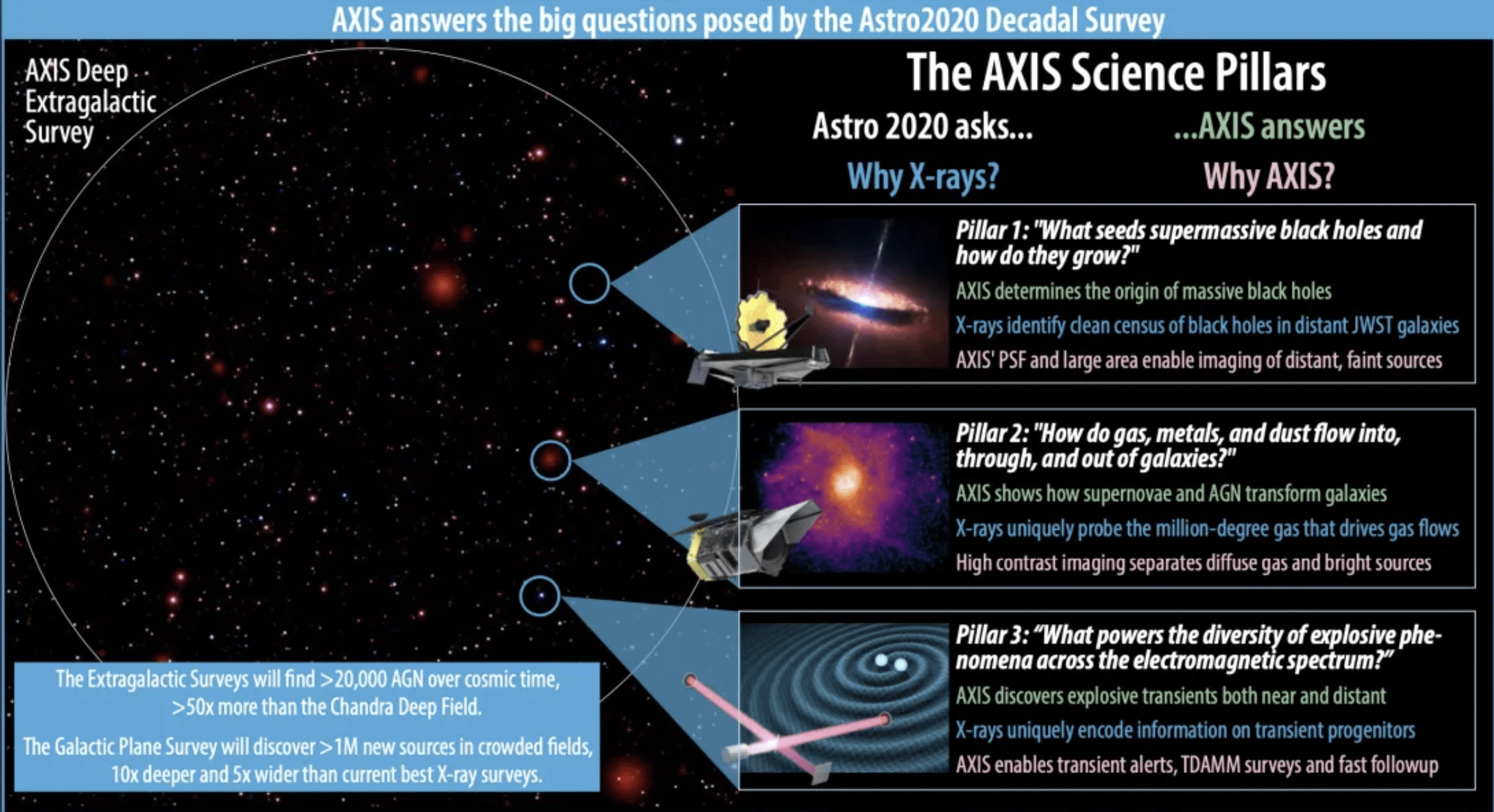
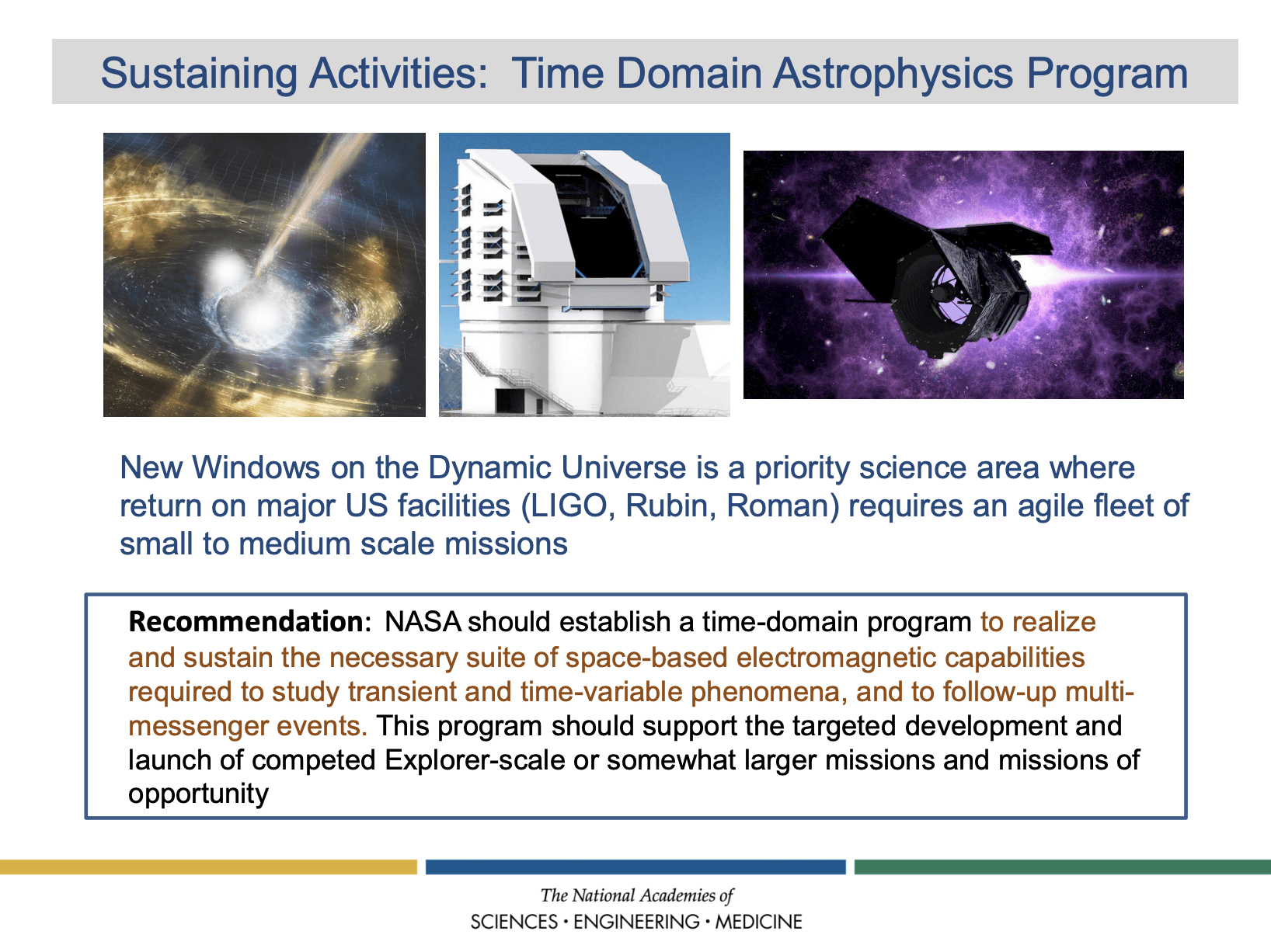
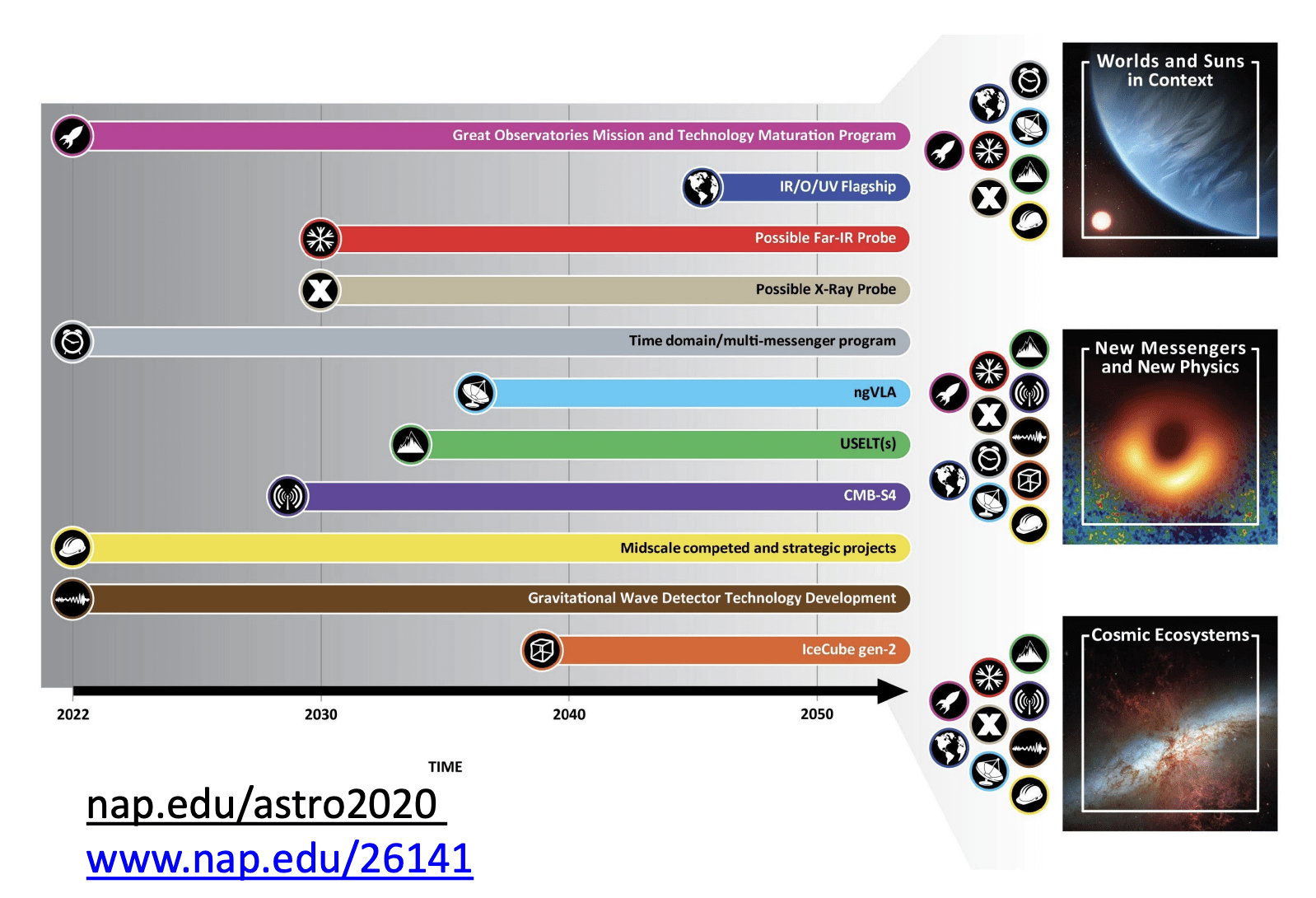
T-REX answers the big questions posed by Astro2020 Decadal Survey
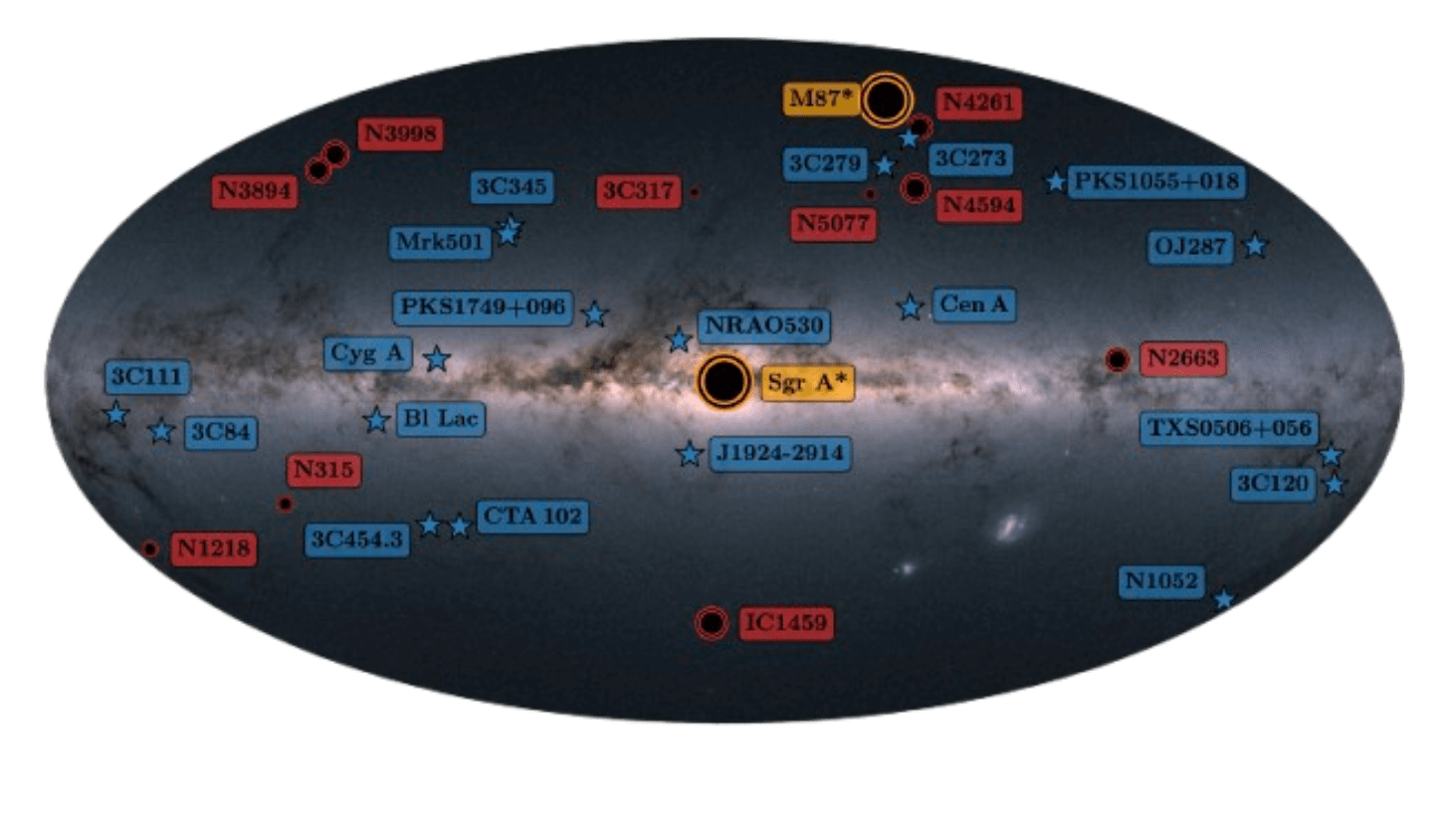
The T-REX Science Pillars
Why VLBI?
Astro2020 asks ...
... T-REX answers
Why T-REX?
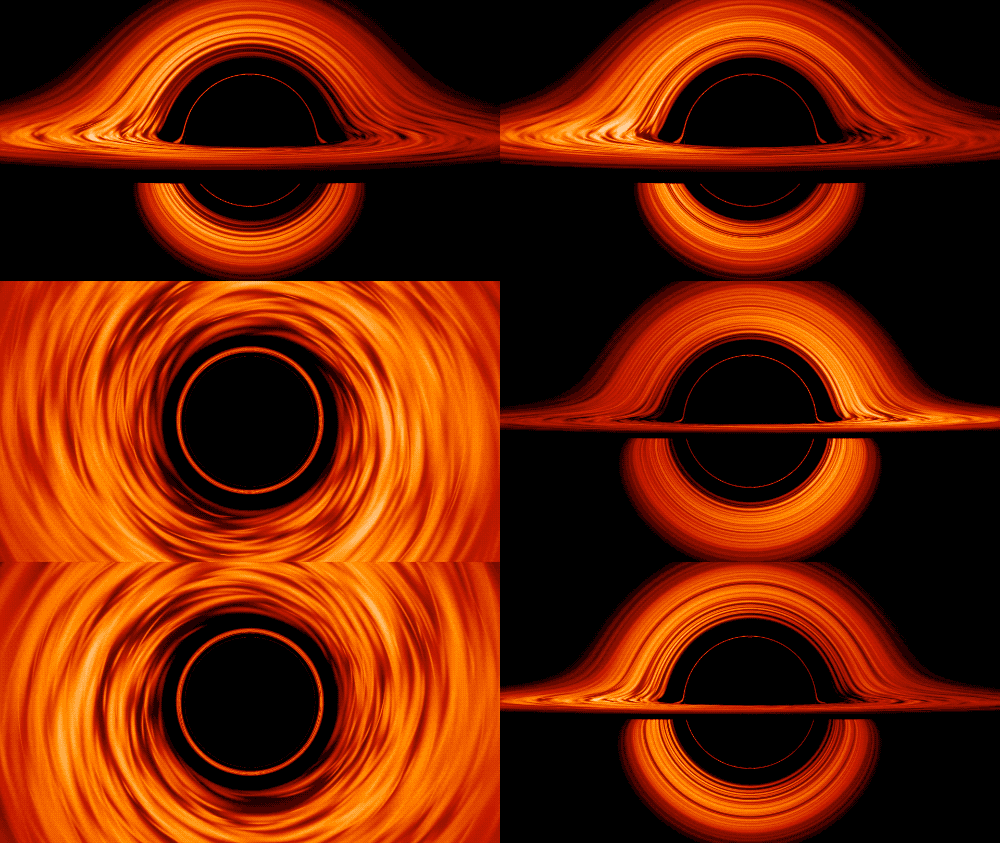
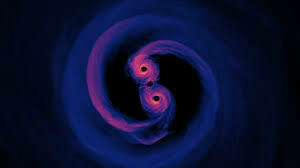
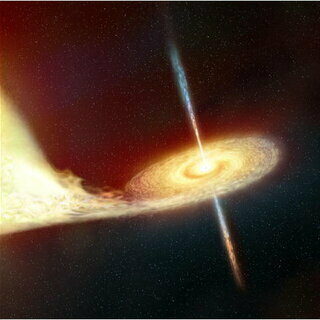
What governs black hole spin and accretion flow?
How do supermassive black hole binaries evolve?
What powers relativistic jets in AGN?
- T-REX will time-resolve Sgr A* / M87 at:
- Observing frequency f ~ 86-150 GHz
- Temporal resolution t ~ 22.5 min
- Angular resolution θ ~ 20-35 μas
- Enables the first definitive constraints on the spin of a supermassive black hole
- T-REX will time-resolve binary dual AGNs to constrain
- Orbital precession of AGN jet
- Resolve tidal disruption events (TDEs)
- parameter estimation on binary black holes
- Enable time-resolved movie of 12-year period optical outburst of OJ 287 in 2033 in conjunction with PTA
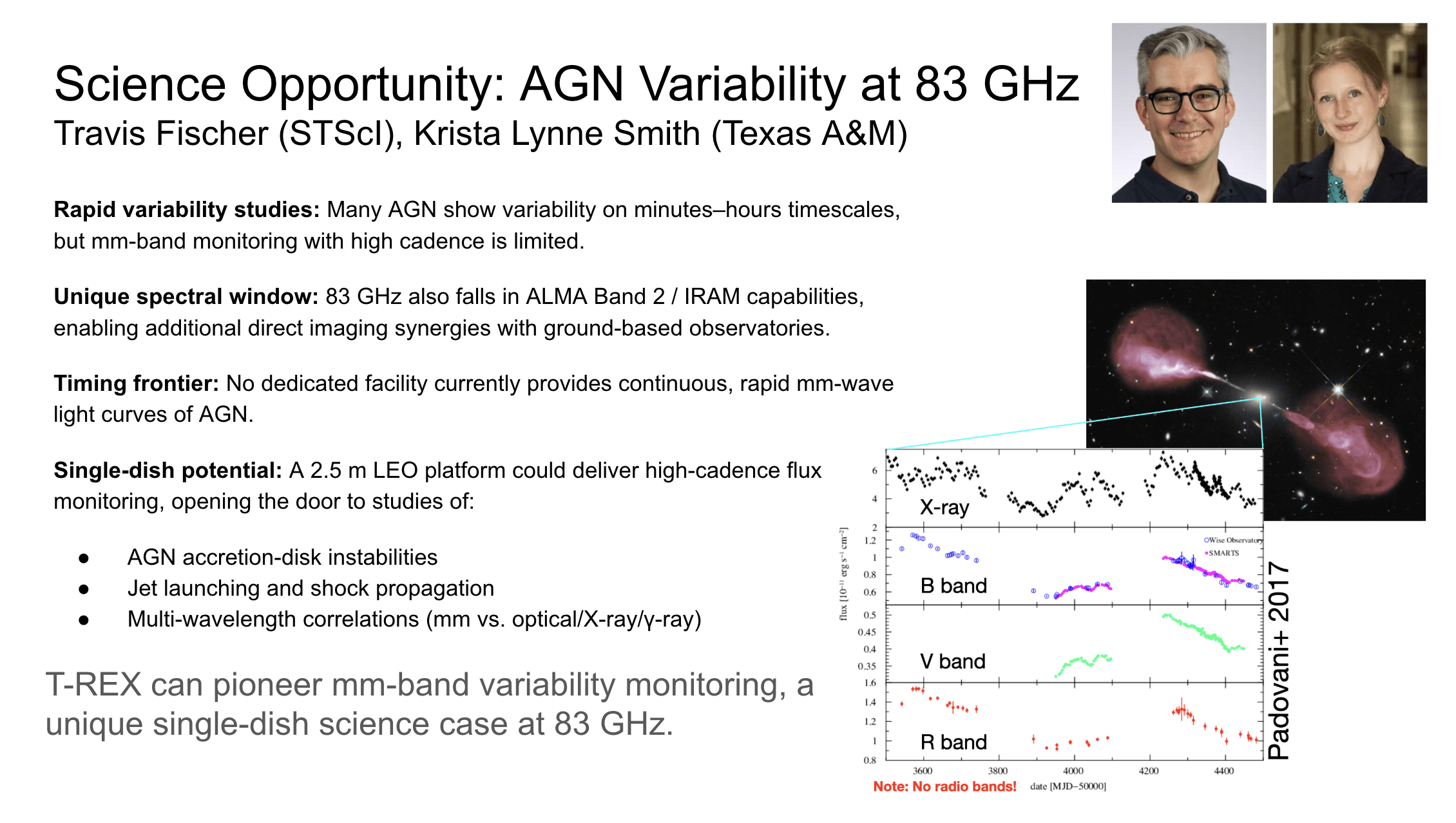
- Many AGN show variability on minutes–hours timescales, but mm-band monitoring with high cadence is limited
- 83 GHz falls in ALMA Band 2 capabilities, enabling direct imaging synergies with ground observatories.
- No dedicated facility currently provides continuous, rapid mm-wave light curves of AGN
Primary Science Target
Secondary Science Target
T-REX answers the big questions posed by Astro2020 Decadal Survey
The T-REX Science Pillars
Why VLBI?
Astro2020 asks ...
... T-REX answers
Why T-REX?
What governs black hole spin and accretion flow?
How do supermassive black hole binaries evolve?
What powers relativistic jets in AGN?
- T-REX will time-resolve binary dual AGNs to constrain
- Orbital precession of AGN jet
- Resolve tidal disruption events (TDEs)
- parameter estimation on binary black holes
- Enable time-resolved movie of 12-year period optical outburst of OJ 287 in 2033 in conjunction with PTA
- Many AGN show variability on minutes–hours timescales, but mm-band monitoring with high cadence is limited
- 83 GHz falls in ALMA Band 2 capabilities, enabling direct imaging synergies with ground observatories.
- No dedicated facility currently provides continuous, rapid mm-wave light curves of AGN
What governs black hole spin and accretion flow?
- T-REX will time-resolve Sgr A* / M87 at:
- Observing frequency f ~ 86-150 GHz
- Temporal resolution t ~ 22.5 min
- Angular resolution θ ~ 20-35 μas
- Enables the first definitive constraints on the spin of a supermassive black hole
Primary Science Target
Secondary Science Target
T-REX answers the big questions posed by Astro2020 Decadal Survey
The T-REX Science Pillars
Why VLBI?
Astro2020 asks ...
... T-REX answers
Why T-REX?
What governs black hole spin and accretion flow?
How do supermassive black hole binaries evolve?
What powers relativistic jets in AGN?
- T-REX will time-resolve binary dual AGNs to constrain
- Orbital precession of AGN jet
- Resolve tidal disruption events (TDEs)
- parameter estimation on binary black holes
- Enable time-resolved movie of 12-year period optical outburst of OJ 287 in 2033 in conjunction with PTA
- Many AGN show variability on minutes–hours timescales, but mm-band monitoring with high cadence is limited
- 83 GHz falls in ALMA Band 2 capabilities, enabling direct imaging synergies with ground observatories.
- No dedicated facility currently provides continuous, rapid mm-wave light curves of AGN
How do supermassive black hole binaries evolve?
Enable time-resolved movie of 12-year period optical outburst of OJ 287 in 2033 in conjunction with PTA. T-REX will constrain:
- Orbital precession of AGN jet
- Resolve tidal disruption events (TDEs)
- Parameter estimation on binary black holes
Primary Science Target
Secondary Science Target
T-REX answers the big questions posed by Astro2020 Decadal Survey
The T-REX Science Pillars
Why VLBI?
Astro2020 asks ...
... T-REX answers
Why T-REX?
What governs black hole spin and accretion flow?
How do supermassive black hole binaries evolve?
What powers relativistic jets in AGN?
- T-REX will time-resolve binary dual AGNs to constrain
- Orbital precession of AGN jet
- Resolve tidal disruption events (TDEs)
- parameter estimation on binary black holes
- Enable time-resolved movie of 12-year period optical outburst of OJ 287 in 2033 in conjunction with PTA
- Many AGN show variability on minutes–hours timescales, but mm-band monitoring with high cadence is limited
- 83 GHz falls in ALMA Band 2 capabilities, enabling direct imaging synergies with ground observatories.
- No dedicated facility currently provides continuous, rapid mm-wave light curves of AGN
What powers relativistic jets in AGN?
- Many AGN show variability on minutes–hours timescales, but mm-band monitoring with high cadence is limited 83 GHz falls in ALMA Band 2 capabilities, enabling direct imaging synergies with ground observatories.
- No dedicated facility currently provides continuous, rapid mm-wave light curves of AGN, enabling accretion disk structure
Primary Science Target
Secondary Science Target
Sub-milli arcsecond angular resolution:
Dual short and long baseline lengths
Decreased signal loss from LEO
Decreased radiation environment in LEO vs. MEO

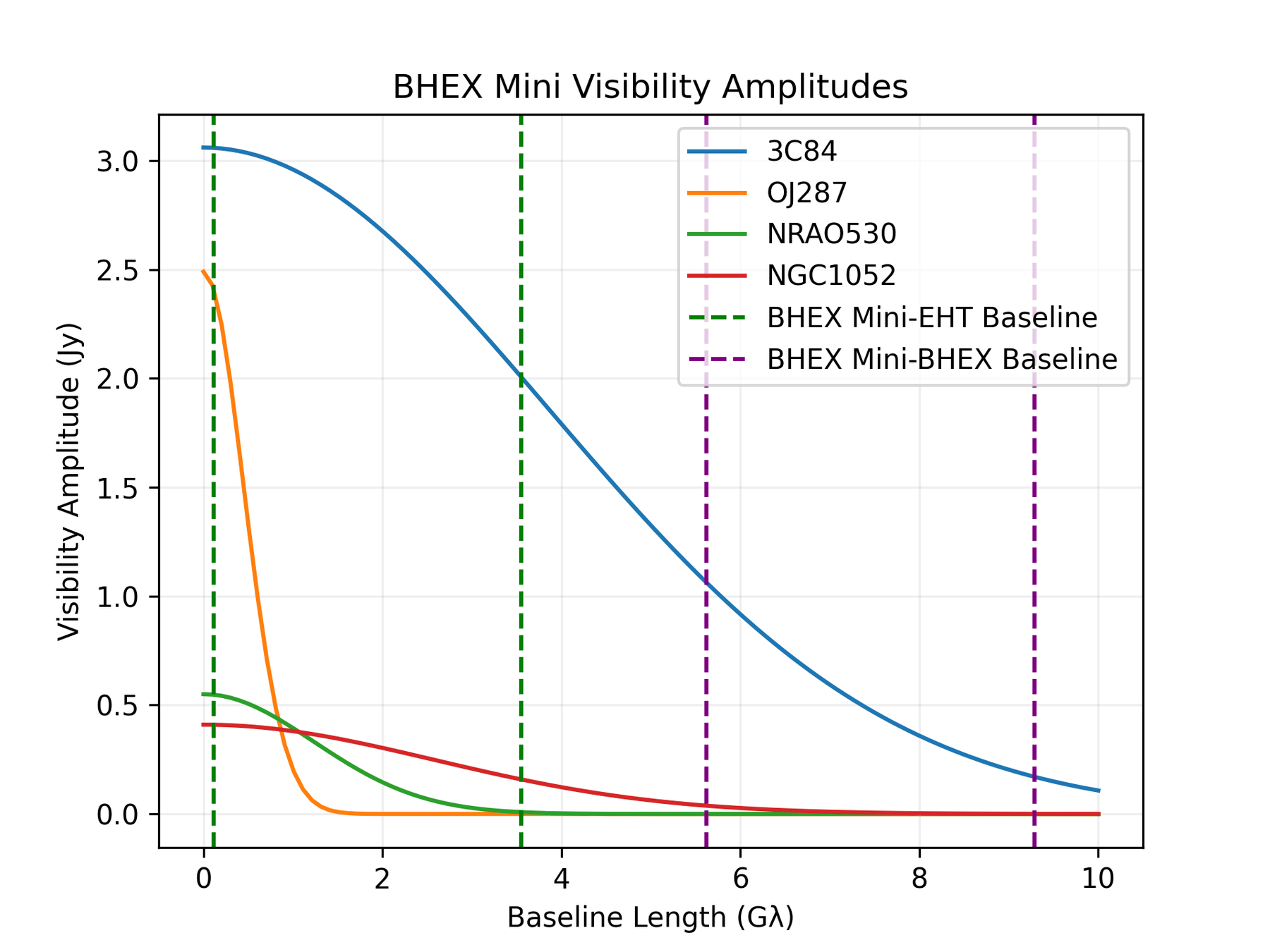
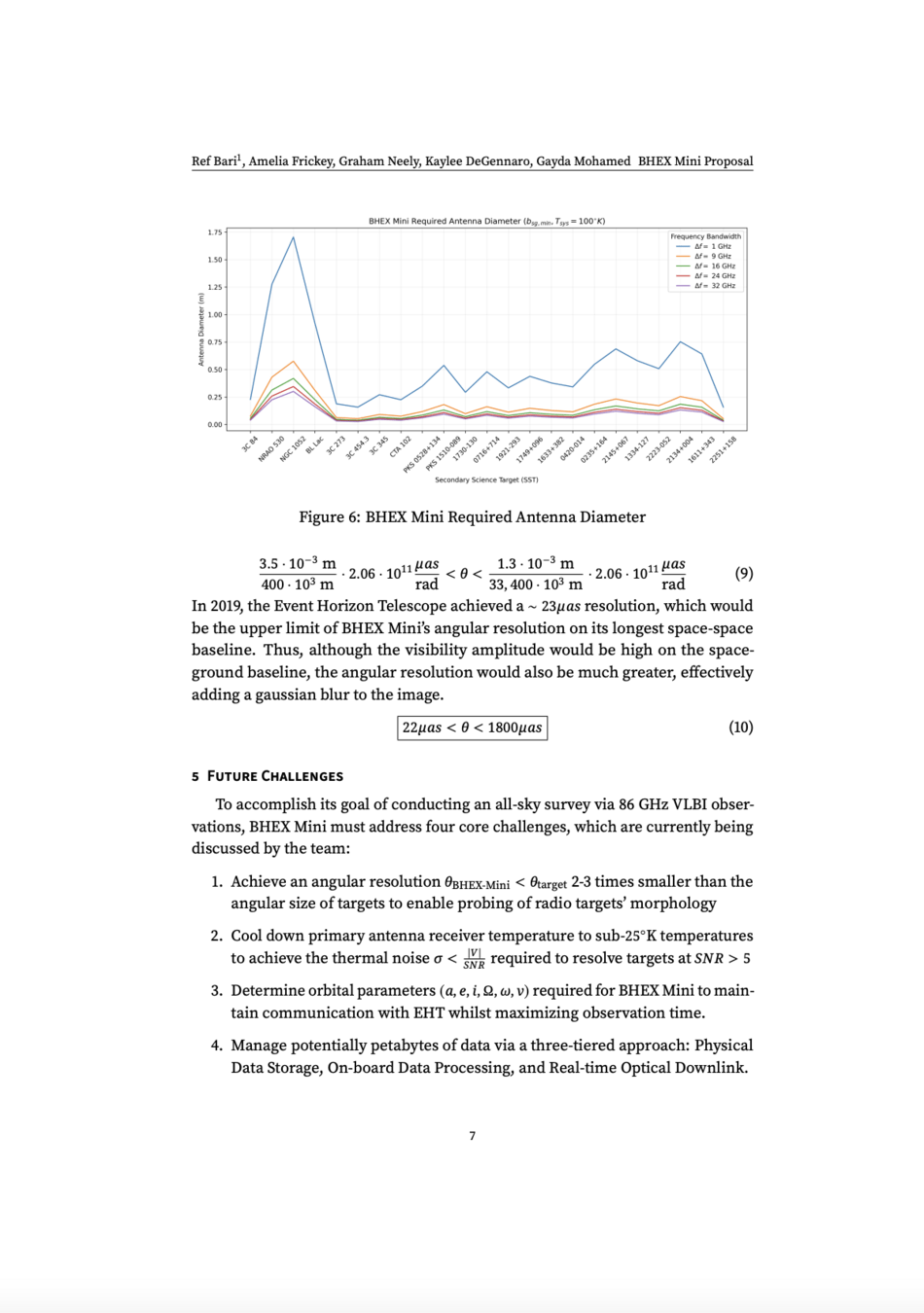
22\mu as<\theta_{\text{BHEX-Mini}} < 1800 \mu as
5.6 G \lambda < b_{s s}<9.3 G \lambda
0.11 G \lambda < b_{s g}<3.5 G \lambda
T-REX
Sub-milli arcsecond angular resolution:
Dual short and long baseline lengths
Decreased signal loss from LEO
Decreased radiation environment in LEO vs. MEO
22\mu as<\theta_{\text{BHEX-Mini}} < 1800 \mu as
5.6 G \lambda < b_{s s}<9.3 G \lambda
0.11 G \lambda < b_{s g}<3.5 G \lambda
T-REX
Sub-milli arcsecond angular resolution:
Dual short and long baseline lengths
Decreased signal loss from LEO
Decreased radiation environment in LEO vs. MEO
22\mu as<\theta_{\text{BHEX-Mini}} < 1800 \mu as
5.6 G \lambda < b_{s s}<9.3 G \lambda
0.11 G \lambda < b_{s g}<3.5 G \lambda
T-REX
Sub-milli arcsecond angular resolution:
Dual short and long baseline lengths
Decreased signal loss from LEO
Decreased radiation environment in LEO vs. MEO
22\mu as<\theta_{\text{BHEX-Mini}} < 1800 \mu as
5.6 G \lambda < b_{s s}<9.3 G \lambda
0.11 G \lambda < b_{s g}<3.5 G \lambda
NASA Pioneers
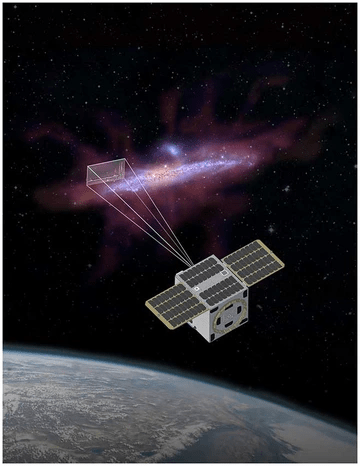
Aspera
Pandora
StarBurst
PUEO
(Galaxy Evolution via UV)
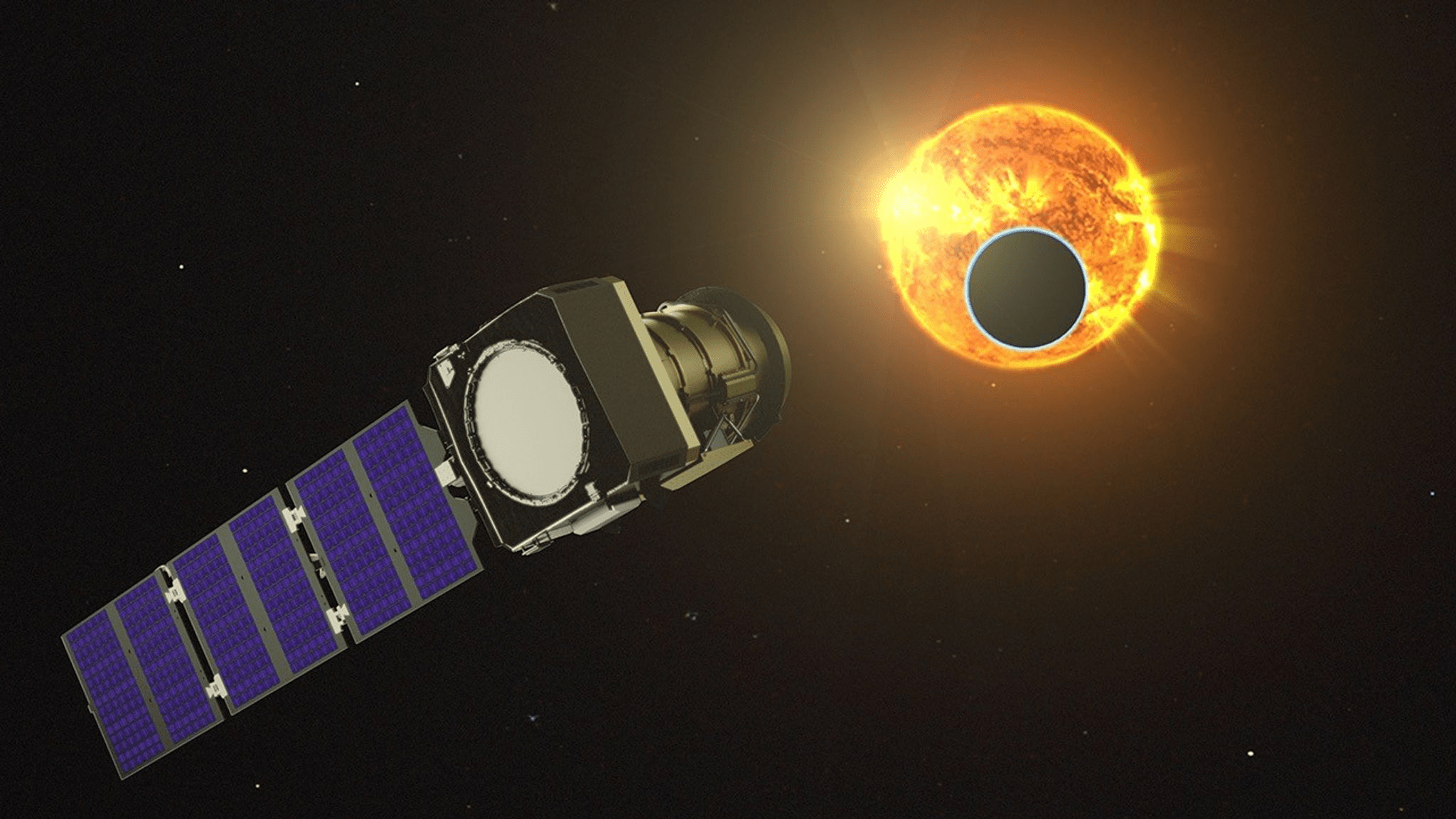
(Exoplanet Explorer)
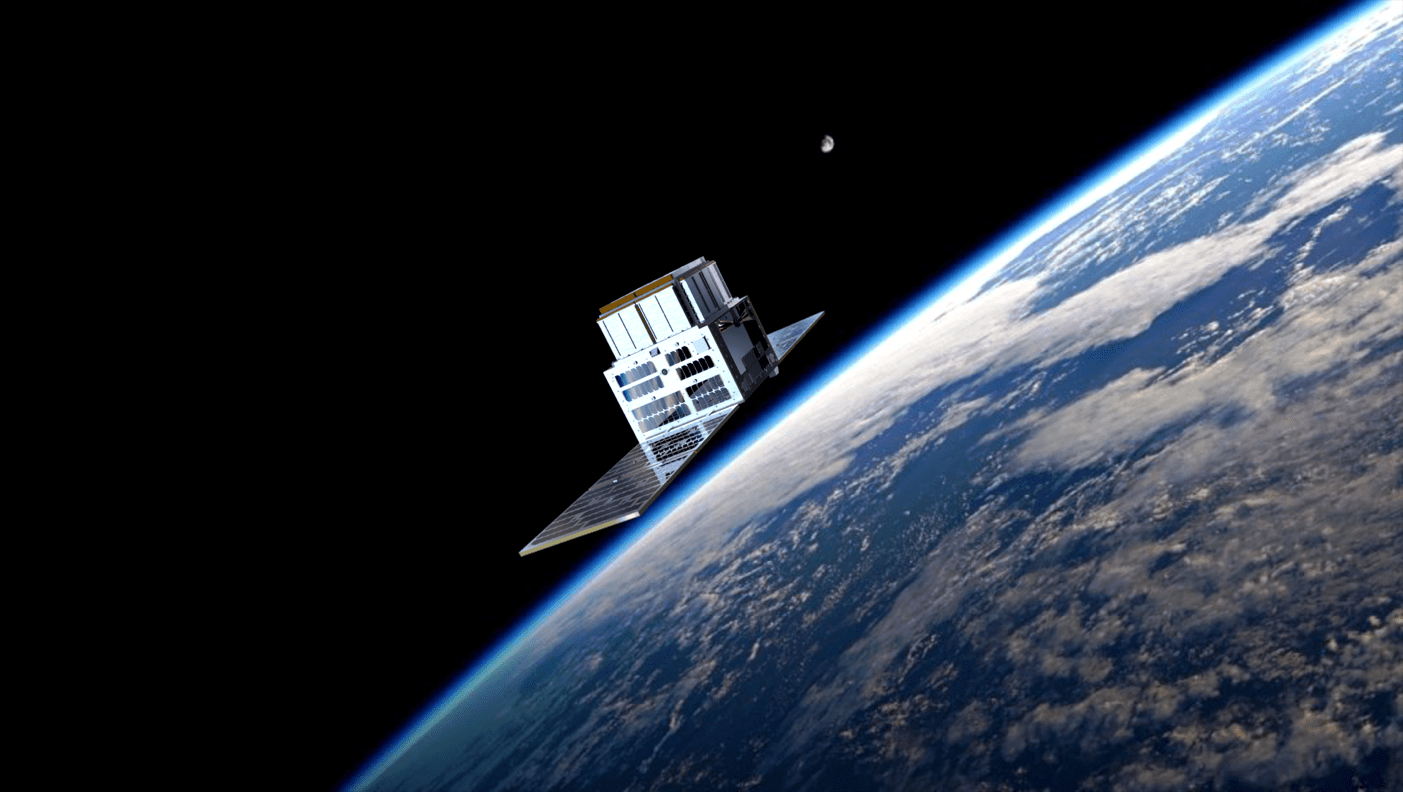
(Neutron Stars via Gamma Rays)
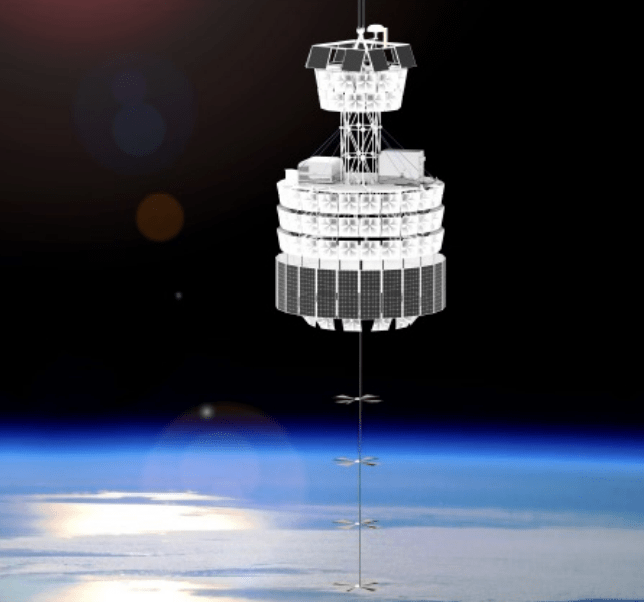
(Particle Physics via High-Energy Neutrinos)
- Introduction
- Science Traceability Matrix
- Primary Science Objectives
- SWaPC Requirements
- NASA Mission Life Cycle
- Work Breakdown Structure (WBS)
- Critical Mission Parameters
- Preliminary Concept of Operations
- Expected Data Products
- Funding & Timeline
T-REX
- Introduction
- Science Traceability Matrix
- Primary Science Objectives
- SWaPC Requirements
- NASA Mission Life Cycle
- Work Breakdown Structure (WBS)
- Critical Mission Parameters
- Preliminary Concept of Operations
- Expected Data Products
- Funding & Timeline
T-REX
T-REX
Capture Time-Resolved Videos of M87 & Sgr A*
Time-Resolve Binary Black Hole Systems
Rapid mm-wave time-domain observations of transient targets
T-REX
Capture Time-Resolved Videos of M87 & Sgr A*
Time-Resolve Binary Black Hole Systems
Rapid mm-wave time-domain observations of transient targets
Sub-milli arcsecond angular resolution:
Dual short and long baseline lengths
Decreased signal loss from LEO
Decreased radiation environment in LEO vs. MEO
22\mu as<\theta_{\text{BHEX-Mini}} < 1800 \mu as
5.6 G \lambda < b_{s s}<9.3 G \lambda
0.11 G \lambda < b_{s g}<3.5 G \lambda
Capture the first video of Sgr A*
T-REX
Sub-milli arcsecond angular resolution:
Dual short and long baseline lengths
Decreased signal loss from LEO
Decreased radiation environment in LEO vs. MEO
22\mu as<\theta_{\text{BHEX-Mini}} < 1800 \mu as
5.6 G \lambda < b_{s s}<9.3 G \lambda
0.11 G \lambda < b_{s g}<3.5 G \lambda
T-REX
f_{obs}=86\text{ GHz}
T-REX
f_{obs}
f_{obs}=150\text{ GHz}
Sub-milli arcsecond angular resolution:
Dual short and long baseline lengths
Decreased signal loss from LEO
Decreased radiation environment in LEO vs. MEO
22\mu as<\theta_{\text{BHEX-Mini}} < 1800 \mu as
5.6 G \lambda < b_{s s}<9.3 G \lambda
0.11 G \lambda < b_{s g}<3.5 G \lambda
T-REX
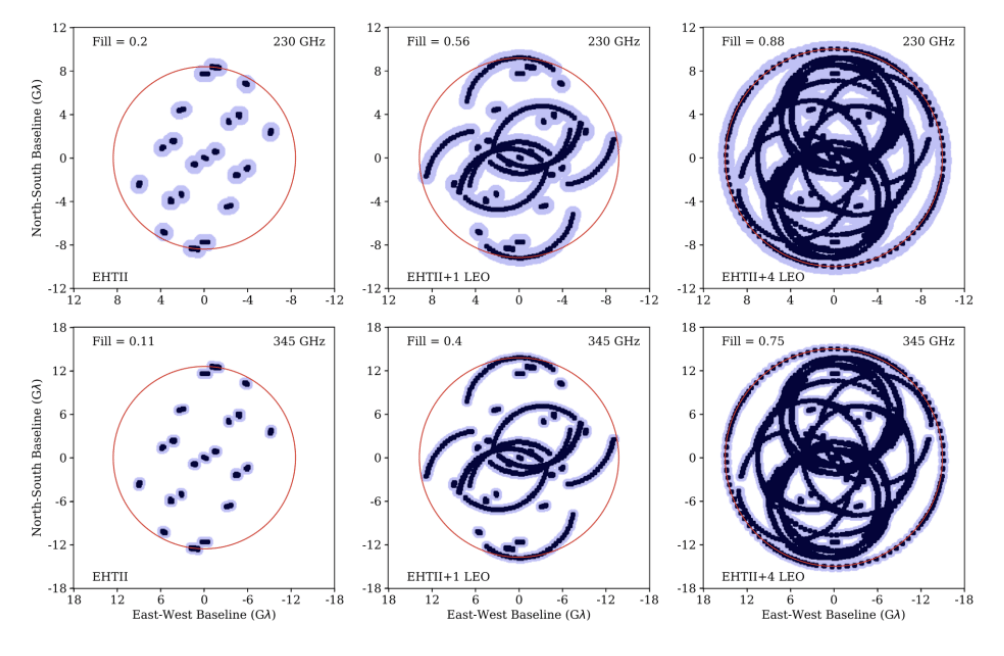
"Metrics and Motivations for Earth–Space VLBI: Time-resolving Sgr A* with the Event Horizon Telescope" Palumbo et. al. ApJ 2019
Sub-milli arcsecond angular resolution:
Dual short and long baseline lengths
Decreased signal loss from LEO
Decreased radiation environment in LEO vs. MEO
22\mu as<\theta_{\text{BHEX-Mini}} < 1800 \mu as
5.6 G \lambda < b_{s s}<9.3 G \lambda
0.11 G \lambda < b_{s g}<3.5 G \lambda
T-REX
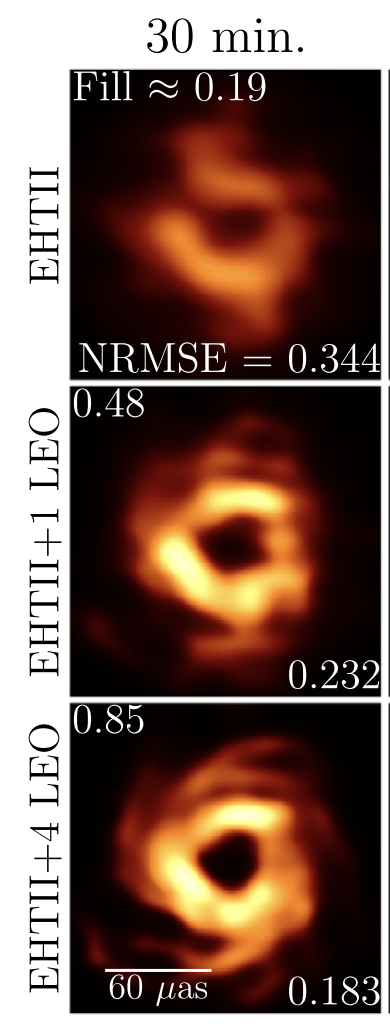
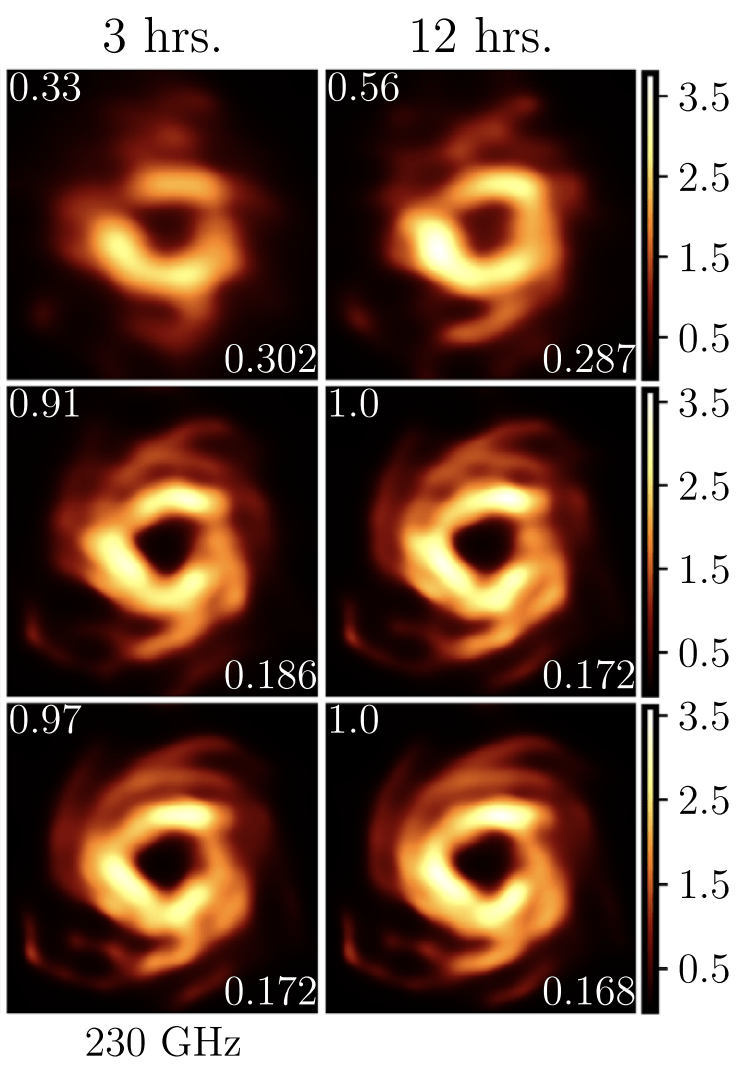
"Metrics and Motivations for Earth–Space VLBI: Time-resolving Sgr A* with the Event Horizon Telescope" Palumbo et. al. ApJ 2019
f_{obs}=230\text{ GHz}
Sub-milli arcsecond angular resolution:
Dual short and long baseline lengths
Decreased signal loss from LEO
Decreased radiation environment in LEO vs. MEO
22\mu as<\theta_{\text{BHEX-Mini}} < 1800 \mu as
5.6 G \lambda < b_{s s}<9.3 G \lambda
0.11 G \lambda < b_{s g}<3.5 G \lambda
T-REX
f_{obs}=230\text{ GHz}
"Metrics and Motivations for Earth–Space VLBI: Time-resolving Sgr A* with the Event Horizon Telescope" Palumbo et. al. ApJ 2019
Sub-milli arcsecond angular resolution:
Dual short and long baseline lengths
Decreased signal loss from LEO
Decreased radiation environment in LEO vs. MEO
22\mu as<\theta_{\text{BHEX-Mini}} < 1800 \mu as
5.6 G \lambda < b_{s s}<9.3 G \lambda
0.11 G \lambda < b_{s g}<3.5 G \lambda
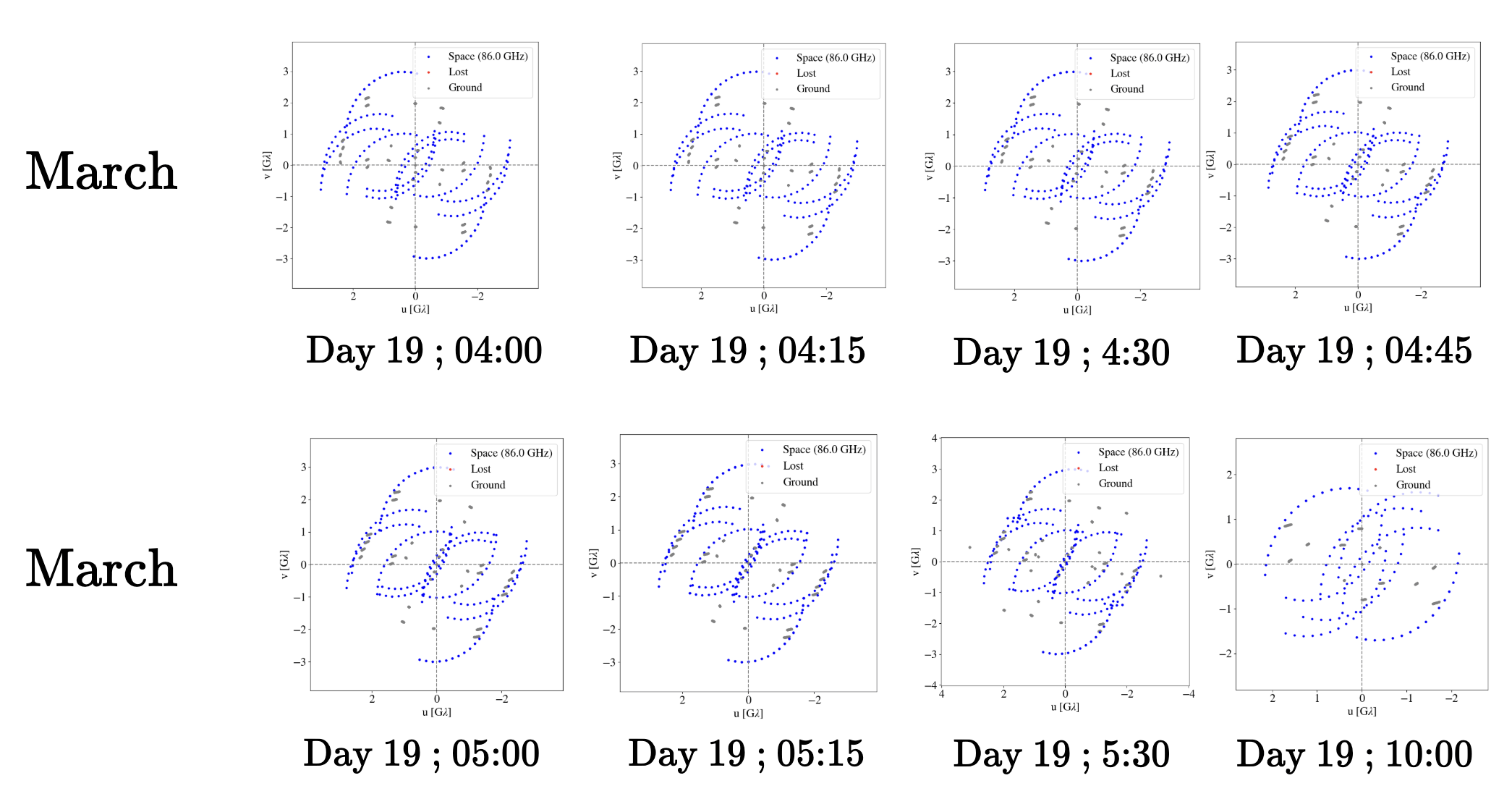
M87
Sub-milli arcsecond angular resolution:
Dual short and long baseline lengths
Decreased signal loss from LEO
Decreased radiation environment in LEO vs. MEO
22\mu as<\theta_{\text{BHEX-Mini}} < 1800 \mu as
5.6 G \lambda < b_{s s}<9.3 G \lambda
0.11 G \lambda < b_{s g}<3.5 G \lambda
Sgr A*
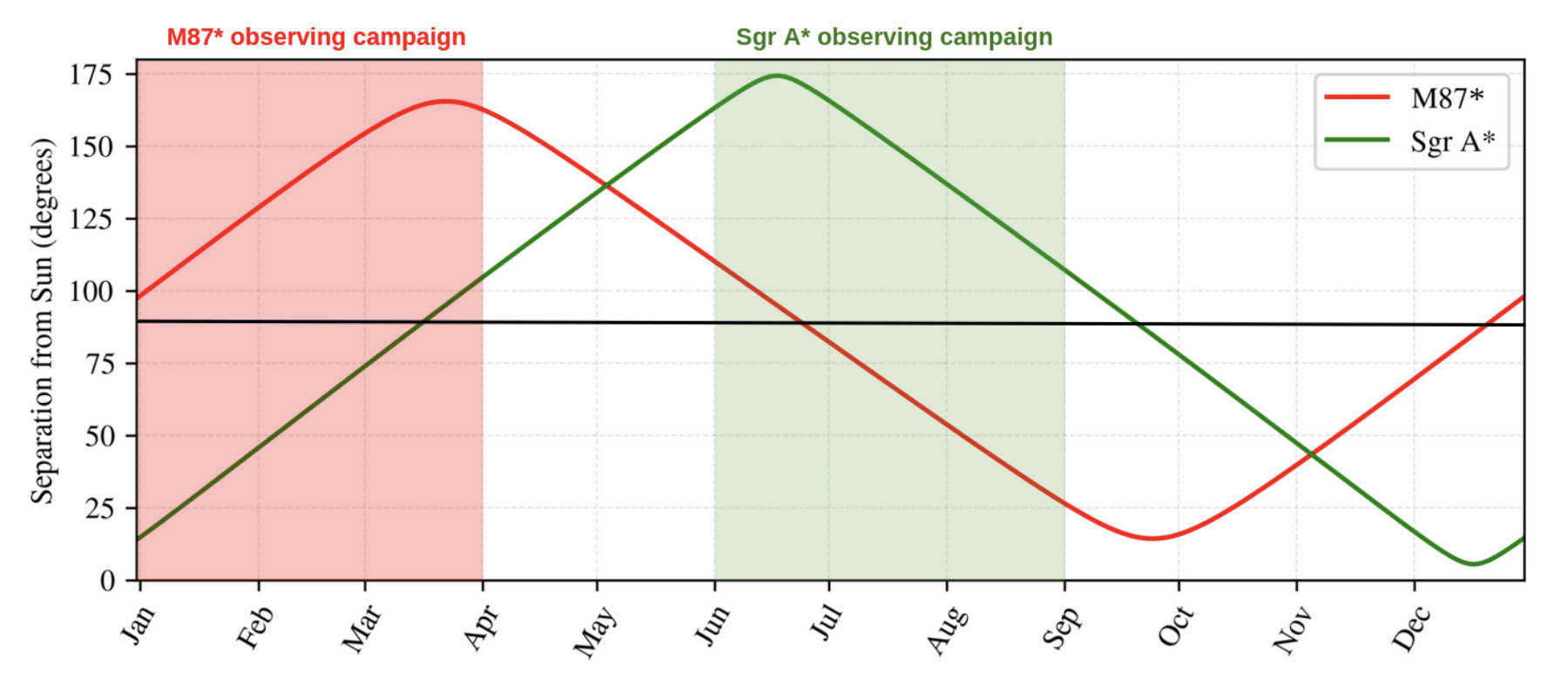
Sub-milli arcsecond angular resolution:
Dual short and long baseline lengths
Decreased signal loss from LEO
Decreased radiation environment in LEO vs. MEO
22\mu as<\theta_{\text{BHEX-Mini}} < 1800 \mu as
5.6 G \lambda < b_{s s}<9.3 G \lambda
0.11 G \lambda < b_{s g}<3.5 G \lambda
Sgr A*
Sgr A*
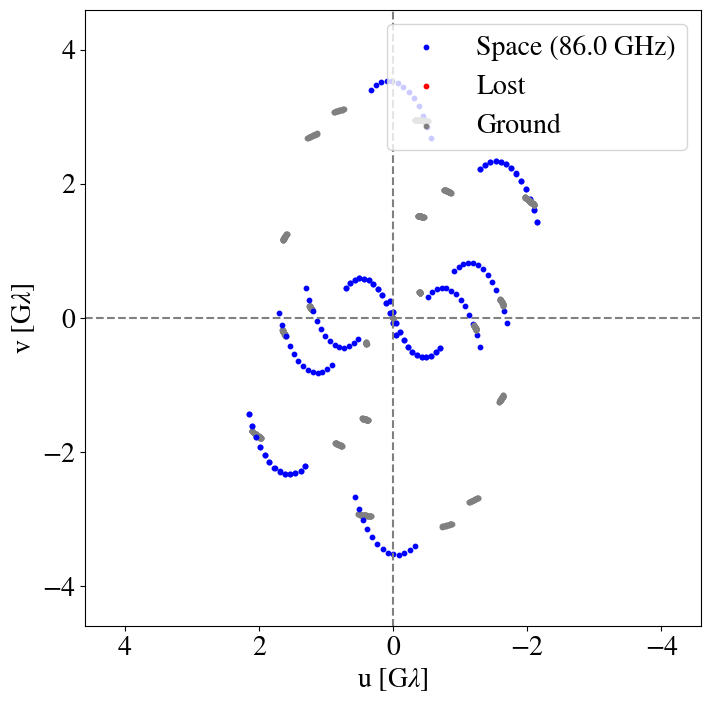
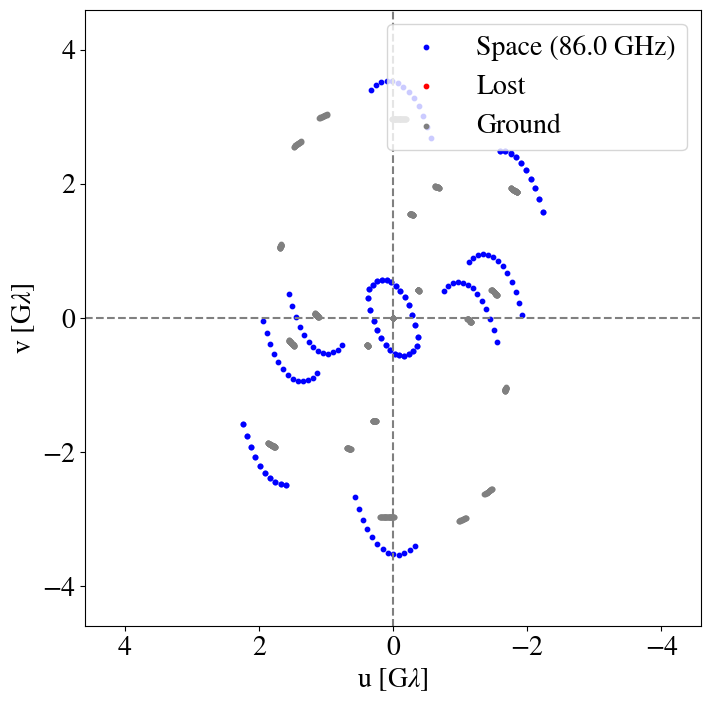
10:15
11:00
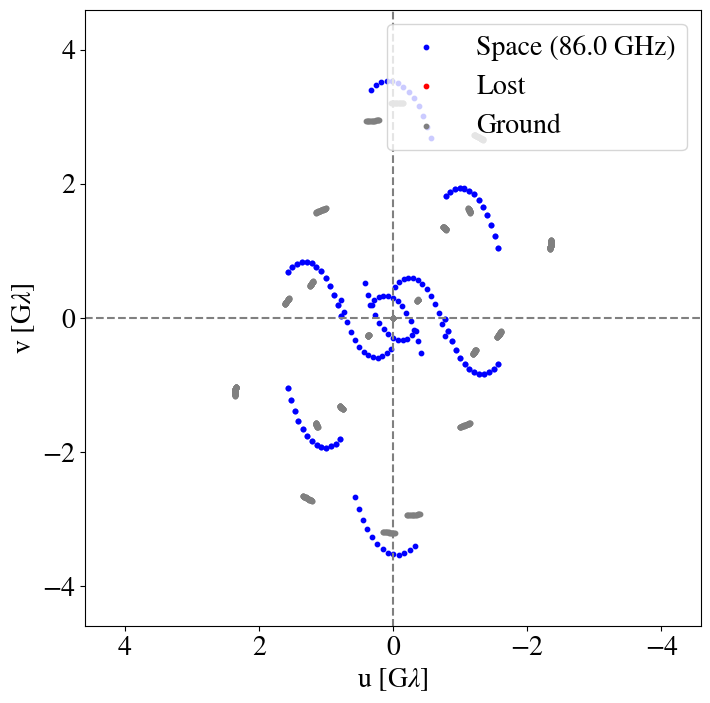
8:00
T-REX
Capture Time-Resolved Videos of M87 & Sgr A*
Time-Resolve Binary Black Hole Systems
Rapid mm-wave time-domain observations of transient targets
T-REX
Capture Time-Resolved Videos of M87 & Sgr A*
Time-Resolve Binary Black Hole Systems
Rapid mm-wave time-domain observations of transient targets
T-REX
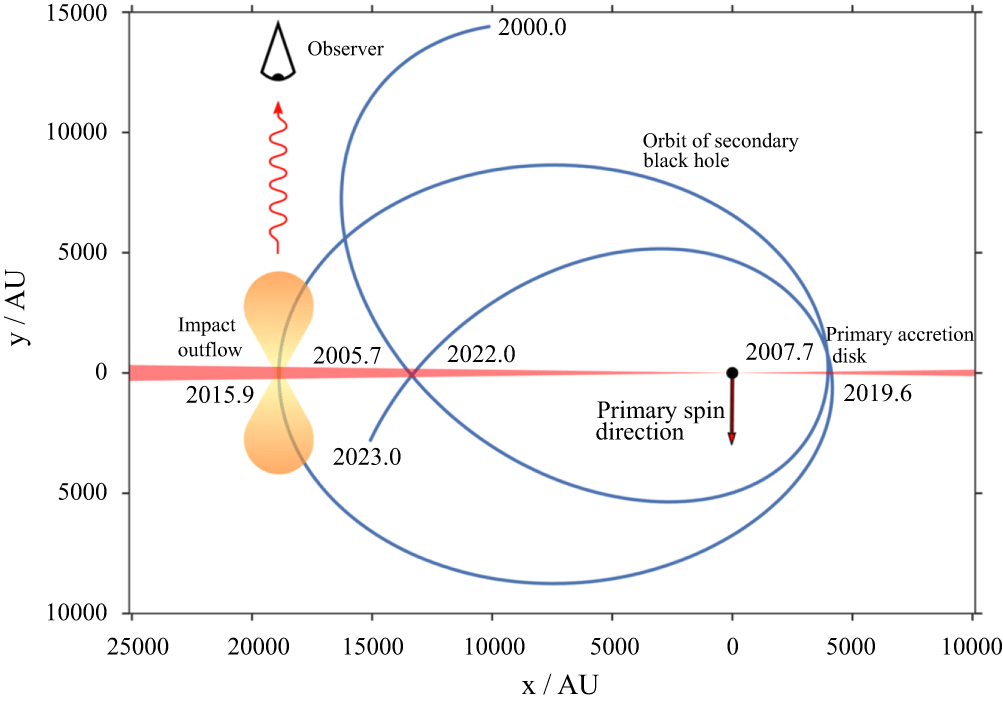
T-REX
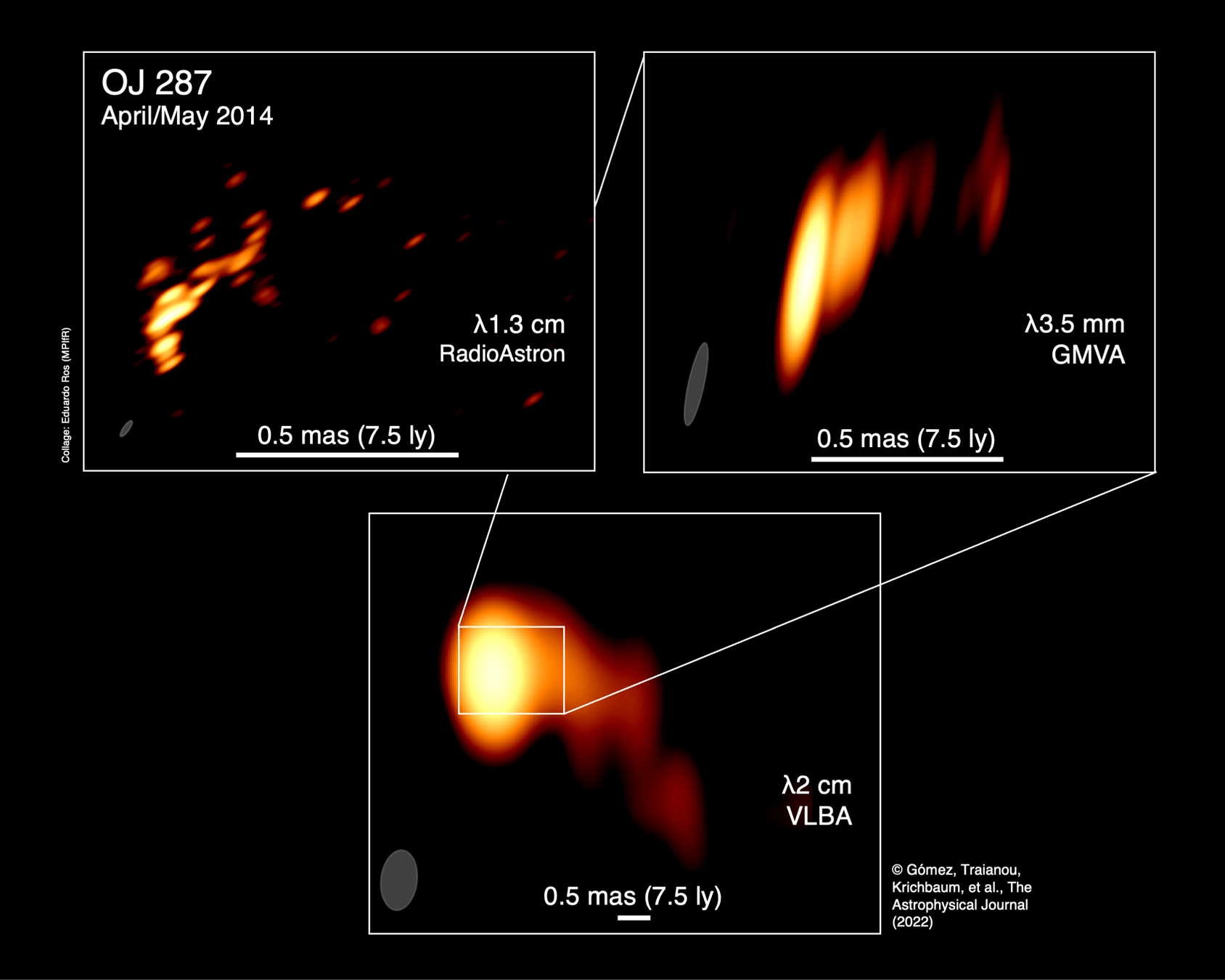
T-REX
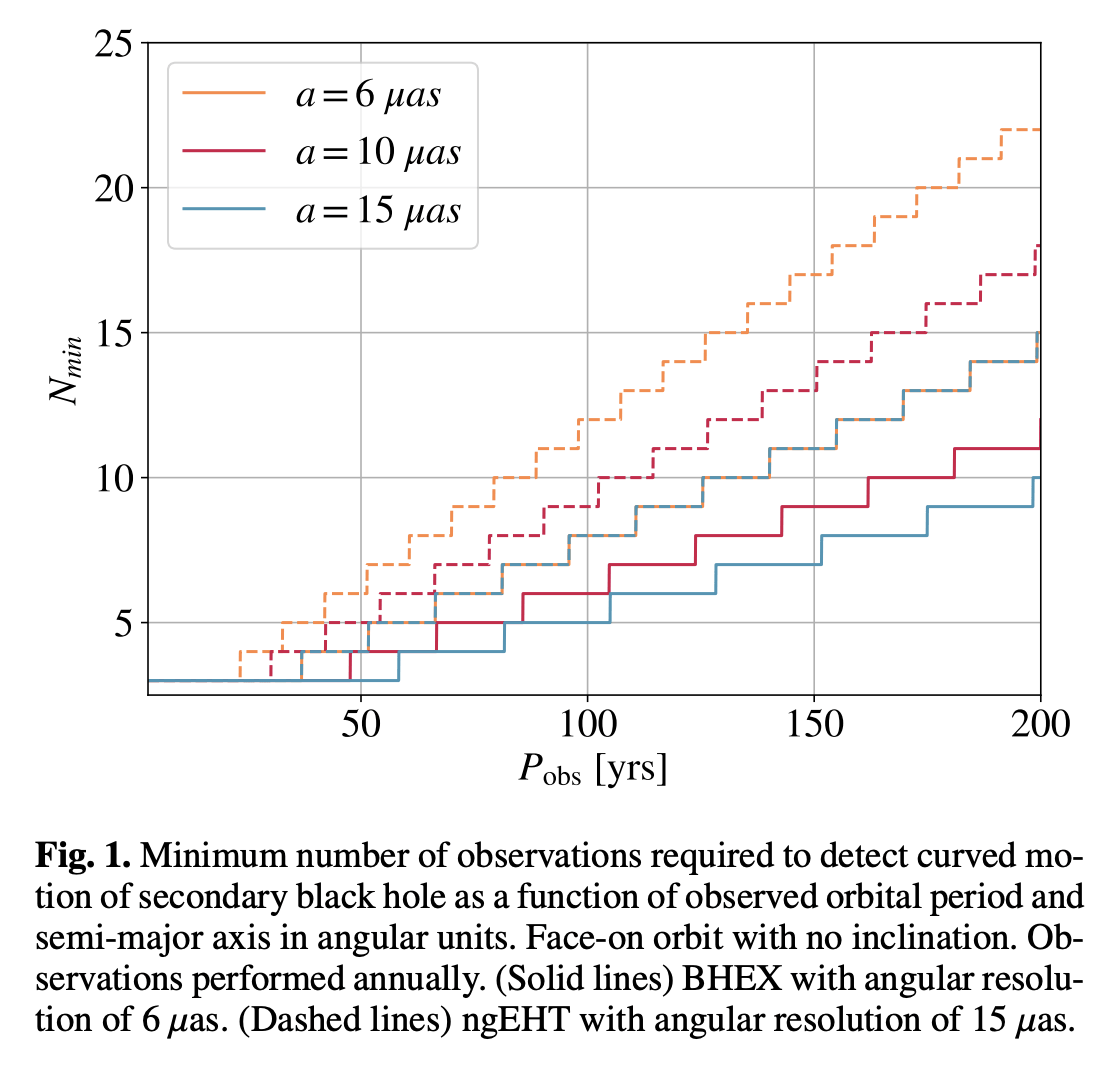
Towards direct imaging and orbital parameter estimation of supermassive black hole binaries with spaceborne VLBI (Hudson et. al.)
T-REX
Capture Time-Resolved Videos of M87 & Sgr A*
Time-Resolve Binary Black Hole Systems
Rapid mm-wave time-domain observations of transient targets
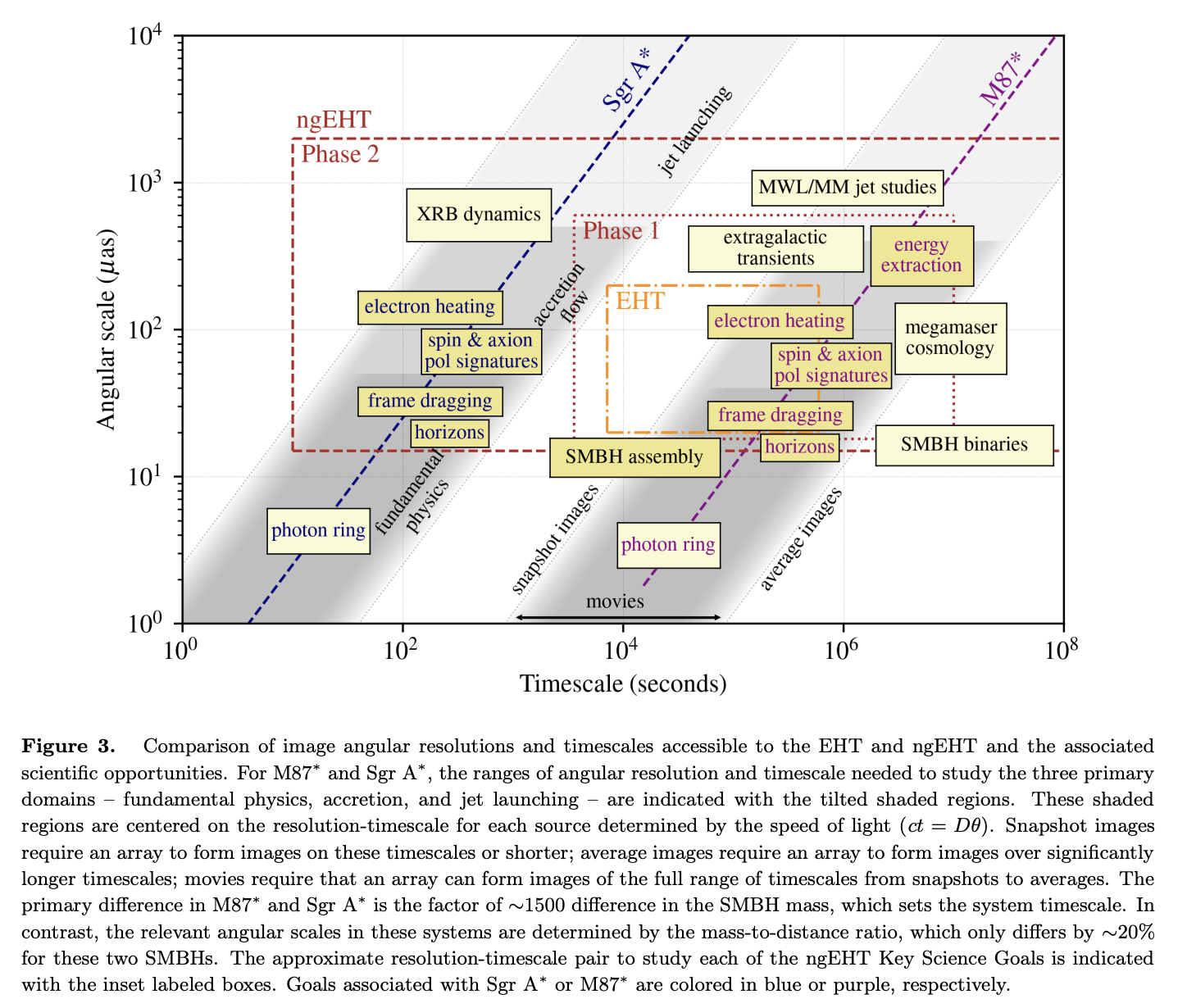
Towards direct imaging and orbital parameter estimation of supermassive black hole binaries with spaceborne VLBI (Hudson et. al.)
T-REX
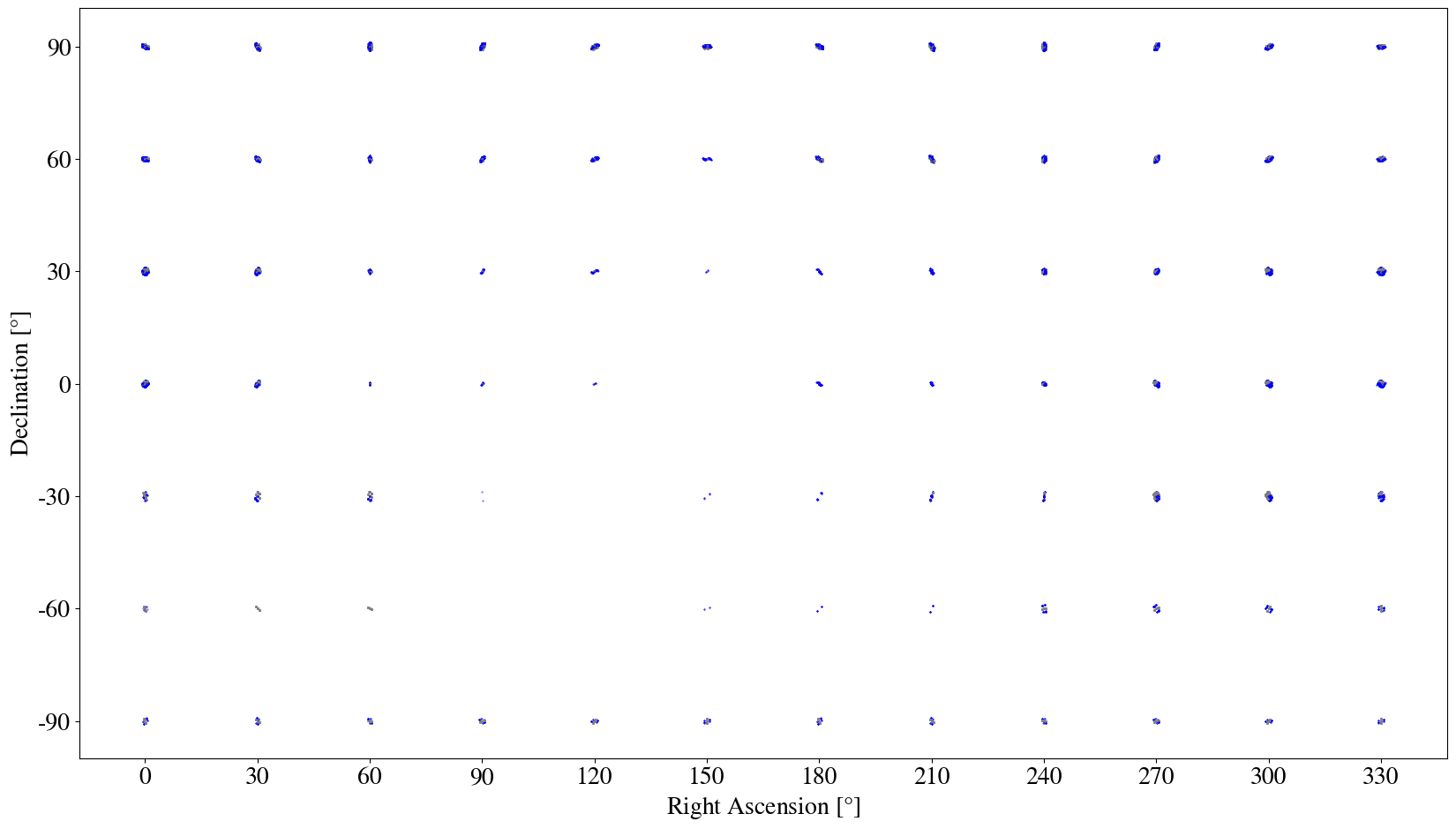
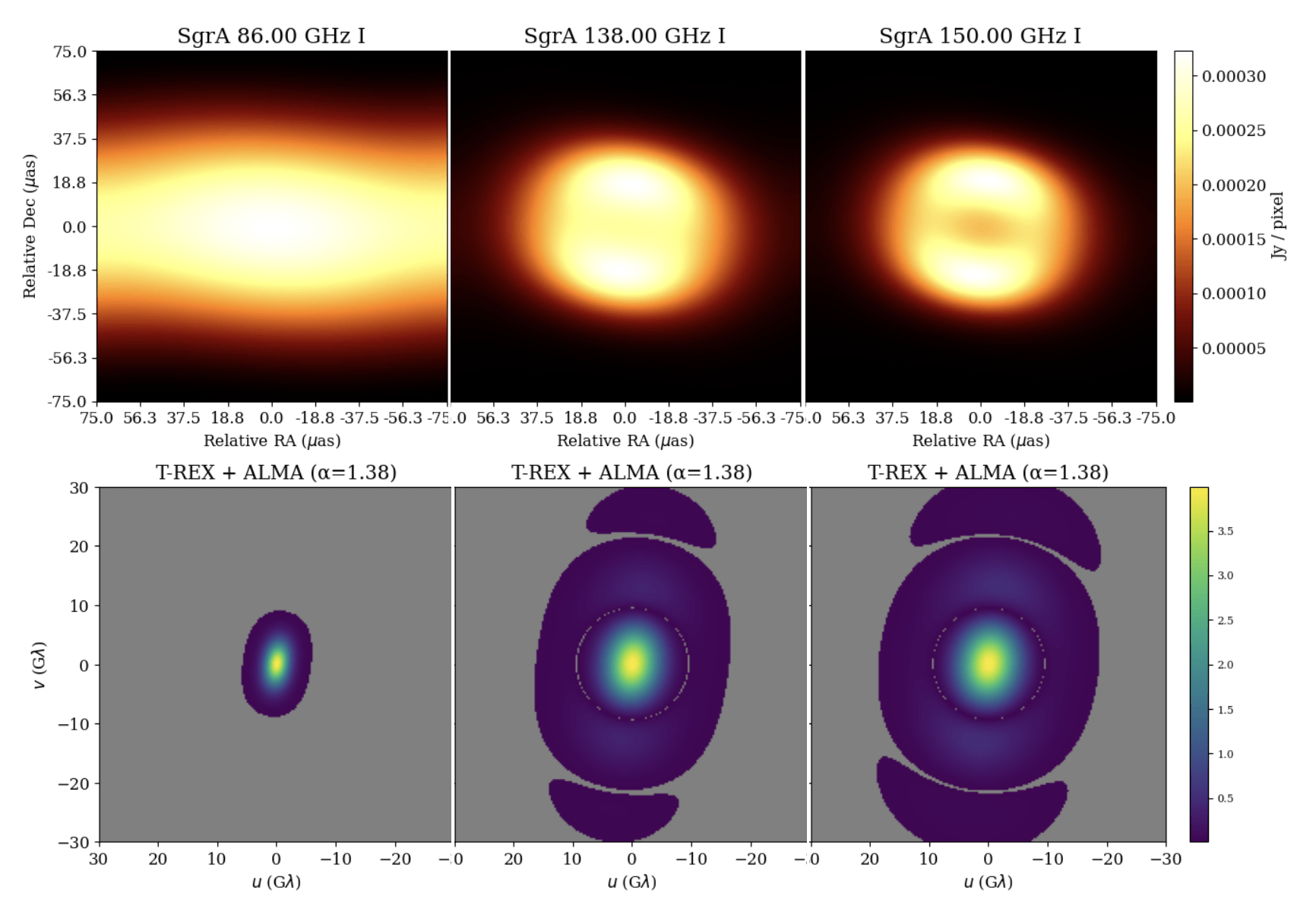
All-sky (u,v) coverage at 86 GHz for 30 min
T-REX
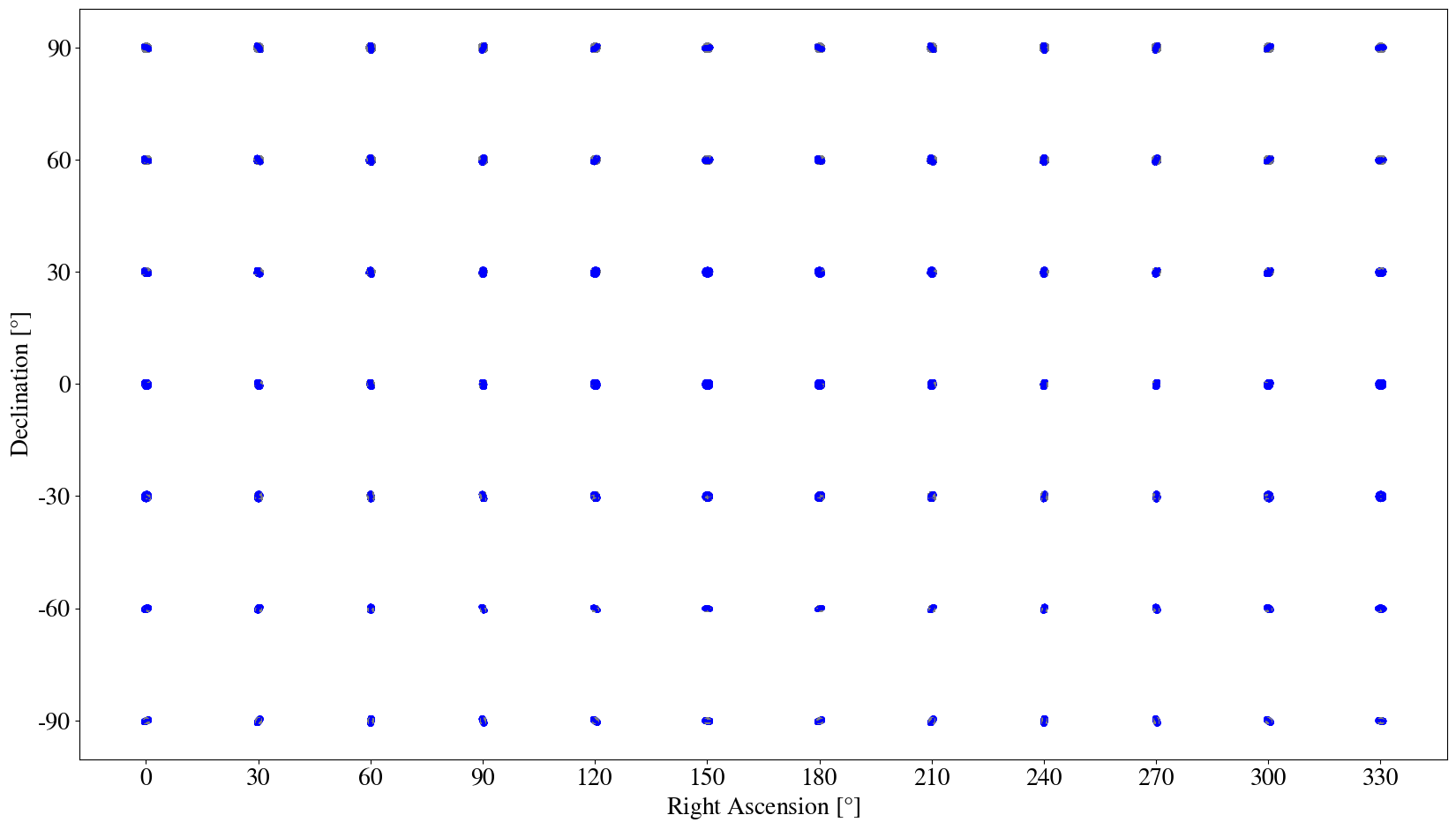
All-sky (u,v) coverage at 86 GHz for 24 hrs
T-REX
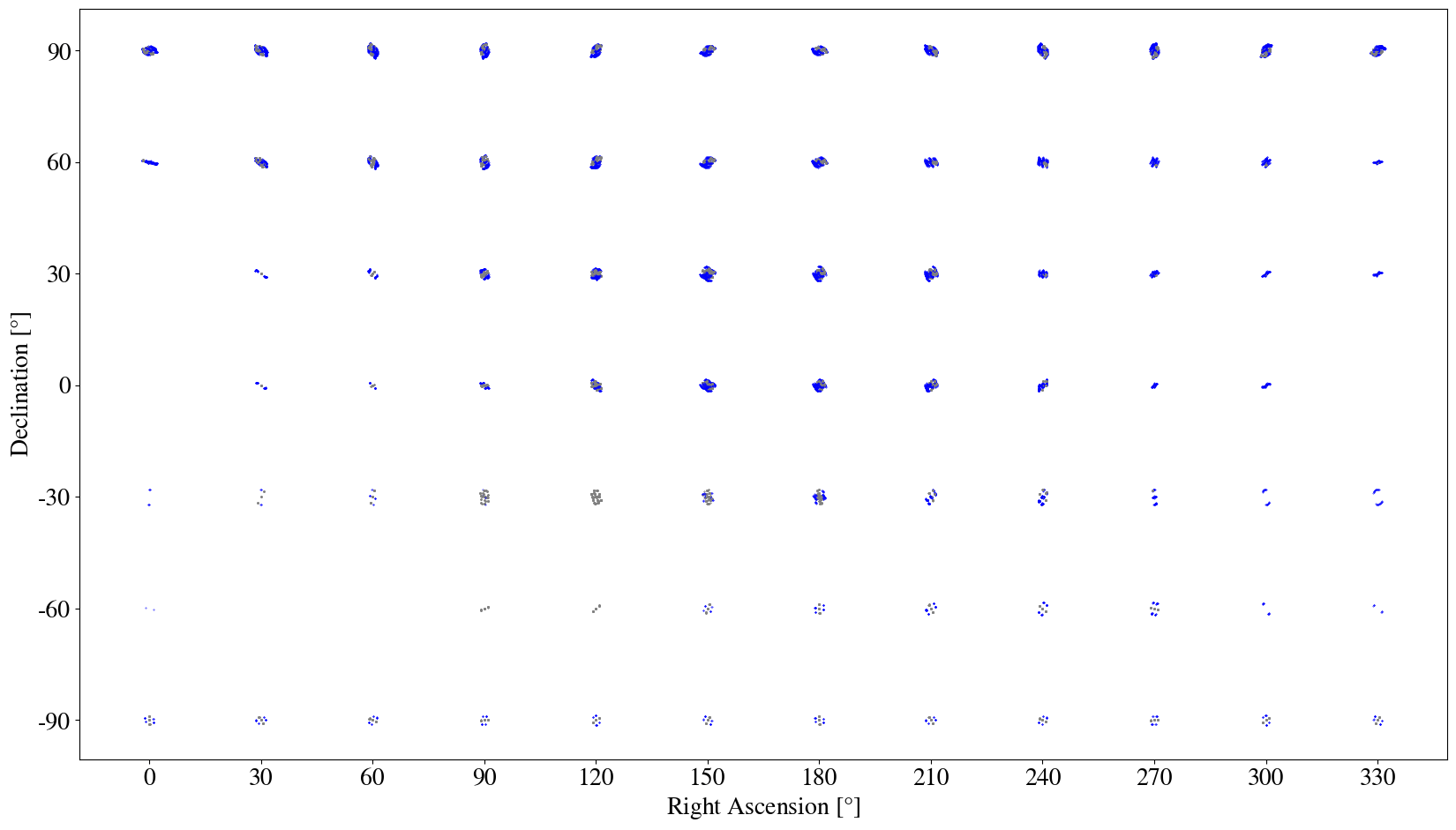
All-sky (u,v) coverage at 150 GHz for 30 min
T-REX
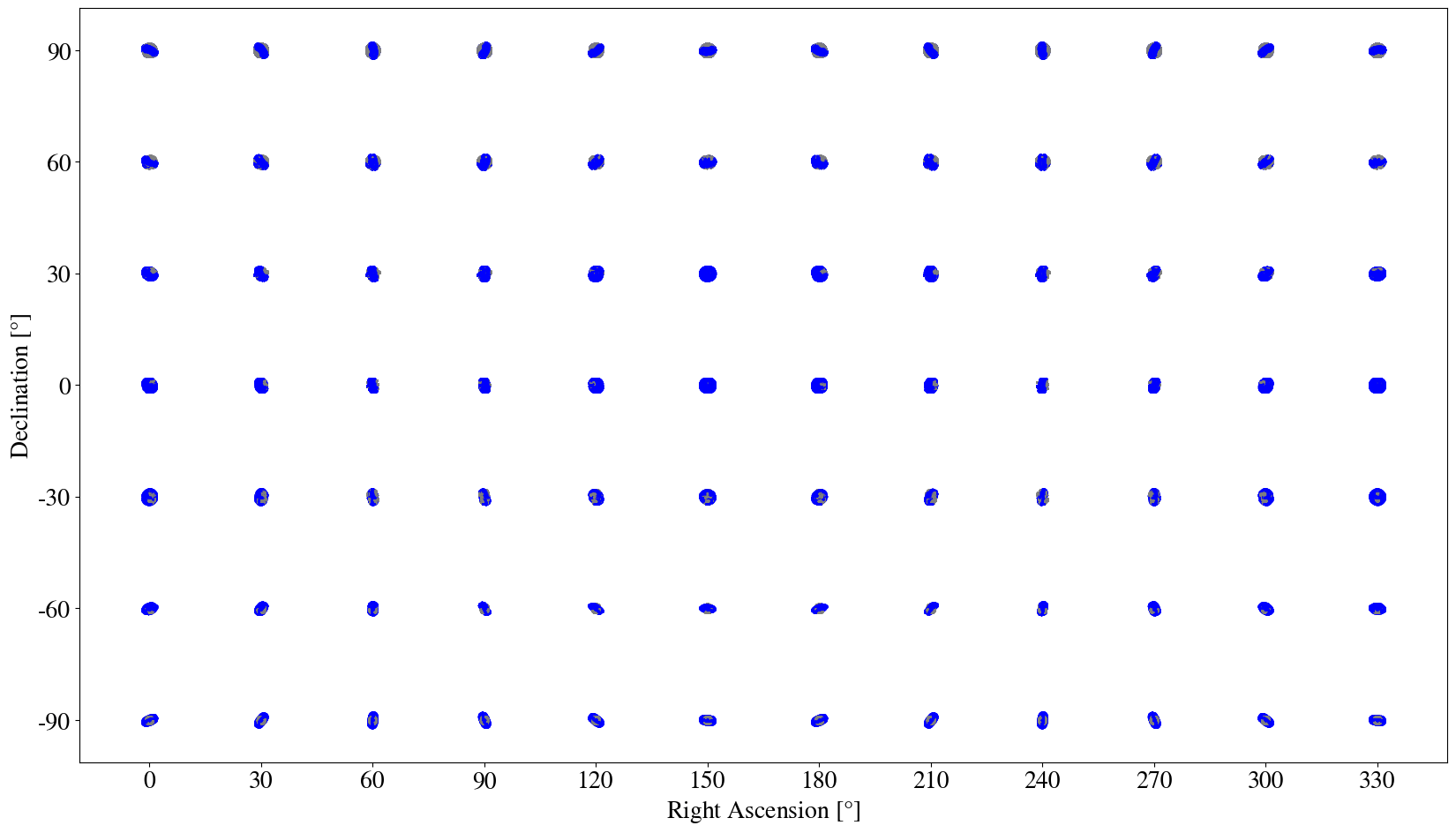
All-sky (u,v) coverage at 150 GHz for 24 hr
- Introduction
- Science Traceability Matrix
- Primary Science Objectives
- SWaPC Requirements
- NASA Mission Life Cycle
- Work Breakdown Structure (WBS)
- Critical Mission Parameters
- Preliminary Concept of Operations
- Expected Data Products
- Funding & Timeline
T-REX
- Introduction
- Science Traceability Matrix
- Primary Science Objectives
- SWaPC Requirements
- NASA Mission Life Cycle
- Work Breakdown Structure (WBS)
- Critical Mission Parameters
- Preliminary Concept of Operations
- Expected Data Products
- Funding & Timeline
T-REX
T-REX
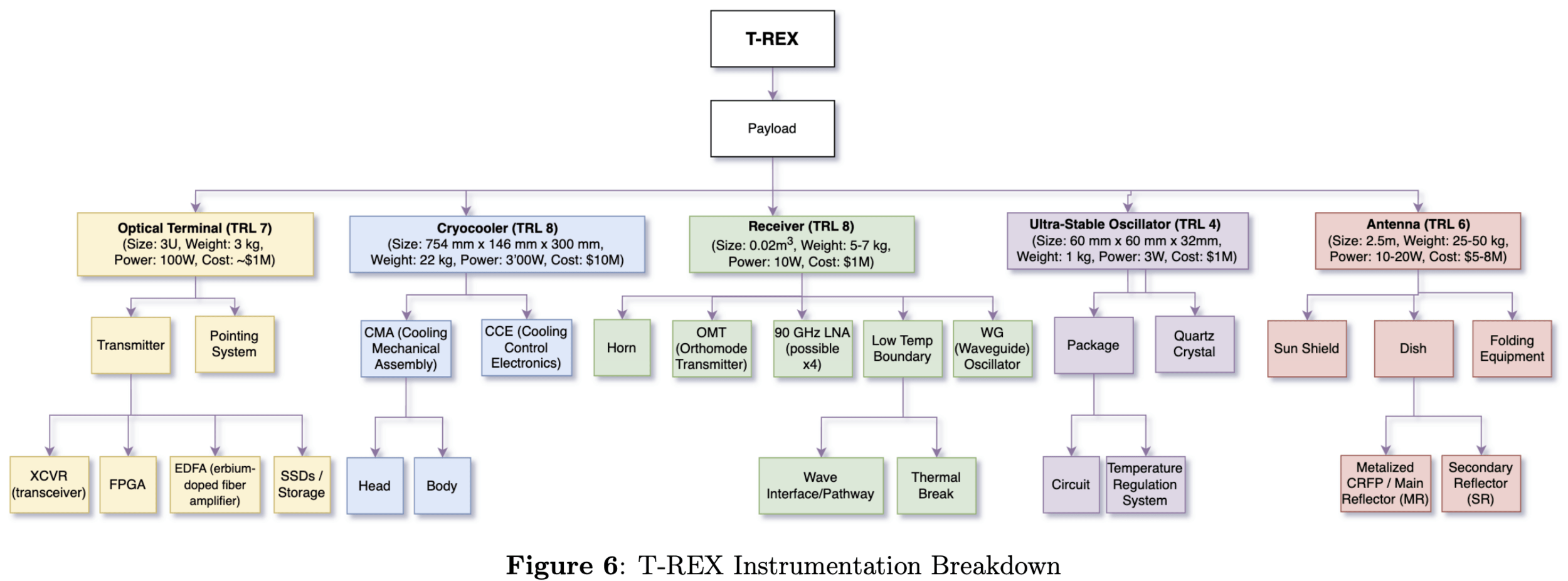
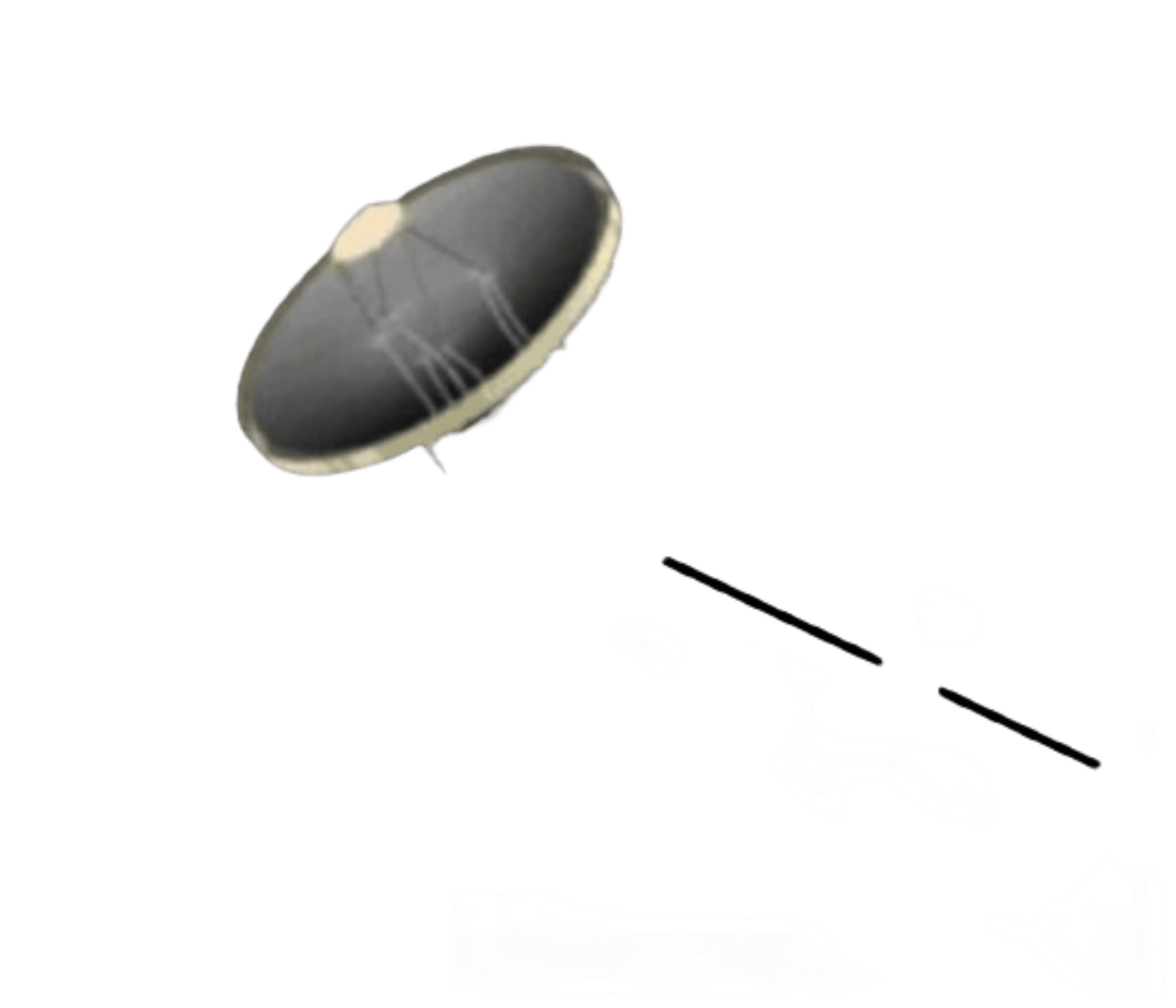
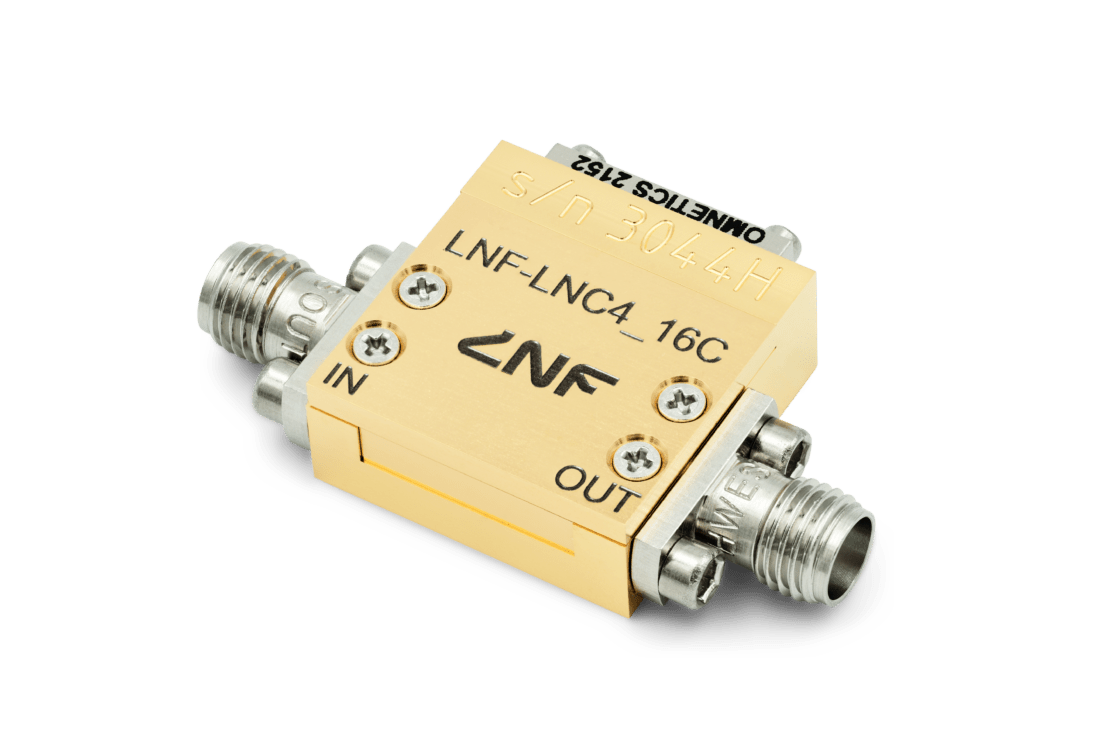
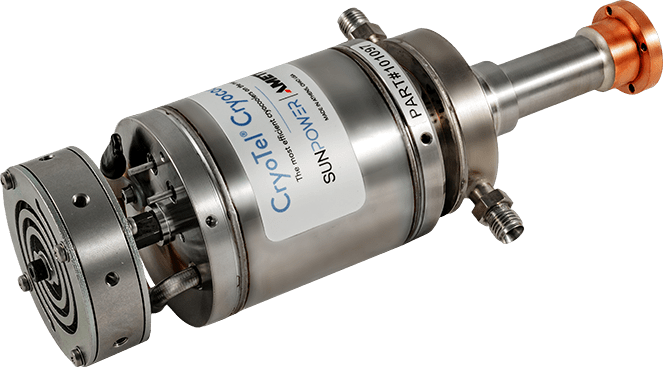
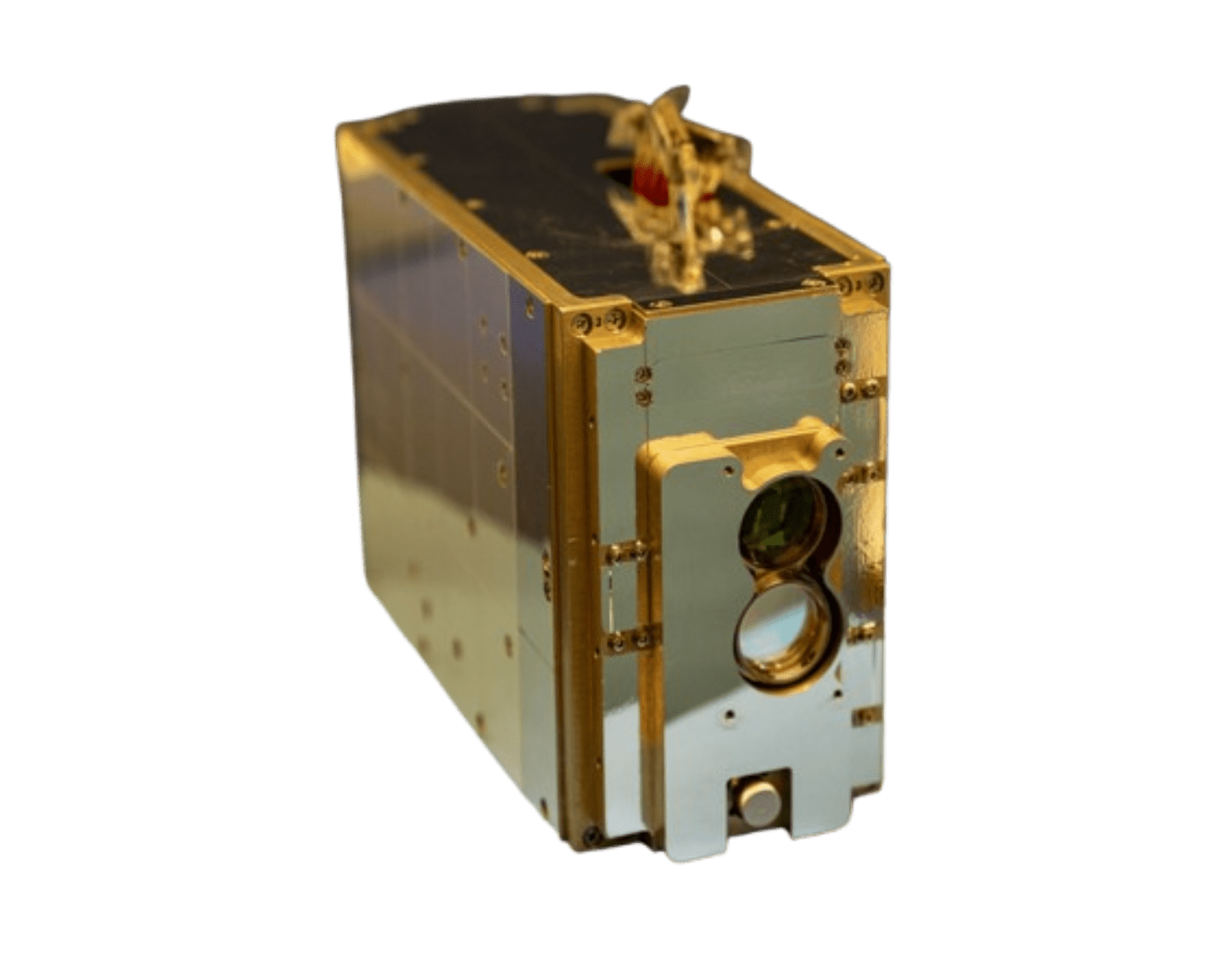
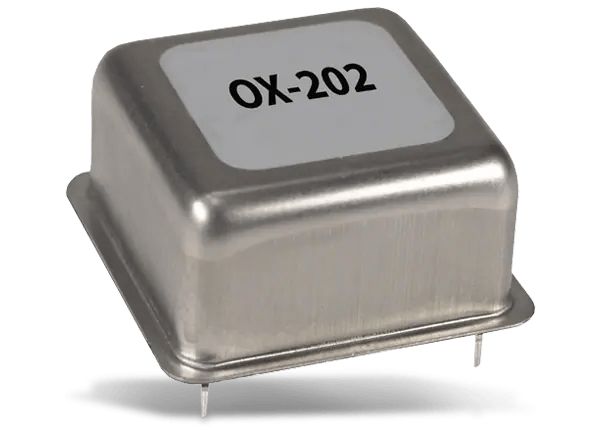
Sub-milli arcsecond angular resolution:
Dual short and long baseline lengths
Decreased signal loss from LEO
Decreased radiation environment in LEO vs. MEO
22\mu as<\theta_{\text{BHEX-Mini}} < 1800 \mu as
5.6 G \lambda < b_{s s}<9.3 G \lambda
0.11 G \lambda < b_{s g}<3.5 G \lambda
Size
Weight
Power
Power
\sim 2.5m
\sim 25-50kg
22 kg
300W
400mW @15^{\circ}K
\$10 \text{mln}
754 mm \times \\ 146 mm \times \\ 300 mm
\$2-5 \text{Mln}
\$4-11 \text{Mln}
10-20W
\text{(deployment)}
5-7 kg
\sim 10W
\sim \$ 1 \text{mln}
\sim0.02m^3
\sim 1 kg
\sim 3W
\sim \$1\text{mln}^*
60 mm\times \\60mm \times \\32 mm
3U (300 mm\times \\300 mm \times \\300 mm)
100W
3 kg
\sim \$1\text{mln}^*
\sim 4W
\sim 1 kg^*
12 mm \times \\12 mm
\sim \$1\text{mln}^*
\sim85.3 kg
\sim 437 W
\sim \$25\text{ million}
N/A
Cost
T-REX Payload
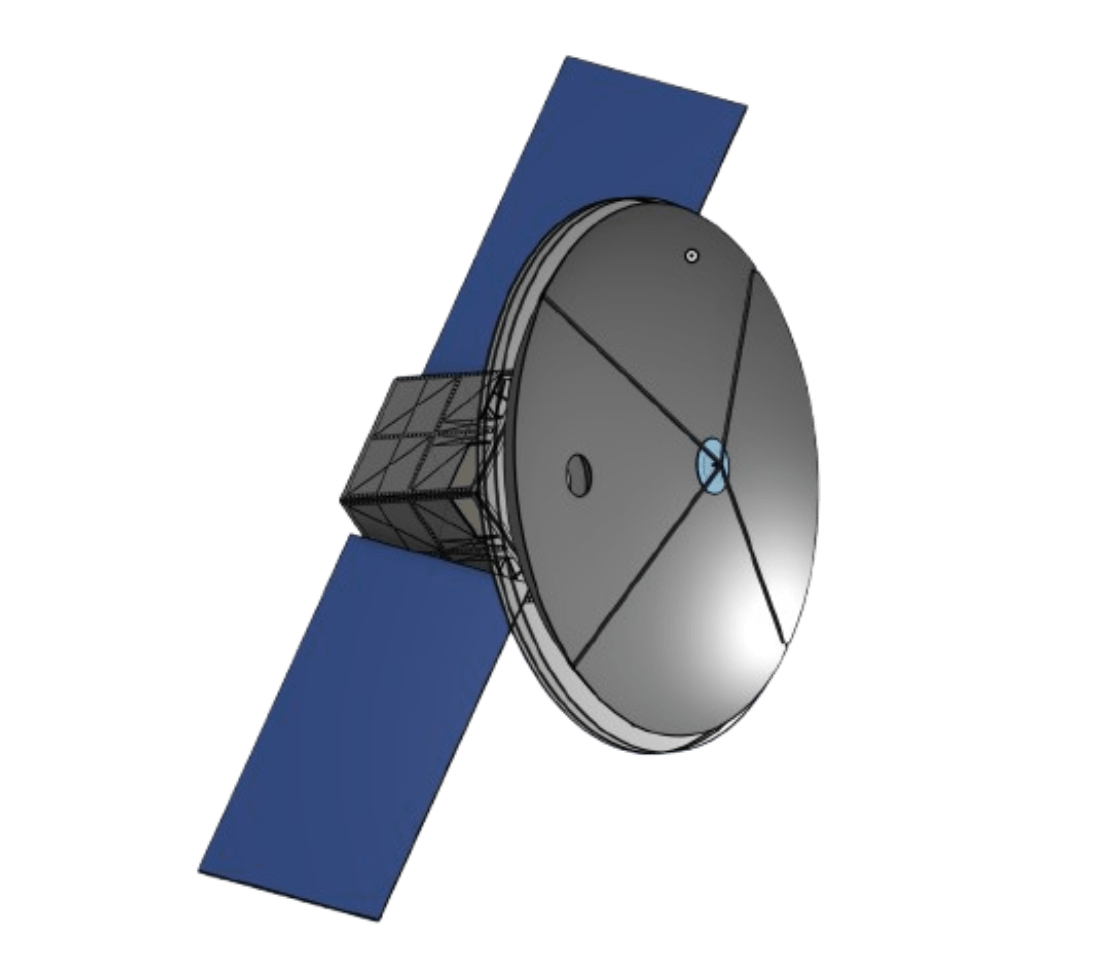
Antenna
Cryocooler
Data Downlink
Digital Backend
USO
Receiver
Sub-milli arcsecond angular resolution:
Dual short and long baseline lengths
Decreased signal loss from LEO
Decreased radiation environment in LEO vs. MEO
22\mu as<\theta_{\text{BHEX-Mini}} < 1800 \mu as
5.6 G \lambda < b_{s s}<9.3 G \lambda
0.11 G \lambda < b_{s g}<3.5 G \lambda
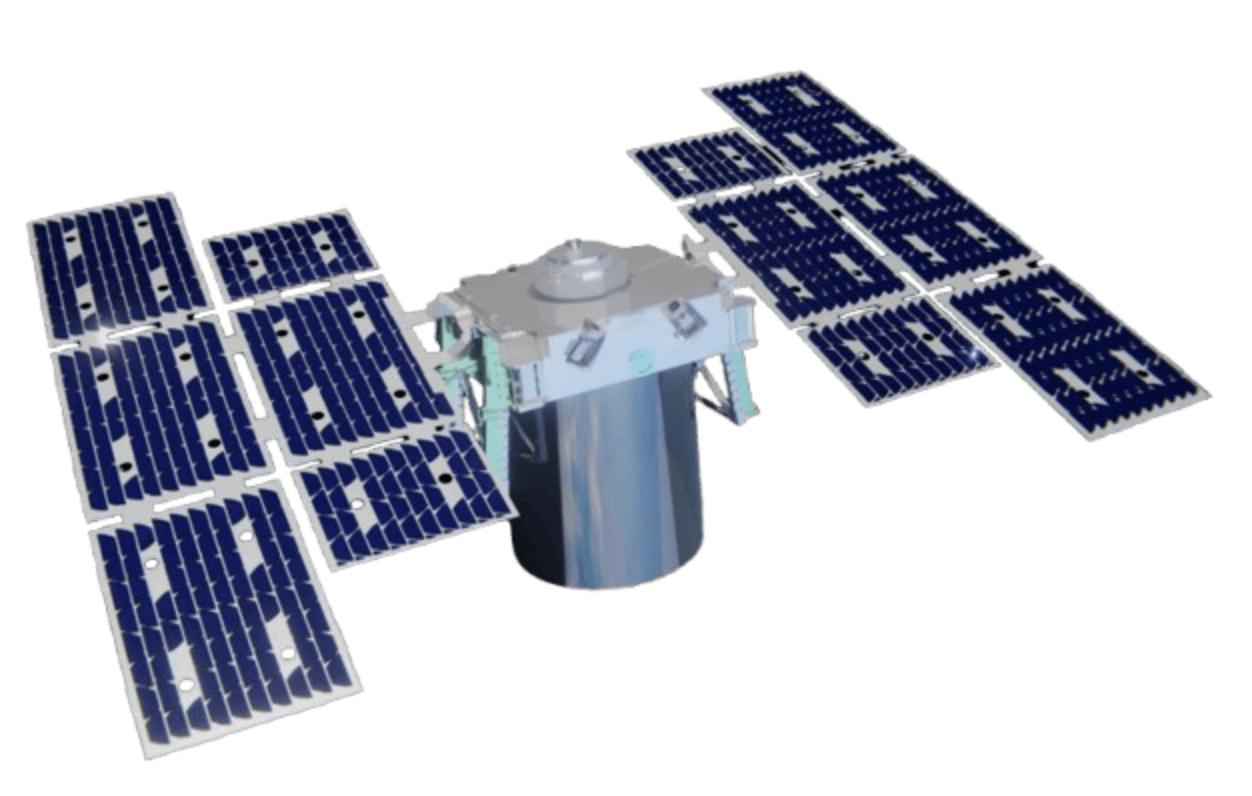
Satellite Bus Class
Bus Parameters
Bus Payload Capacity
T-REX Bus
Sub-milli arcsecond angular resolution:
Dual short and long baseline lengths
Decreased signal loss from LEO
Decreased radiation environment in LEO vs. MEO
22\mu as<\theta_{\text{BHEX-Mini}} < 1800 \mu as
5.6 G \lambda < b_{s s}<9.3 G \lambda
0.11 G \lambda < b_{s g}<3.5 G \lambda
T-REX Bus
SBC
- ESPA-Grande
- 4-point mount launch vehicle interface
- Compliant to SpaceX Rideshare
BP
- Energy Storage: 75 Ah
- Orbital lifetime: LEO (>5 yrs)
- Solar Array Power: 1876 W (50% sunlight for LEO ~ 1kW)
BPC
- Standard rideshare payload capability: 250 kg
- Pointing accuracy: 0.002 (1-sigma), 3 axes, 2 trackers
- 40.0" x 40.0" x 45.0" (objective)
- Slew rate: 3.1 deg/sec
T-REX
T-REX
- Introduction
- Science Traceability Matrix
- Primary Science Objectives
- SWaPC Requirements
- NASA Mission Life Cycle
- Work Breakdown Structure (WBS)
- Critical Mission Parameters
- Preliminary Concept of Operations
- Expected Data Products
- Funding & Timeline
T-REX
- Introduction
- Science Traceability Matrix
- Primary Science Objectives
- SWaPC Requirements
- NASA Mission Life Cycle
- Work Breakdown Structure (WBS)
- Critical Mission Parameters
- Preliminary Concept of Operations
- Expected Data Products
- Funding & Timeline
T-REX
Sub-milli arcsecond angular resolution:
Dual short and long baseline lengths
Decreased signal loss from LEO
Decreased radiation environment in LEO vs. MEO
22\mu as<\theta_{\text{BHEX-Mini}} < 1800 \mu as
5.6 G \lambda < b_{s s}<9.3 G \lambda
0.11 G \lambda < b_{s g}<3.5 G \lambda
T-REX
Sub-milli arcsecond angular resolution:
Dual short and long baseline lengths
Decreased signal loss from LEO
Decreased radiation environment in LEO vs. MEO
22\mu as<\theta_{\text{BHEX-Mini}} < 1800 \mu as
5.6 G \lambda < b_{s s}<9.3 G \lambda
0.11 G \lambda < b_{s g}<3.5 G \lambda
- Introduction
- Science Traceability Matrix
- Primary Science Objectives
- SWaPC Requirements
- NASA Mission Life Cycle
- Work Breakdown Structure (WBS)
- Critical Mission Parameters
- Preliminary Concept of Operations
- Expected Data Products
- Funding & Timeline
T-REX
- Introduction
- Science Traceability Matrix
- Primary Science Objectives
- SWaPC Requirements
- NASA Mission Life Cycle
- Work Breakdown Structure (WBS)
- Critical Mission Parameters
- Preliminary Concept of Operations
- Expected Data Products
- Funding & Timeline
T-REX
Sub-milli arcsecond angular resolution:
Dual short and long baseline lengths
Decreased signal loss from LEO
Decreased radiation environment in LEO vs. MEO
22\mu as<\theta_{\text{BHEX-Mini}} < 1800 \mu as
5.6 G \lambda < b_{s s}<9.3 G \lambda
0.11 G \lambda < b_{s g}<3.5 G \lambda
T-REX
- Introduction
- Science Traceability Matrix
- Primary Science Objectives
- SWaPC Requirements
- NASA Mission Life Cycle
- Work Breakdown Structure (WBS)
- Critical Mission Parameters
- Preliminary Concept of Operations
- Expected Data Products
- Funding & Timeline
T-REX
- Introduction
- Science Traceability Matrix
- Primary Science Objectives
- SWaPC Requirements
- NASA Mission Life Cycle
- Work Breakdown Structure (WBS)
- Critical Mission Parameters
- Preliminary Concept of Operations
- Expected Data Products
- Funding & Timeline
T-REX
Mission Parameters
T^*_{sys} = [T_{rx}+\eta_{ff}T_{b, inc}](1+r)\sim 30K
T_{b,inc}=\frac{F_{tot}A_{eff}}{2k}\sim 3\cdot 10^{-3} K
T_{rx}=15K, \eta_{ff}=0.95, \eta_{A}=0.85, r= 1, F_{tot}\sim 2\pm 0.2 Jy
SEFD
USO
Data
\theta_{\text{Res}}
Orbit
\sigma_{\text{Noise}}
\tau_{\text{max}}
\Delta \phi = 4.3\cdot 10^{-3} \text{ rad } (\text{LISA USO})
L\sim 1\% \text{ (JUICE USO)}
\operatorname{Rate}(\mathrm{bps})\sim 20,750 \text{ GB }(T_{obs}=.5T_{orb}) \text{ over 1 orbit}
\theta_{\text{T-REX - EHT}} \sim 35 \mu as
\text{Circular Highly-Inclined Polar LEO}, r\sim 400 km, e \sim 0, i>78^{\circ}
\tau_{\text{Coherence, T-REX}}\lessapprox 2 \text{ min} \sim 120 s
\text{SEFD}_{\text{T-REX}}=\frac{2kT^*_{sys}}{\eta_A A}\sim 66,000 \text{ Jy}
\sigma_{\text{T-REX - EHT}}\sim 40 \text{ mJy}
- Introduction
- Science Traceability Matrix
- Primary Science Objectives
- SWaPC Requirements
- NASA Mission Life Cycle
- Work Breakdown Structure (WBS)
- Critical Mission Parameters
- Preliminary Concept of Operations
- Expected Data Products
- Funding & Timeline
T-REX
- Introduction
- Science Traceability Matrix
- Primary Science Objectives
- SWaPC Requirements
- NASA Mission Life Cycle
- Work Breakdown Structure (WBS)
- Critical Mission Parameters
- Preliminary Concept of Operations
- Expected Data Products
- Funding & Timeline
T-REX
% Gain Error
NRMSE
0%
25%
50%
100%
0
1
0.5
Bispectrum
Cl Amplitude + Cl Phase
T-REX
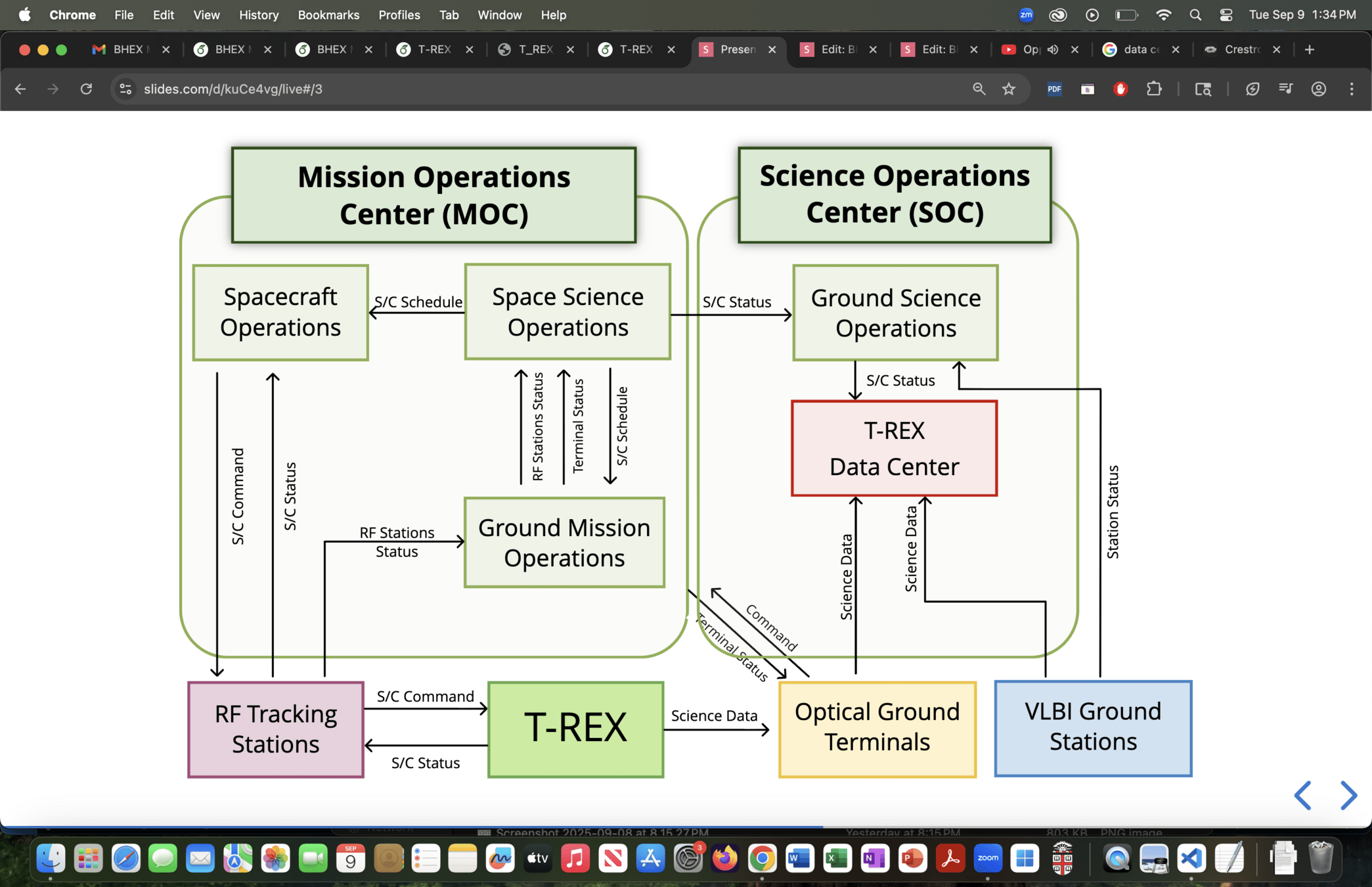
Optical Terminals
RF Tracking Stations
VLBI Ground Stations
\text{T-REX}

T-REX Data Center
T-REX
- Introduction
- Science Traceability Matrix
- Primary Science Objectives
- SWaPC Requirements
- NASA Mission Life Cycle
- Work Breakdown Structure (WBS)
- Critical Mission Parameters
- Preliminary Concept of Operations
- Expected Data Products
- Funding & Timeline
T-REX
- Introduction
- Science Traceability Matrix
- Primary Science Objectives
- SWaPC Requirements
- NASA Mission Life Cycle
- Work Breakdown Structure (WBS)
- Critical Mission Parameters
- Preliminary Concept of Operations
- Expected Data Products
- Funding & Timeline
T-REX
Sub-milli arcsecond angular resolution:
Dual short and long baseline lengths
Decreased signal loss from LEO
Decreased radiation environment in LEO vs. MEO
22\mu as<\theta_{\text{BHEX-Mini}} < 1800 \mu as
5.6 G \lambda < b_{s s}<9.3 G \lambda
0.11 G \lambda < b_{s g}<3.5 G \lambda
T-REX
T-REX
T-REX
f_{obs}
f_{obs}=86\text{ GHz}
T-REX
f_{obs}
f_{obs}=150\text{ GHz}
Sub-milli arcsecond angular resolution:
Dual short and long baseline lengths
Decreased signal loss from LEO
Decreased radiation environment in LEO vs. MEO
22\mu as<\theta_{\text{BHEX-Mini}} < 1800 \mu as
5.6 G \lambda < b_{s s}<9.3 G \lambda
0.11 G \lambda < b_{s g}<3.5 G \lambda
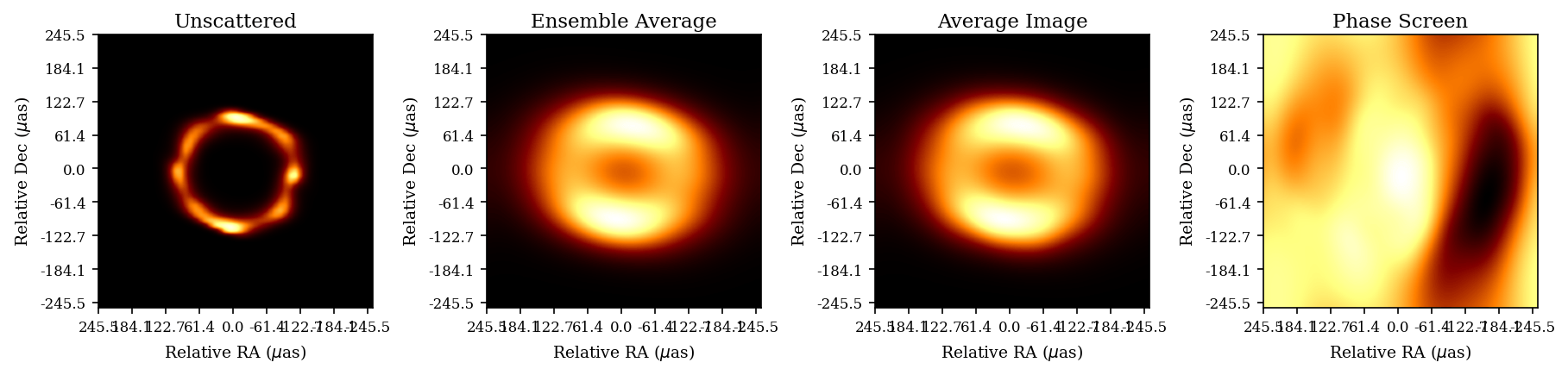
f_{obs}=86\text{ GHz}
5.6 G \lambda < b_{s s}<9.3 G \lambda
T-REX
Sub-milli arcsecond angular resolution:
Dual short and long baseline lengths
Decreased signal loss from LEO
Decreased radiation environment in LEO vs. MEO
22\mu as<\theta_{\text{BHEX-Mini}} < 1800 \mu as
5.6 G \lambda < b_{s s}<9.3 G \lambda
0.11 G \lambda < b_{s g}<3.5 G \lambda
T-REX
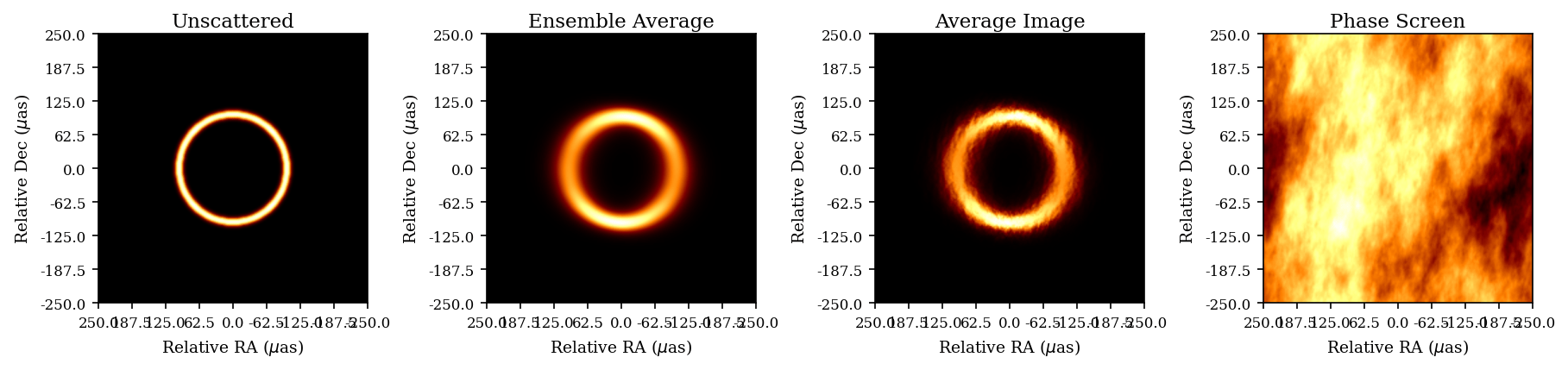
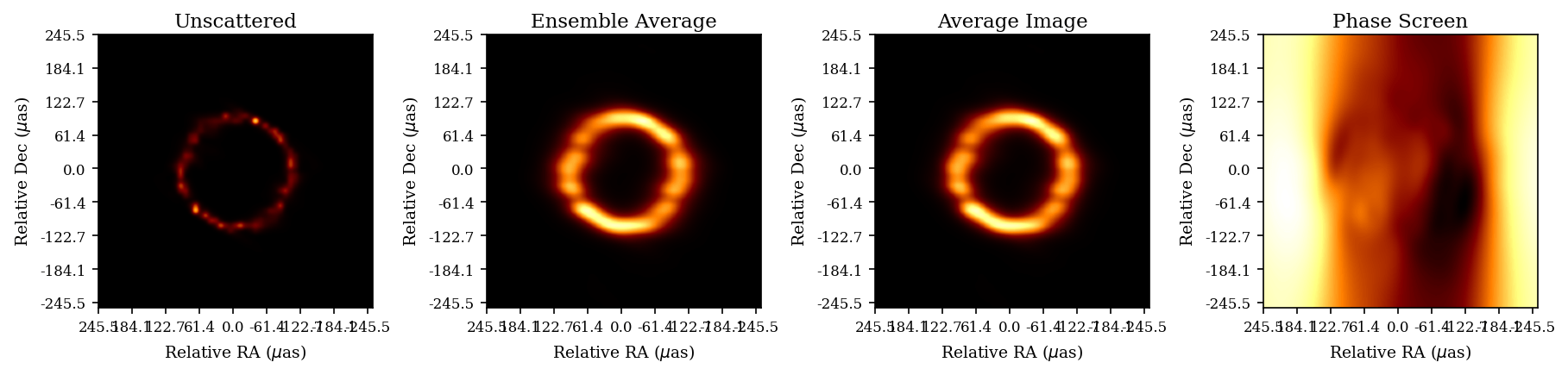
f_{obs}=150\text{ GHz}
- Introduction
- Science Traceability Matrix
- Primary Science Objectives
- SWaPC Requirements
- NASA Mission Life Cycle
- Work Breakdown Structure (WBS)
- Critical Mission Parameters
- Preliminary Concept of Operations
- Expected Data Products
- Funding & Timeline
T-REX
- Introduction
- Science Traceability Matrix
- Primary Science Objectives
- SWaPC Requirements
- NASA Mission Life Cycle
- Work Breakdown Structure (WBS)
- Critical Mission Parameters
- Preliminary Concept of Operations
- Expected Data Products
- Funding & Timeline
T-REX
Sub-milli arcsecond angular resolution:
Dual short and long baseline lengths
Decreased signal loss from LEO
Decreased radiation environment in LEO vs. MEO
22\mu as<\theta_{\text{BHEX-Mini}} < 1800 \mu as
5.6 G \lambda < b_{s s}<9.3 G \lambda
0.11 G \lambda < b_{s g}<3.5 G \lambda
T-REX
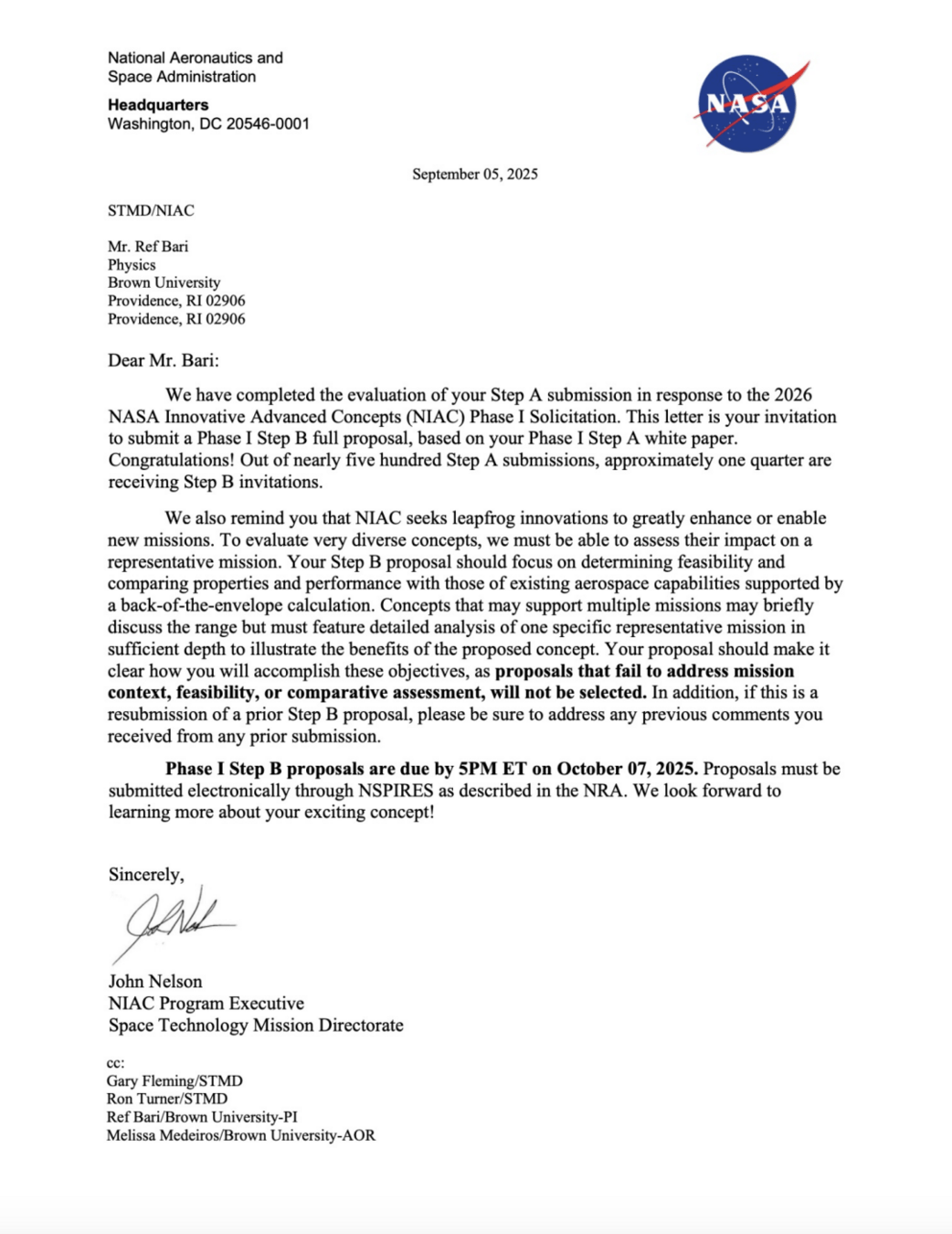
Oct

-
NASA NIAC Phase I
- Submitted: July 15
- Decision: Sep 6
$175,000
$60,000

-
Brown DSI Grant
- Submitted: Oct 15
- Decision: Dec 10

-
AAS Splinter Meeting
- Submitted: Sep 25
- Decision: Oct 30

-
CSA FAST Grant
- Submitted: Oct 26
- Decision: Dec 15
>$400,000
- Introduction
- What is a black hole?
- How do you image a black hole?
- How do you record a black hole?
- T-REX Primary Science Objectives
- T-REX (u,v) Coverage
- T-REX Engineering Challenges
- T-REX SWaPC Requirements
- T-REX Concept of Operations
- T-REX Timeline & Funding Deadlines
T-REX
T-REX
T-REX
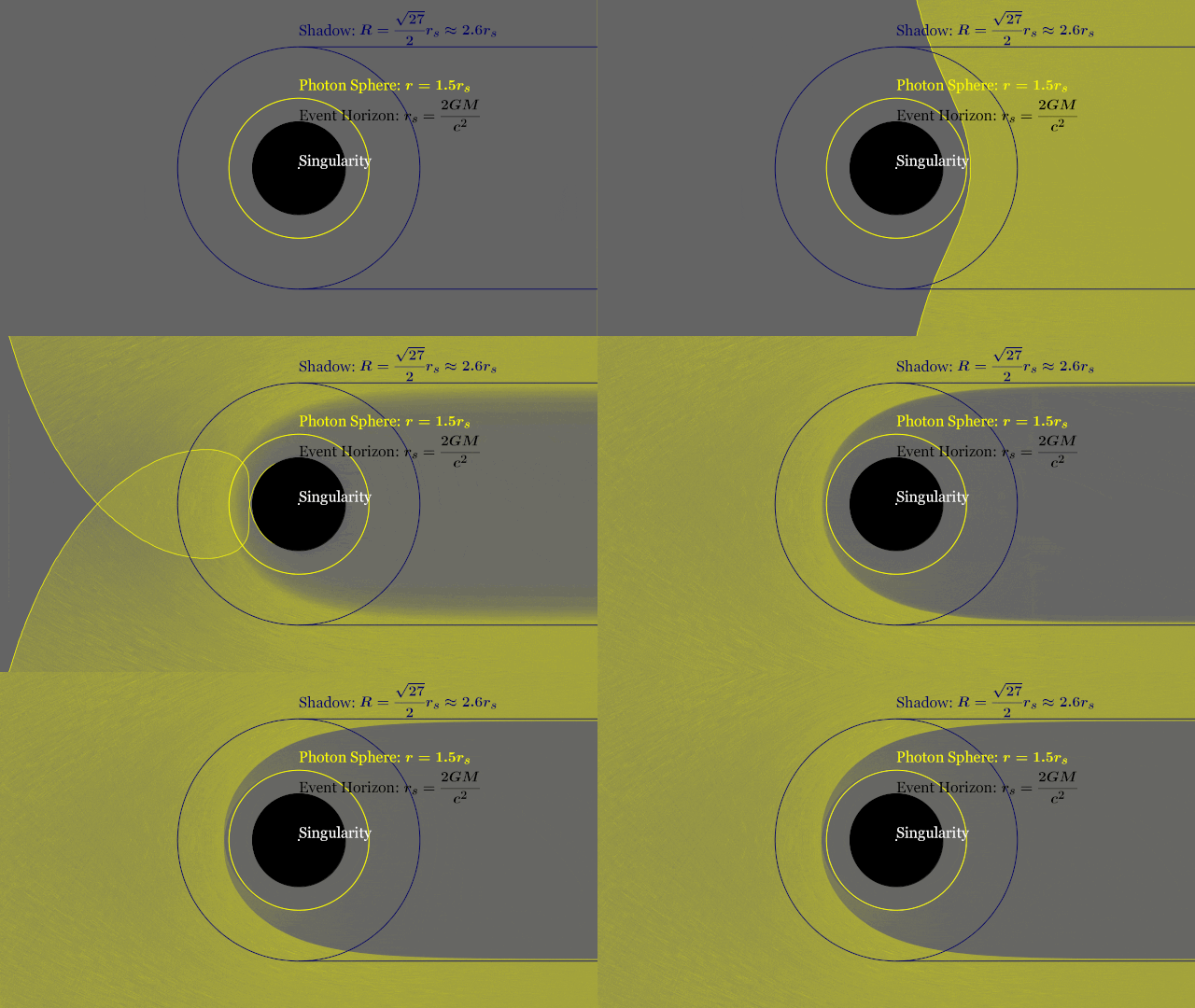
R
Event Horizon
Singularity
T-REX
R
Event Horizon
Singularity
Photon Sphere
1.5R
T-REX
R
Event Horizon
Black Hole Shadow
1.5R
Photon Ring
2.6R_s
T-REX
R
Event Horizon
Black Hole Shadow
1.5R_s
Photon Ring
2.6R_s
Innermost Stable
Circular Orbit
3R_s
T-REX
ds^2 = -\left(1-\frac{2M}{R}\right)dt^2 + -\left(1-\frac{2M}{R}\right)^{-1}dr^2 + r^2 d\Omega^2
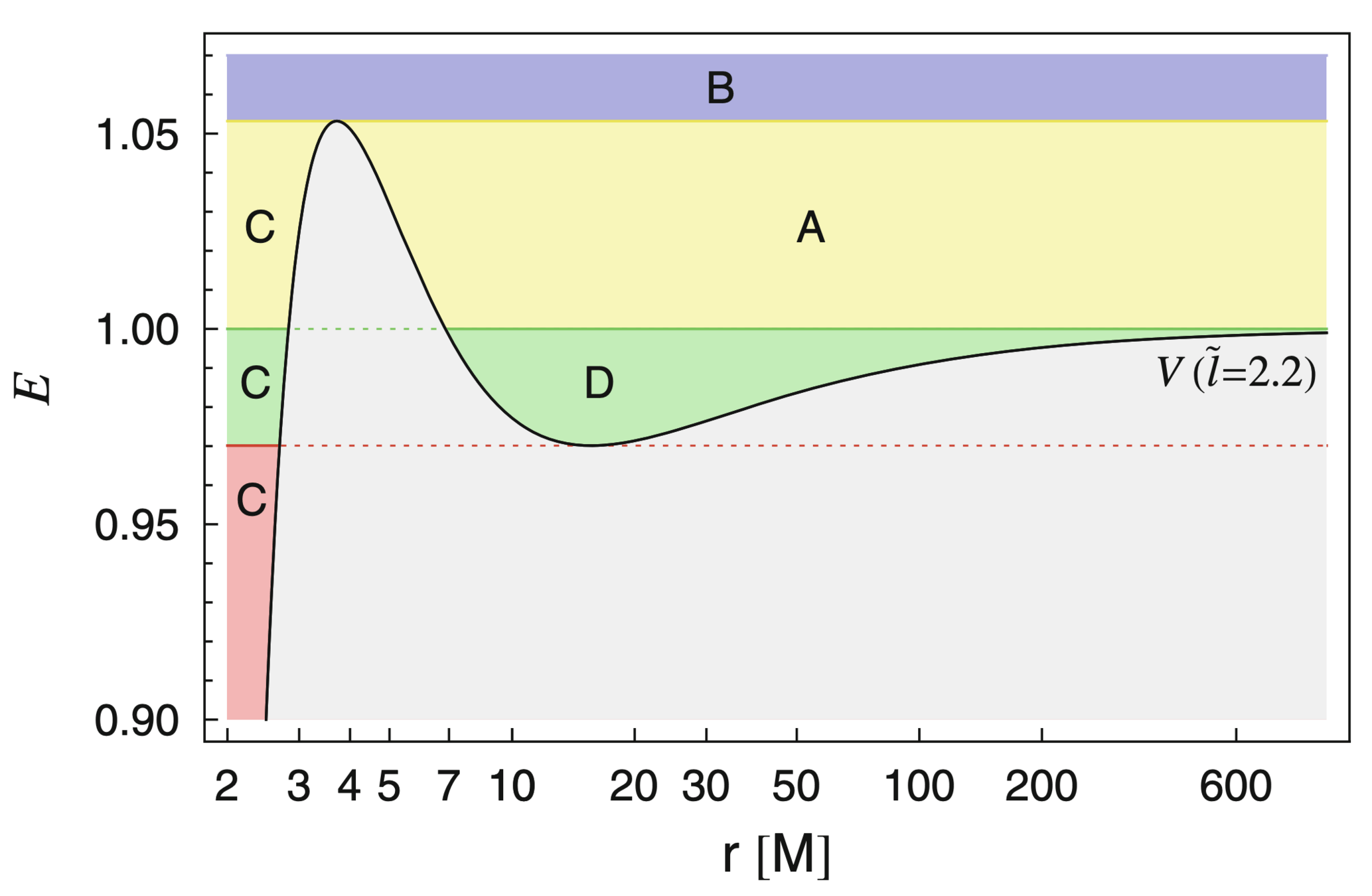
p^\mu p_\mu = -m^2 \to \left(\frac{dr}{d\tau}\right)^2=E^2-\left(1-\frac{2M}{r} \right)\left(1+ \frac{L^2}{r^2}\right)
Event Horizon
Photon Ring
Shadow
ISCO
T-REX
ds^2 = -\left(1-\frac{2M}{R}\right)dt^2 + -\left(1-\frac{2M}{R}\right)^{-1}dr^2 + r^2 d\Omega^2
p^\mu p_\mu = -m^2 \to \left(\frac{dr}{d\tau}\right)^2=E^2-\left(1-\frac{2M}{r} \right)\left(1+ \frac{L^2}{r^2}\right)
Event Horizon
Photon Ring
Shadow
ISCO
T-REX
ds^2 = -\left(1-\frac{2M}{R}\right)dt^2 + -\left(1-\frac{2M}{R}\right)^{-1}dr^2 + r^2 d\Omega^2
p^\mu p_\mu = -m^2 \to \left(\frac{dr}{d\tau}\right)^2=E^2-\left(1-\frac{2M}{r} \right)\left(1+ \frac{L^2}{r^2}\right)
Event Horizon
Photon Ring
Shadow
ISCO
Photon Ring
T-REX
ds^2 = -\left(1-\frac{2M}{R}\right)dt^2 + -\left(1-\frac{2M}{R}\right)^{-1}dr^2 + r^2 d\Omega^2
p^\mu p_\mu = -m^2 \to \left(\frac{dr}{d\tau}\right)^2=E^2-\left(1-\frac{2M}{r} \right)\left(\frac{L^2}{r^2}\right)
Event Horizon
Photon Ring
Shadow
ISCO
Photon Ring
T-REX
ds^2 = -\left(1-\frac{2M}{R}\right)dt^2 + -\left(1-\frac{2M}{R}\right)^{-1}dr^2 + r^2 d\Omega^2
p^\mu p_\mu = -m^2 \to \left(\frac{dr}{d\tau}\right)^2=E^2-\left(1-\frac{2M}{r} \right)\left(1+\frac{L^2}{r^2}\right)
Event Horizon
Photon Ring
Shadow
ISCO
ISCO
T-REX
R
T-REX
T-REX
- Introduction
- What is a black hole?
- How do you image a black hole?
- How do you record a black hole?
- T-REX Primary Science Objectives
- T-REX (u,v) Coverage
- T-REX Engineering Challenges
- T-REX SWaPC Requirements
- T-REX Concept of Operations
- T-REX Timeline & Funding Deadlines
T-REX
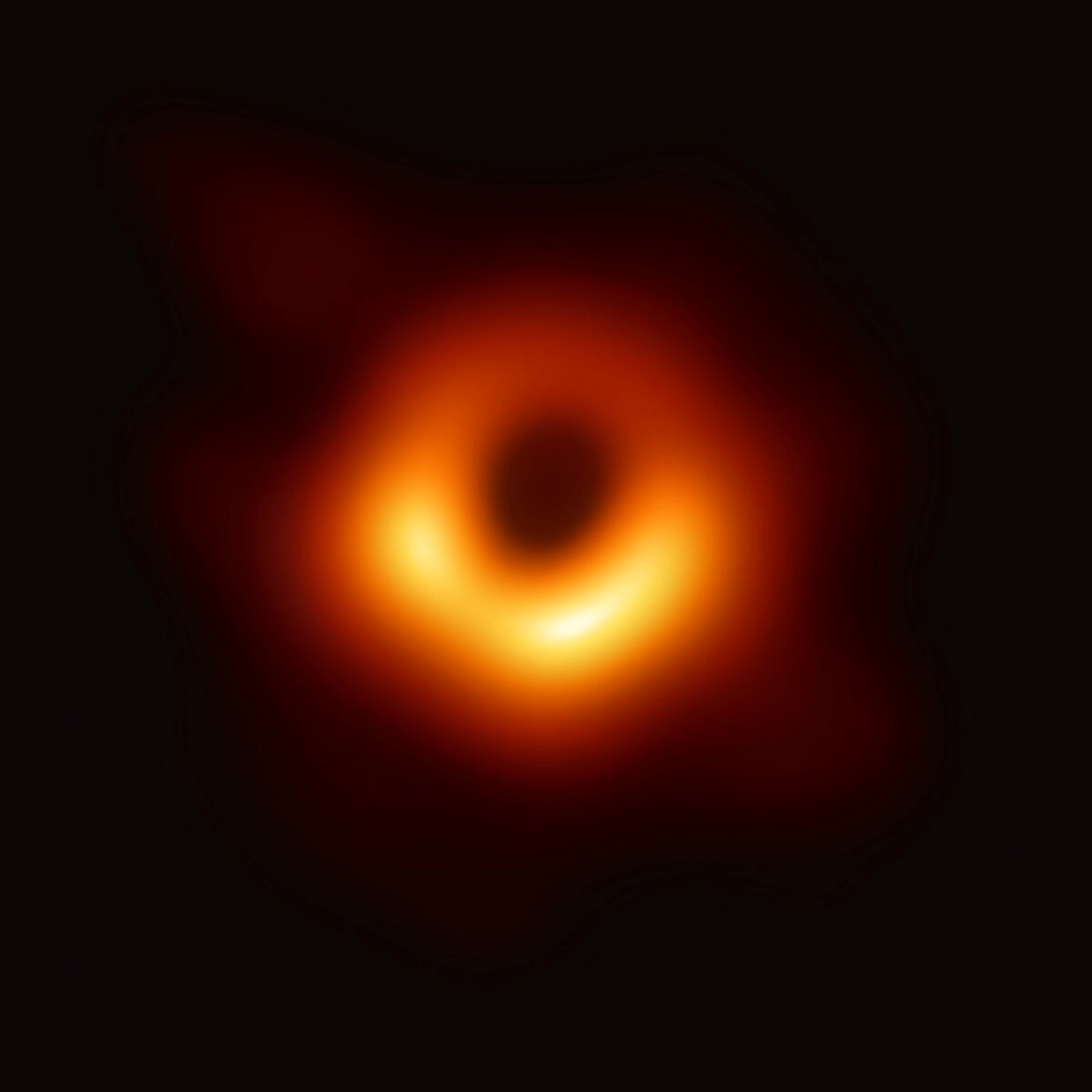
M87
T-REX
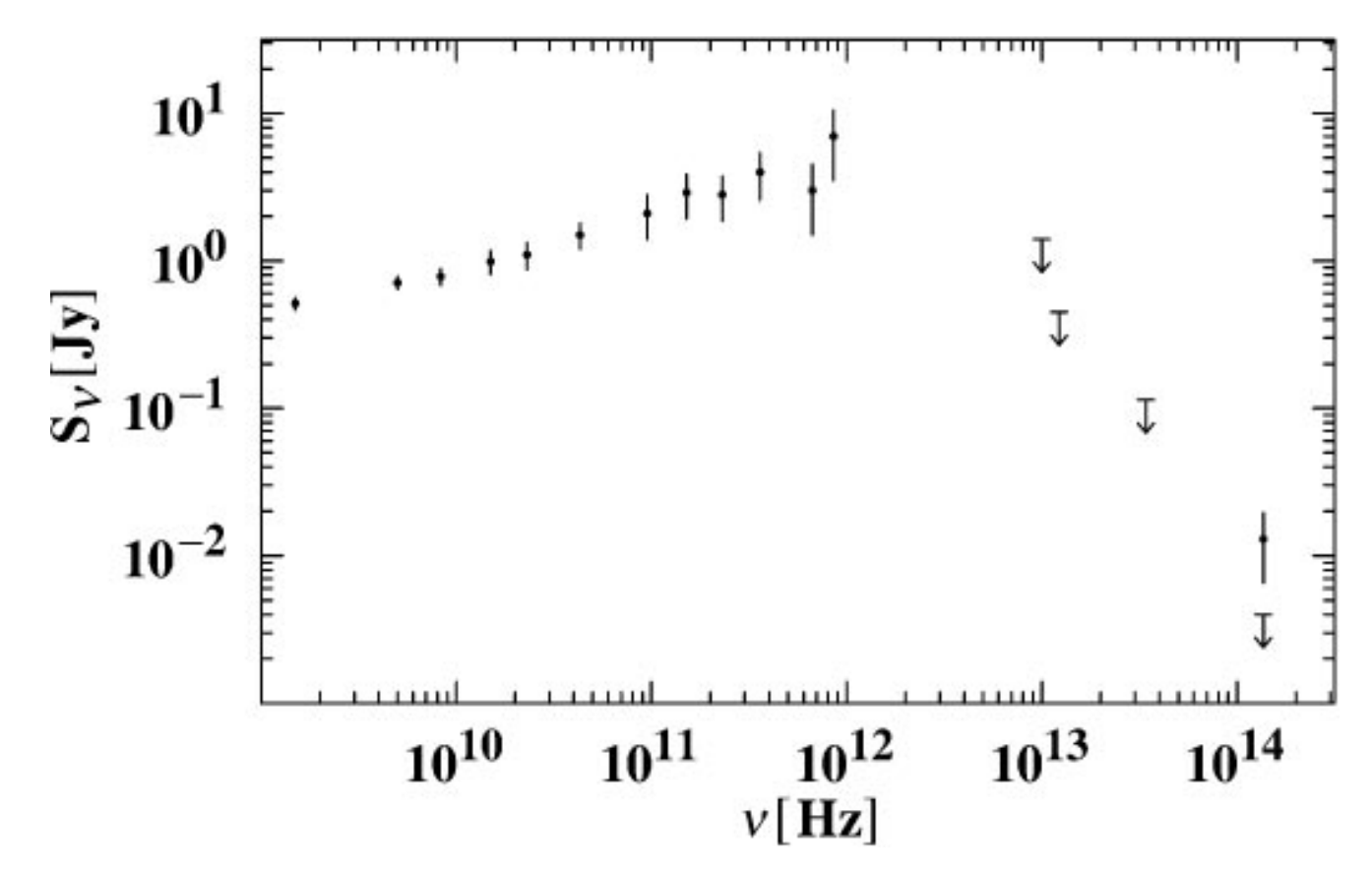
SED, Sgr A*
The Supermassive Black Hole at the Galactic Center (Melia & Falcke, 2001)
The Supermassive Black Hole at the Galactic Center (Melia & Falcke, 2001)
T-REX
Spectral Energy Distribution (Sgr A*)
The Supermassive Black Hole at the Galactic Center (Melia & Falcke, 2001)
The Supermassive Black Hole at the Galactic Center (Melia & Falcke, 2001)
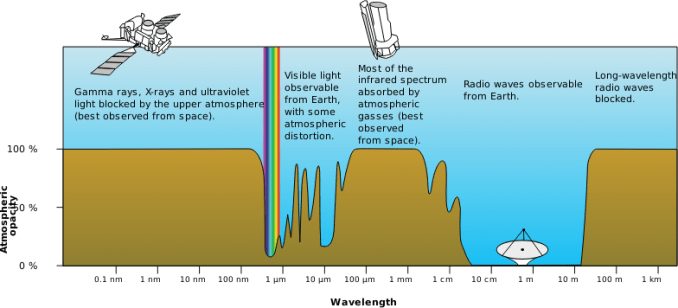
radio
infrared
T-REX
SED, Sgr A*
The Supermassive Black Hole at the Galactic Center (Melia & Falcke, 2001)
The Supermassive Black Hole at the Galactic Center (Melia & Falcke, 2001)
T-REX
SED, Sgr A*
The Supermassive Black Hole at the Galactic Center (Melia & Falcke, 2001)
\theta\sim \frac{\lambda}{D}
\sim 50\mu as
T-REX
\sim 50\mu as

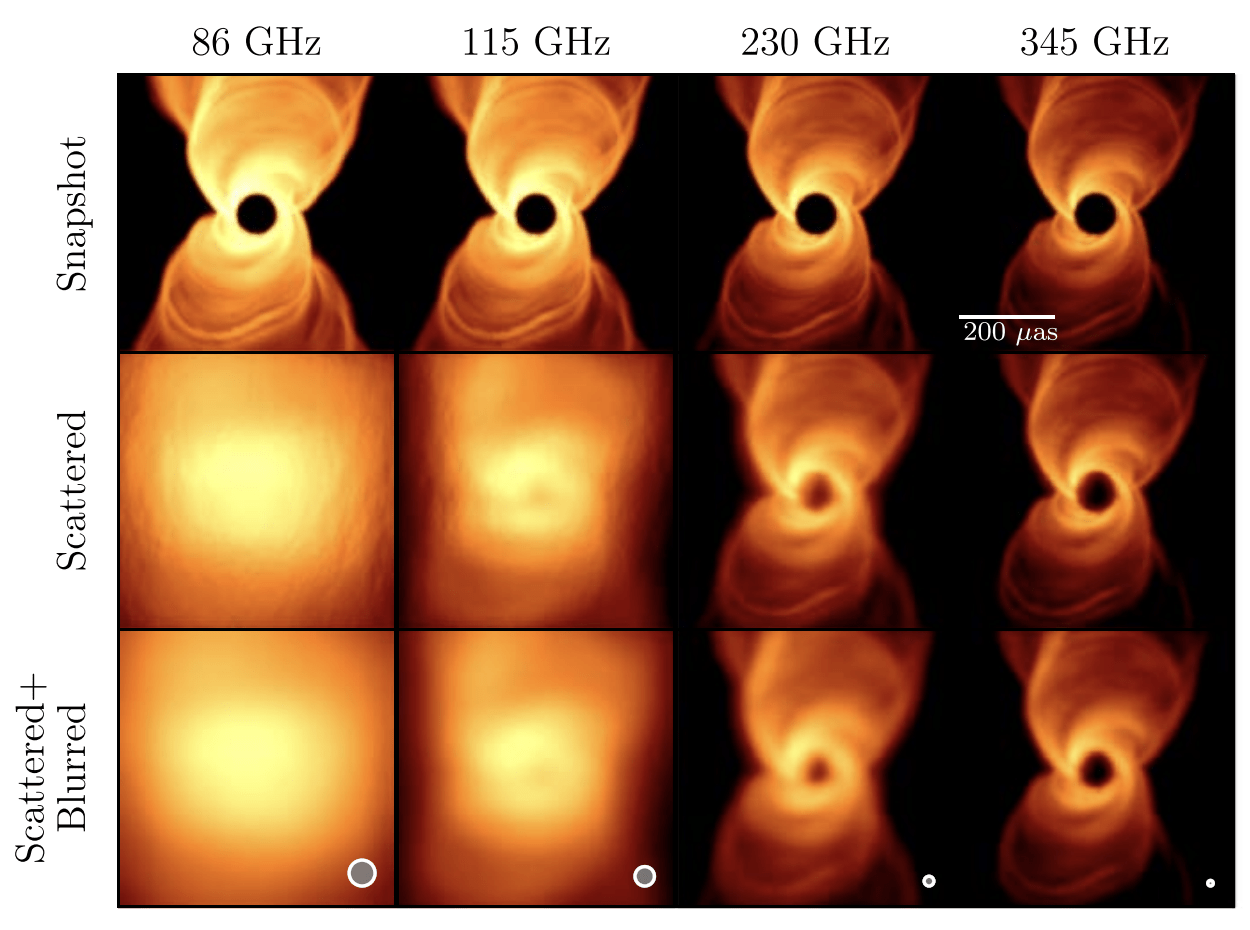
T-REX
\sim 50\mu as
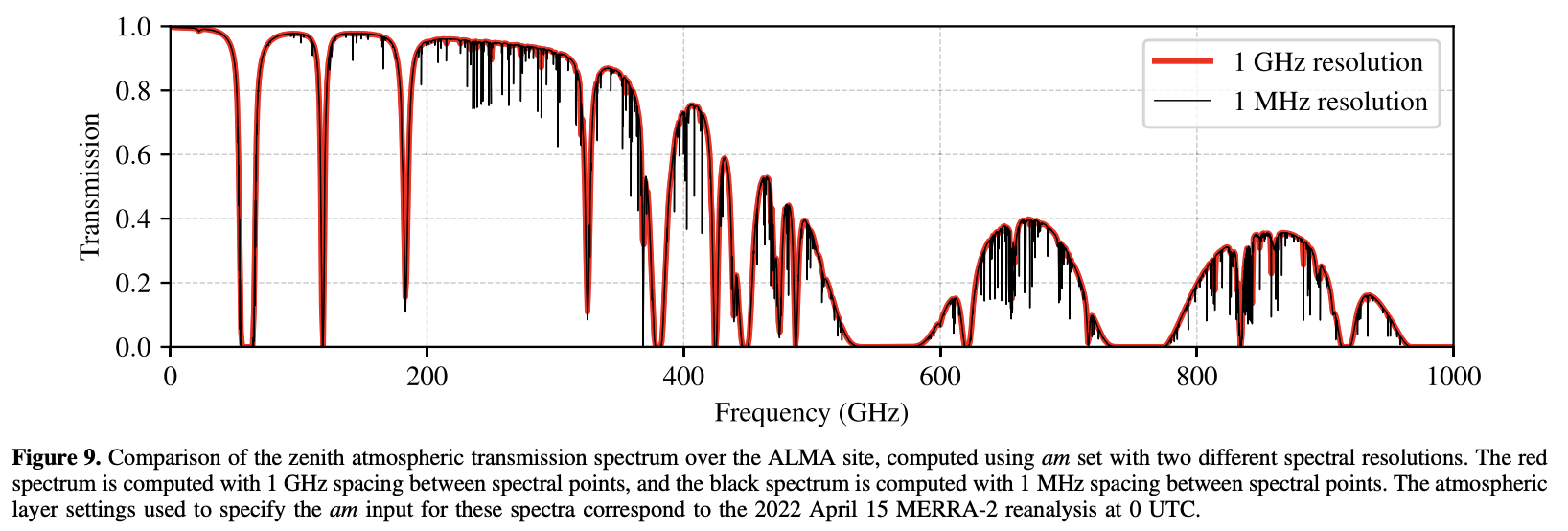
T-REX
SED, Sgr A*
The Supermassive Black Hole at the Galactic Center (Melia & Falcke, 2001)
\theta\sim \frac{\lambda}{D}
\sim 50\mu as
T-REX
T-REX
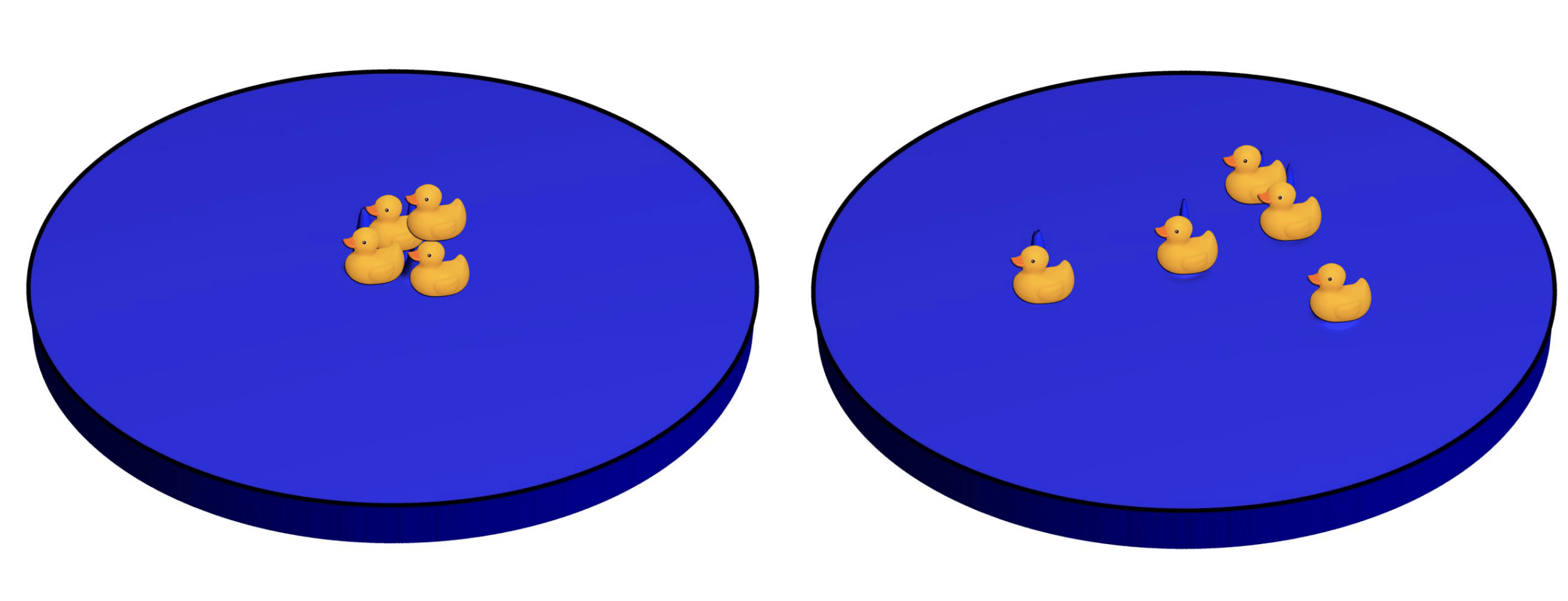
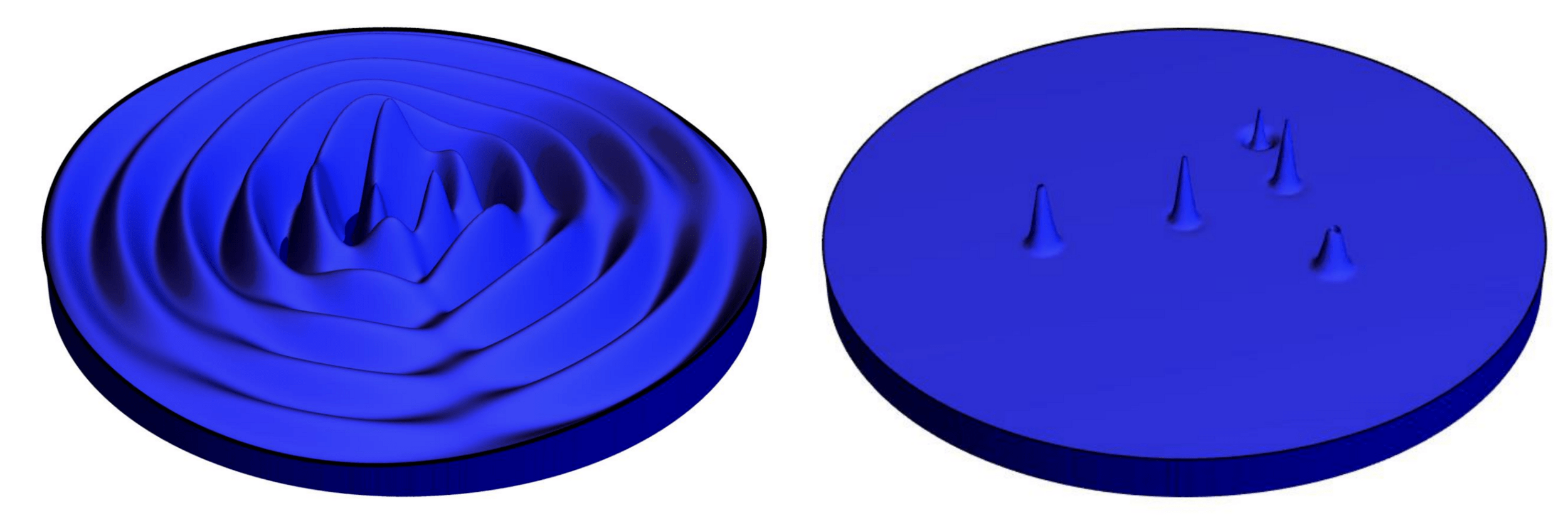
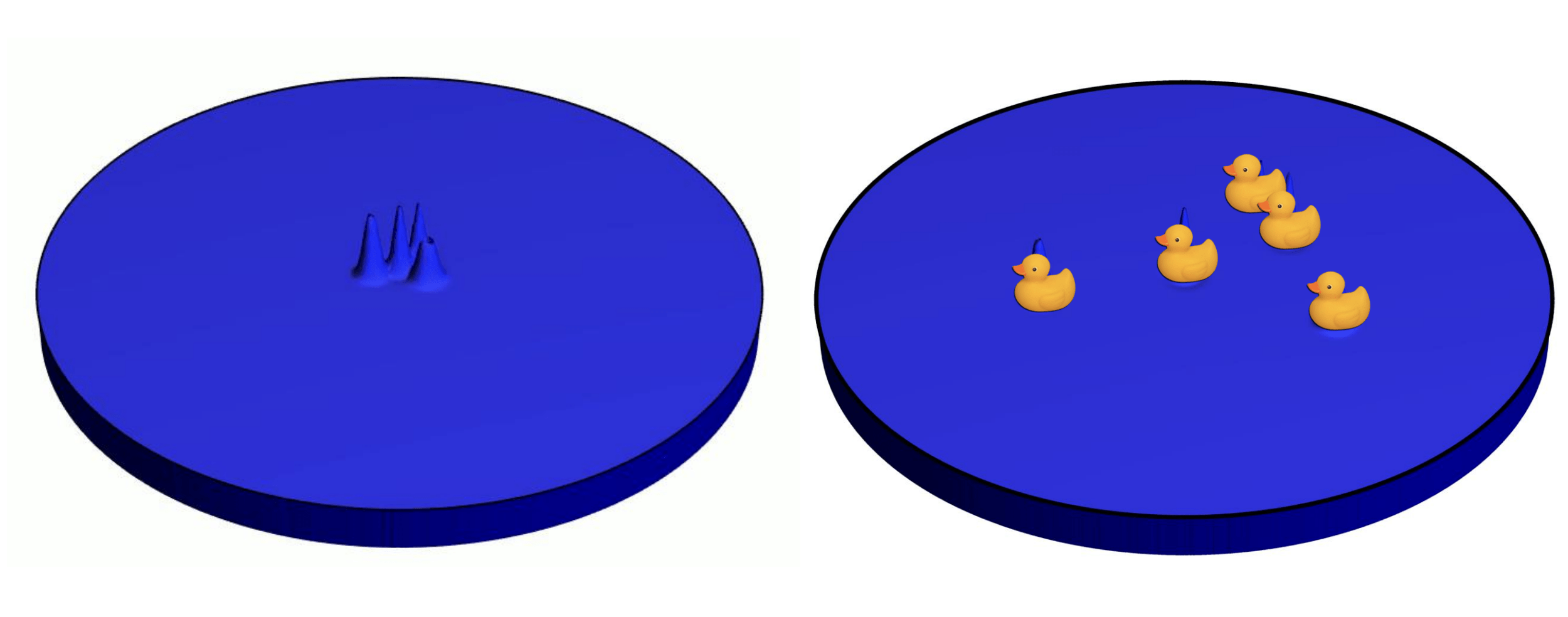
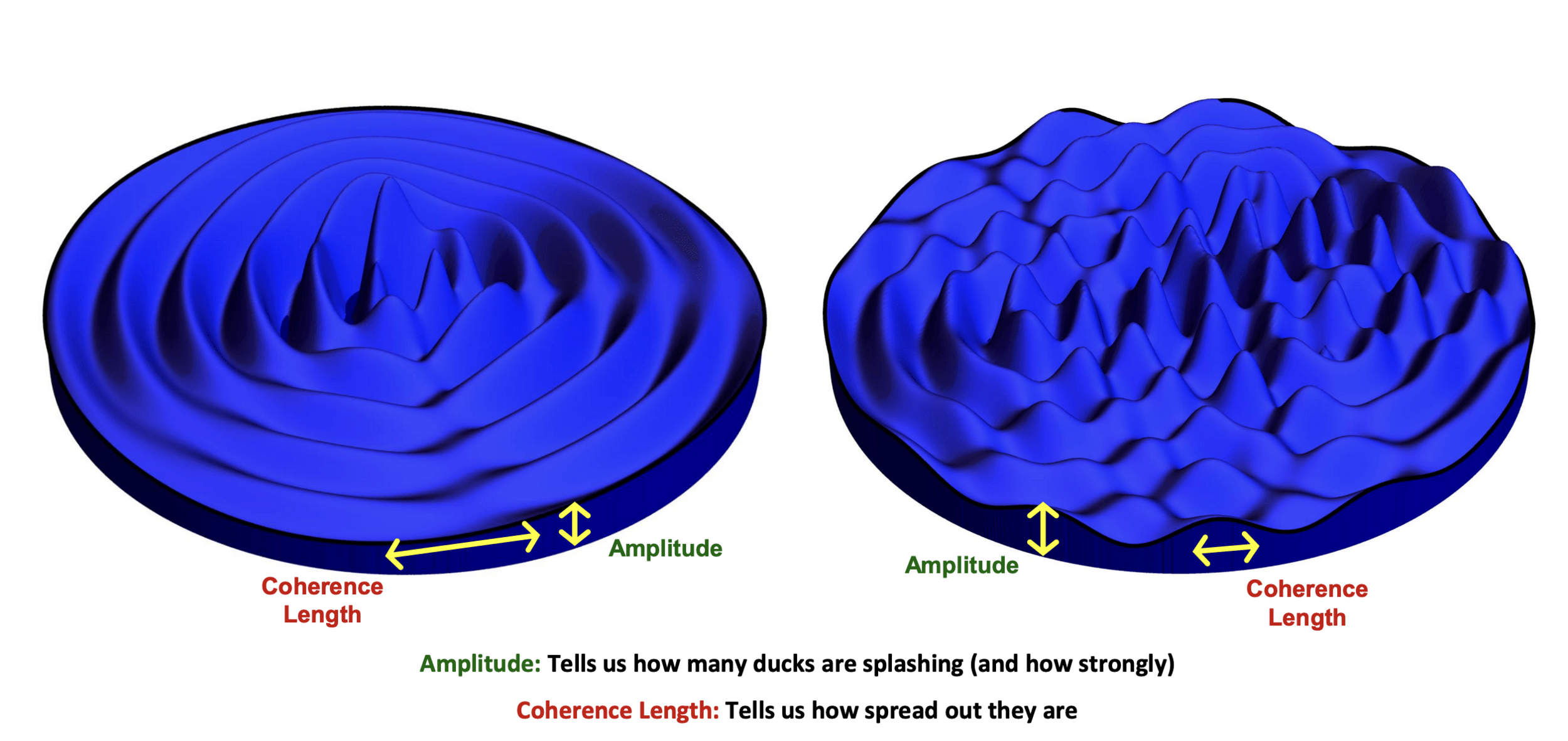
Knox et al., “Spatial coherence from ducks”, Physics Today, March 2010
T-REX
T-REX
T-REX


T-REX
T-REX
E_1
E_2
T-REX
V(r_1 ,r_2)=\langle E_1^*
E_2\rangle
T-REX
V(r_1 ,r_2)=\langle E_1^*
E_2\rangle
T-REX
V(r_1 ,r_2)=\langle E_1^*
E_2\rangle
T-REX
V(r_1 ,r_2)=\langle E_1^*
E_2\rangle
T-REX
V(r_1 ,r_2)=\langle E_1^*
E_2\rangle
E_1
E_2
T-REX
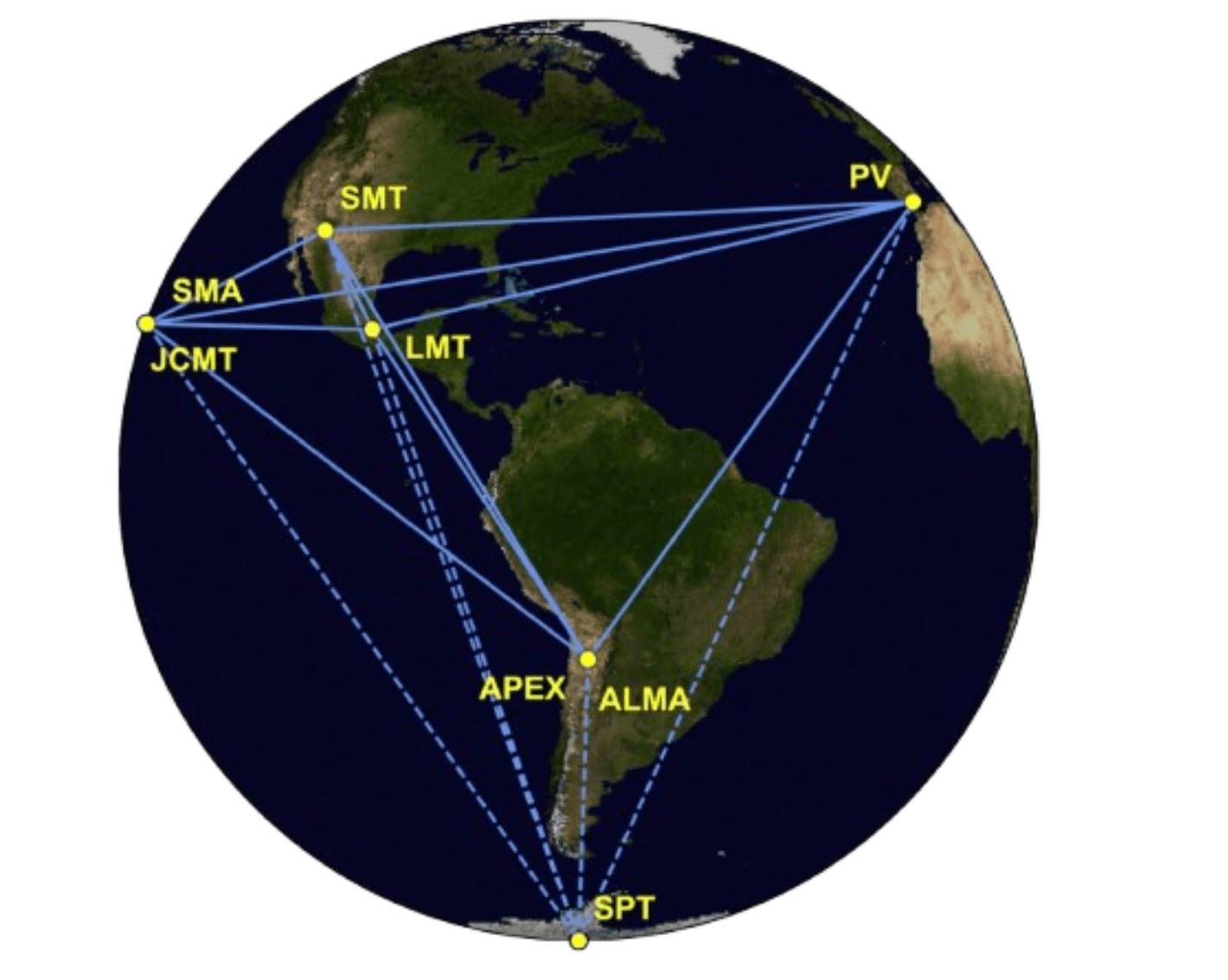
T-REX
T-REX
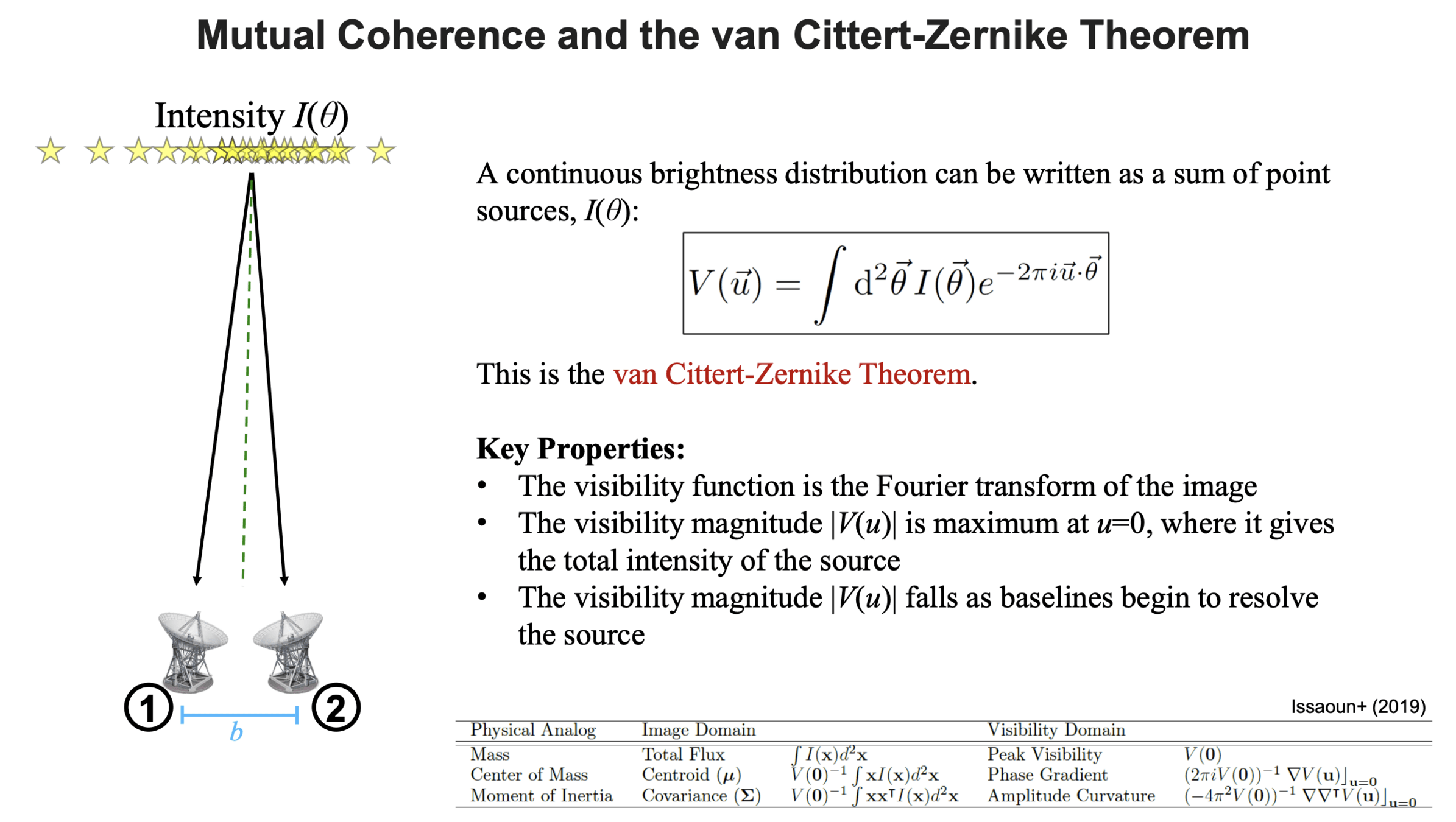
T-REX
T-REX
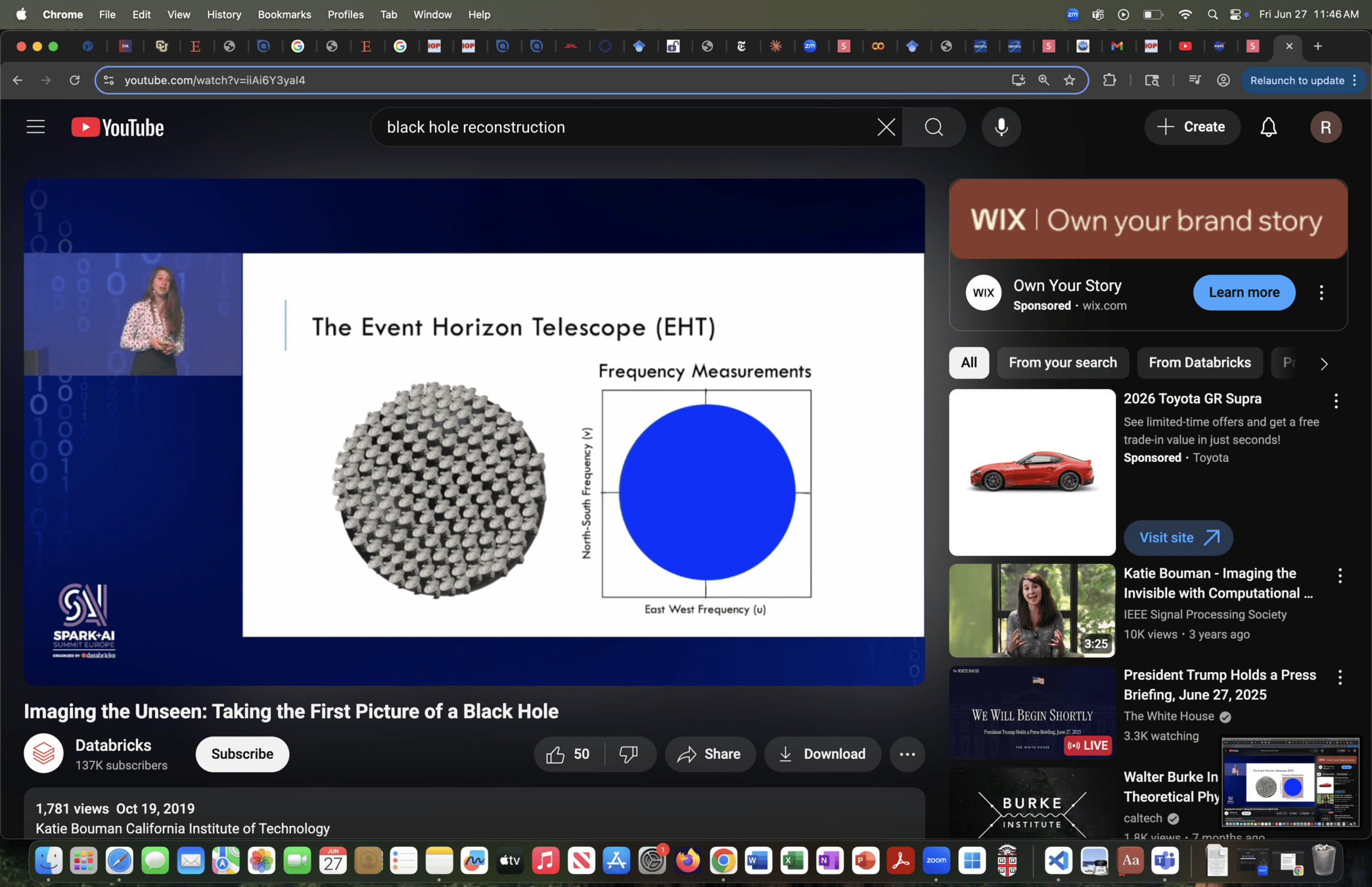
T-REX
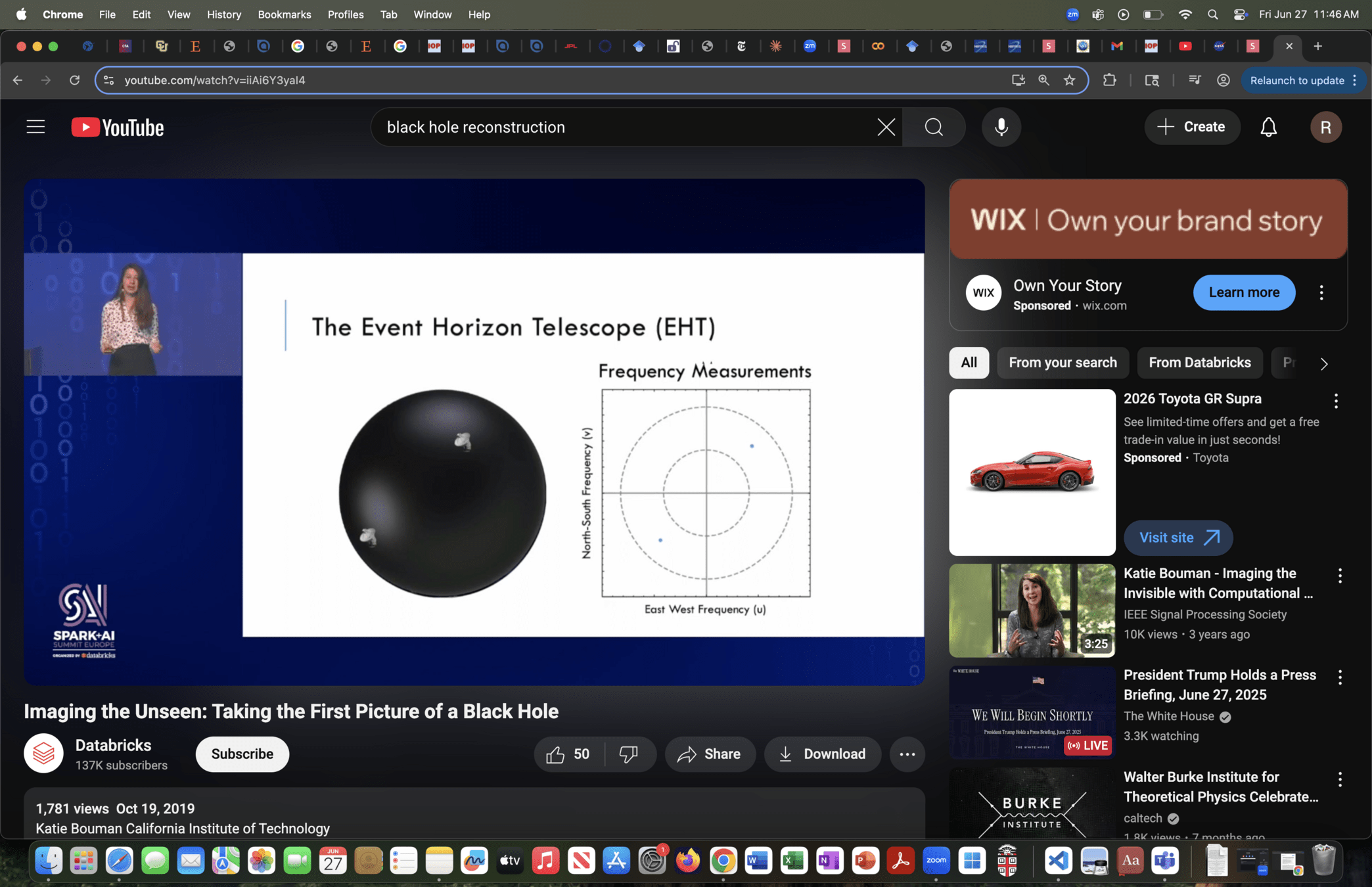
T-REX
T-REX
T-REX
EHT
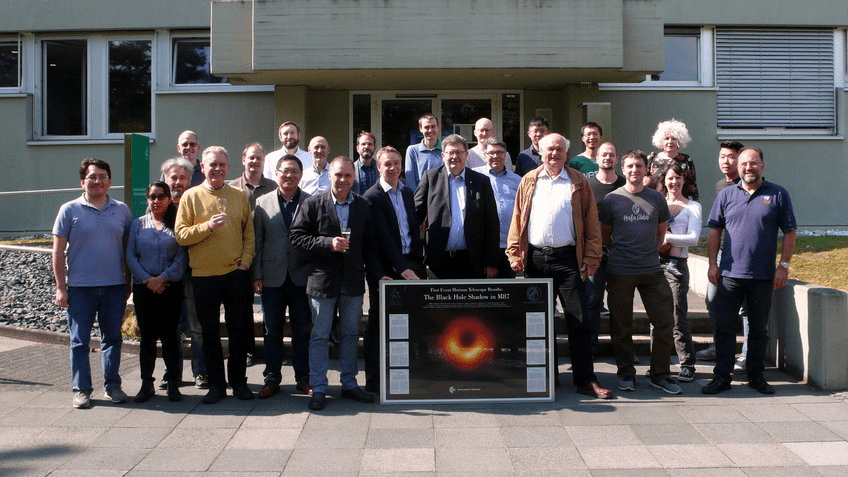
(2019)
Event Horizon Telescope (EHT)
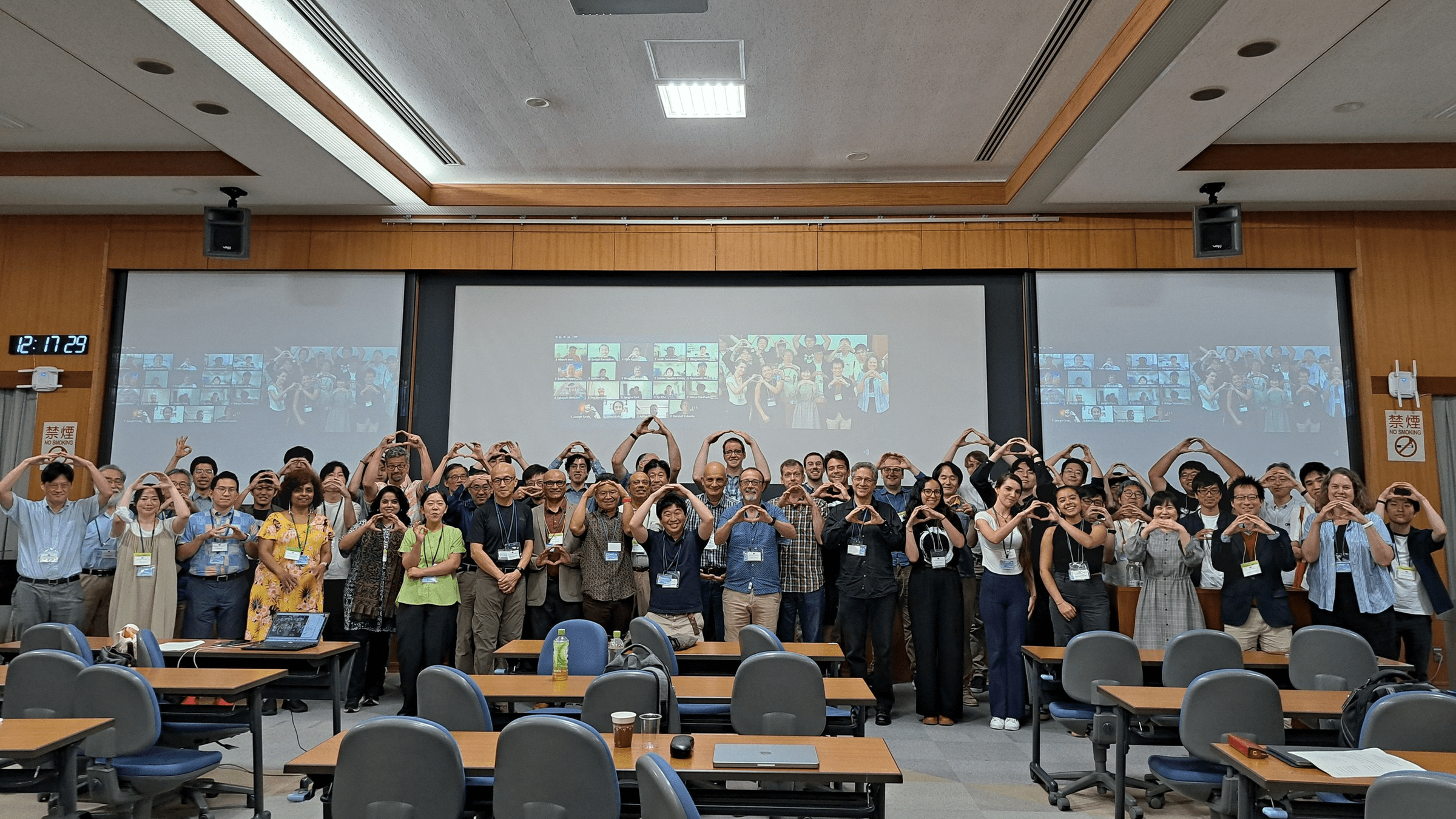
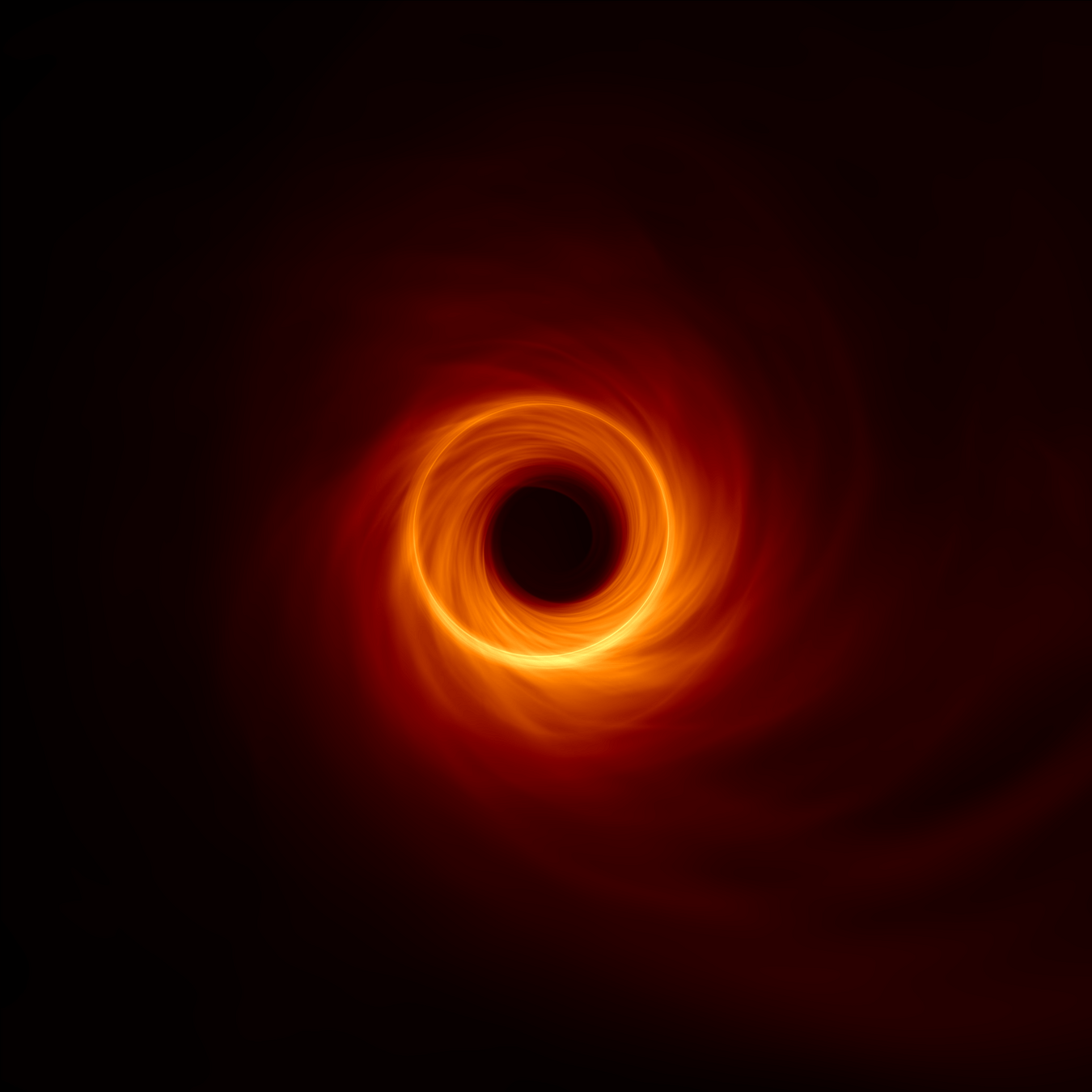
BHEX
(2031)
Black Hole Explorer Satellite (BHEX) Mission
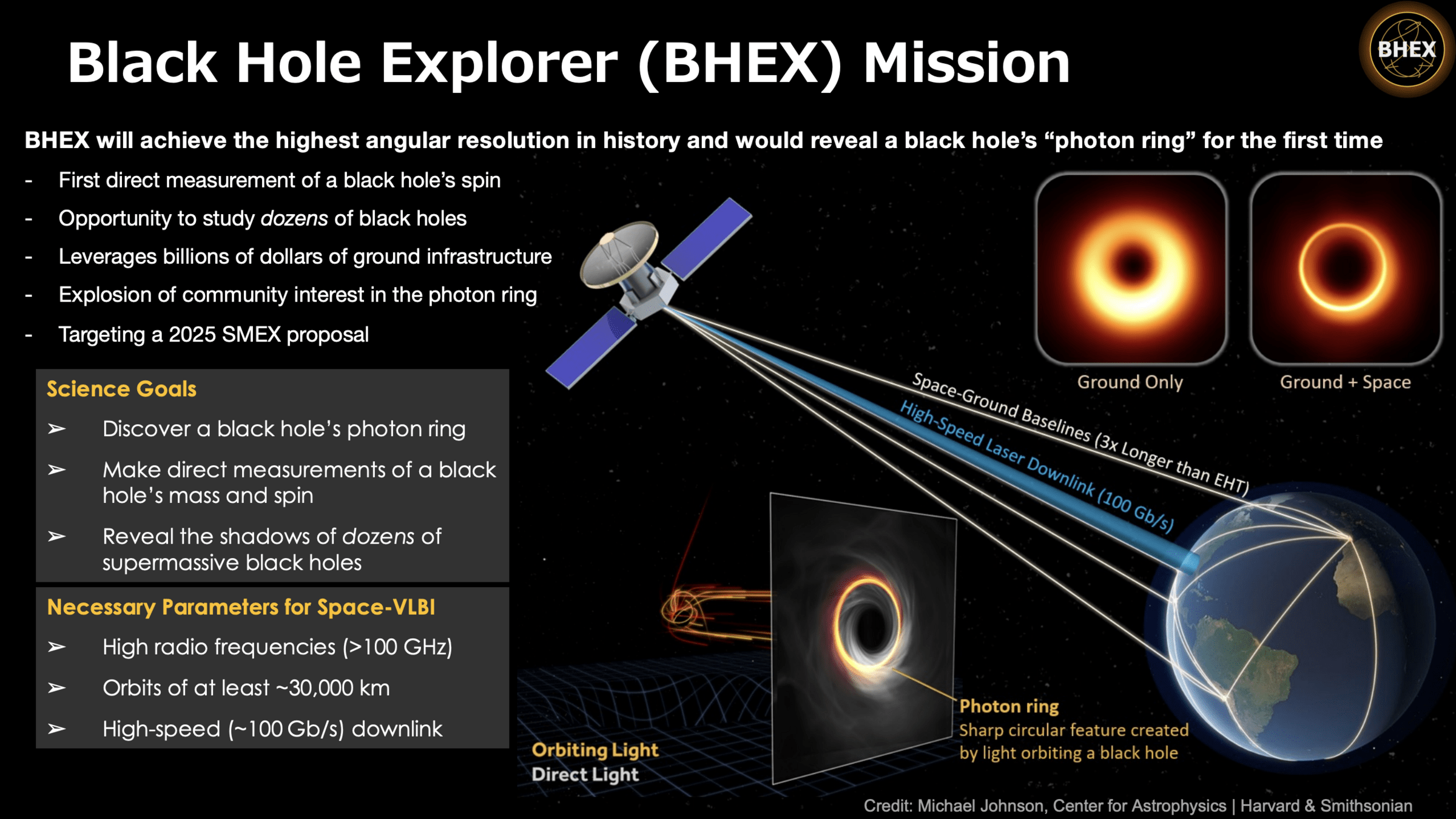
BHEX
- Introduction
- What is a black hole?
- How do you image a black hole?
- How do you record a black hole?
- T-REX Primary Science Objectives
- T-REX (u,v) Coverage
- T-REX Engineering Challenges
- T-REX SWaPC Requirements
- T-REX Concept of Operations
- T-REX Timeline & Funding Deadlines
T-REX
Sub-milli arcsecond angular resolution:
Dual short and long baseline lengths
Decreased signal loss from LEO
Decreased radiation environment in LEO vs. MEO
22\mu as<\theta_{\text{BHEX-Mini}} < 1800 \mu as
5.6 G \lambda < b_{s s}<9.3 G \lambda
0.11 G \lambda < b_{s g}<3.5 G \lambda
T-REX
Sub-milli arcsecond angular resolution:
Dual short and long baseline lengths
Rapid coverage of (u,v) plane
Decreased signal loss from LEO
Decreased radiation environment in LEO vs. MEO
22\mu as<\theta_{\text{BHEX-Mini}} < 1800 \mu as
5.6 G \lambda < b_{s s}<9.3 G \lambda
0.11 G \lambda < b_{s g}<3.5 G \lambda
T_{orb}=90 \text{ min}
- Time-scale of Sgr A* accretion disk: 4<T<30 minutes (0<J<1)
- Time-scale of LEO Orbit: 90 minutes, with 22-minute (u,v) coverage
T-REX
Sub-milli arcsecond angular resolution:
Dual short and long baseline lengths
Decreased signal loss from LEO
Decreased radiation environment in LEO vs. MEO
22\mu as<\theta_{\text{BHEX-Mini}} < 1800 \mu as
5.6 G \lambda < b_{s s}<9.3 G \lambda
0.11 G \lambda < b_{s g}<3.5 G \lambda
T-REX
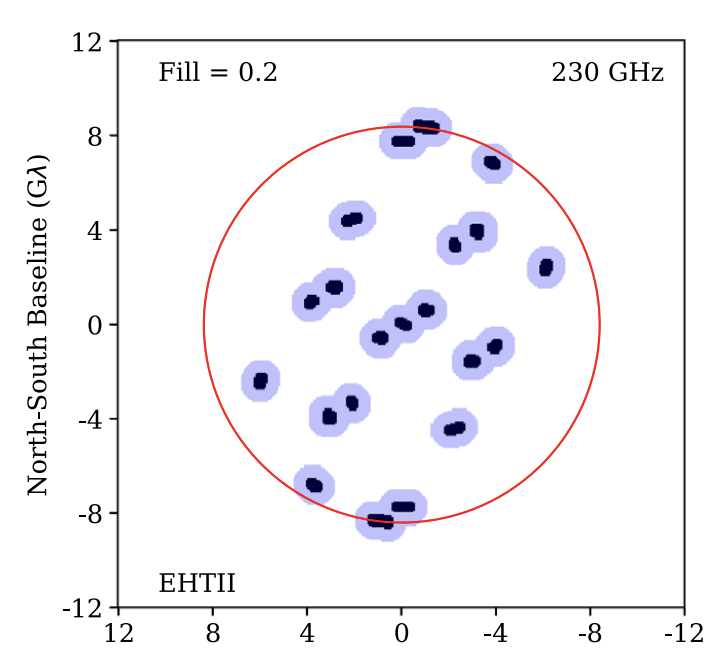
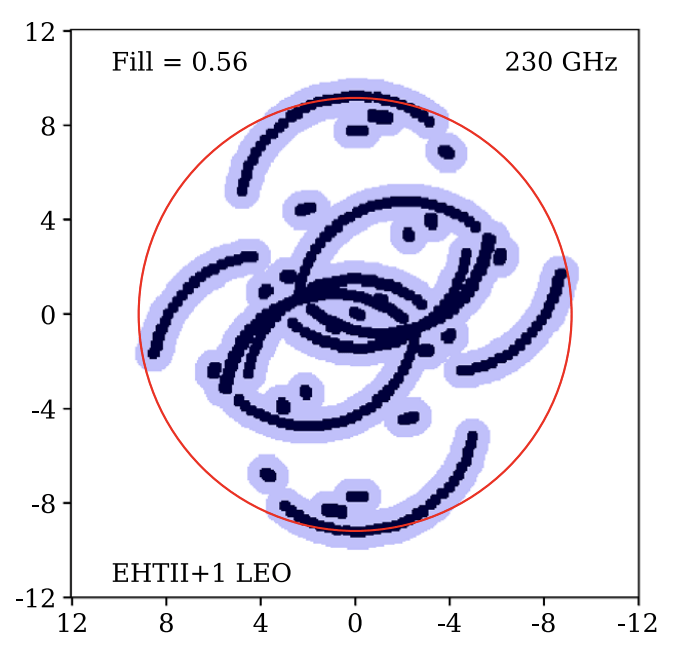
\text{To time resolve Sgr A*, we must have} \\f_{coverage}>50\% \text{ in } t < T_{ISCO} \sim 30 \text{ min}
- Introduction
- What is a black hole?
- How do you image a black hole?
- How do you record a black hole?
- T-REX Primary Science Objectives
- T-REX (u,v) Coverage
- T-REX Engineering Challenges
- T-REX SWaPC Requirements
- T-REX Concept of Operations
- T-REX Timeline & Funding Deadlines
T-REX
T-REX
Capture Time-Resolved Videos of M87 & Sgr A*
Time-Resolve Binary Black Hole Systems
Conduct VLBI Survey of AGN targets at 86 GHz
T-REX
Capture Time-Resolved Videos of M87 & Sgr A*
Time-Resolve Binary Black Hole Systems
Conduct VLBI Survey of AGN targets at 86 GHz
T-REX
Supplement (u,v) coverage at 86 GHz
Enable parameter estimation of Sgr A*/M87
400\text{ km}
Capture Time-Resolved Videos of M87 & Sgr A*
"Metrics and Motivations for Earth–Space VLBI: Time-resolving Sgr A* with the Event Horizon Telescope" Palumbo et. al. ApJ 2019
T-REX
T-REX
"Metrics and Motivations for Earth–Space VLBI: Time-resolving Sgr A* with the Event Horizon Telescope" Palumbo et. al. ApJ 2019
T-REX
"Metrics and Motivations for Earth–Space VLBI: Time-resolving Sgr A* with the Event Horizon Telescope" Palumbo et. al. ApJ 2019
T-REX
T-REX
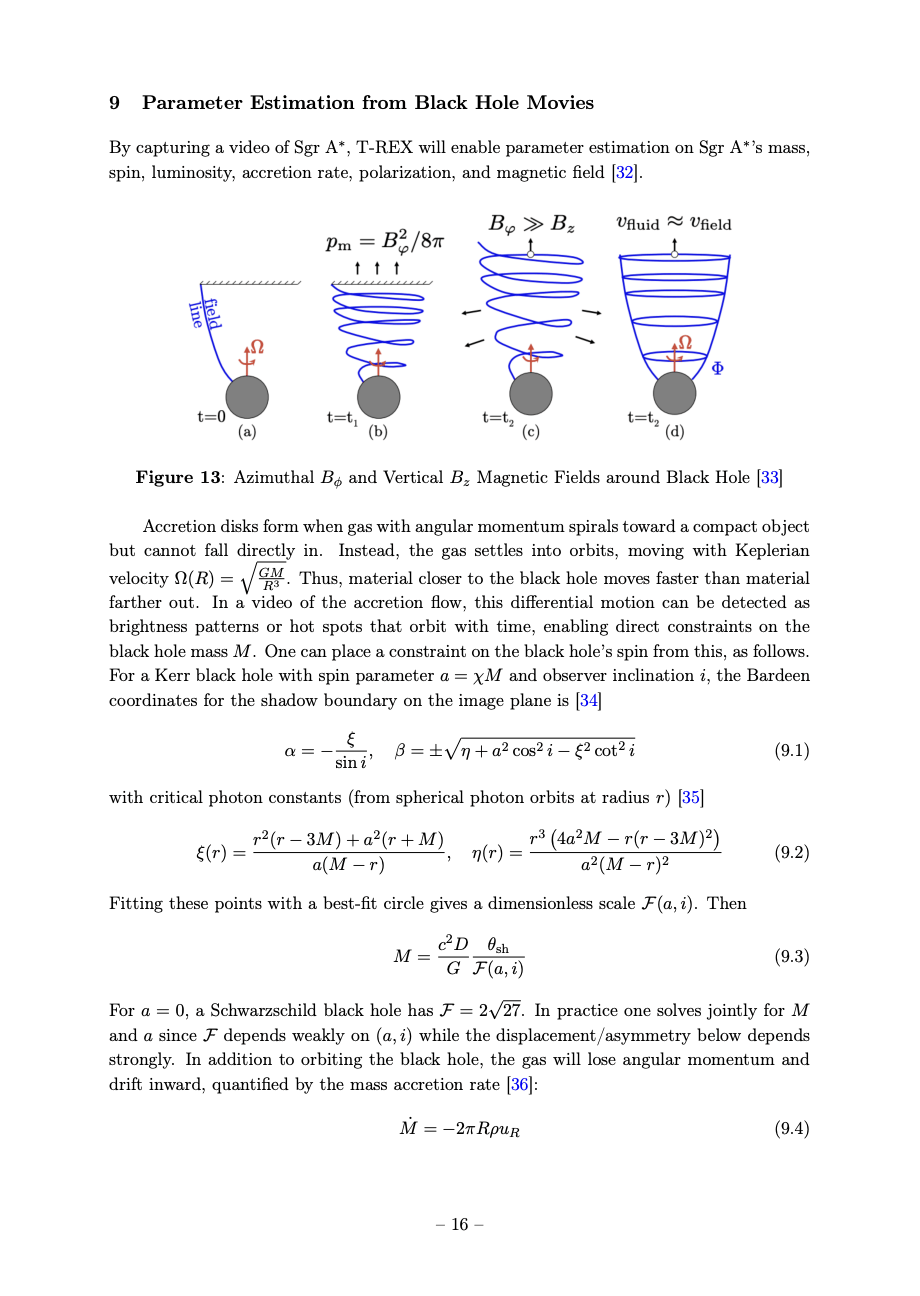
$$\alpha=-\frac{\xi}{\sin i}, \quad \beta= \pm \sqrt{\eta+a^2 \cos ^2 i-\xi^2 \cot ^2 i}$$
$$M=\frac{c^2 D}{G} \frac{\theta_{sh}}{\mathcal{F}(a, i)}$$
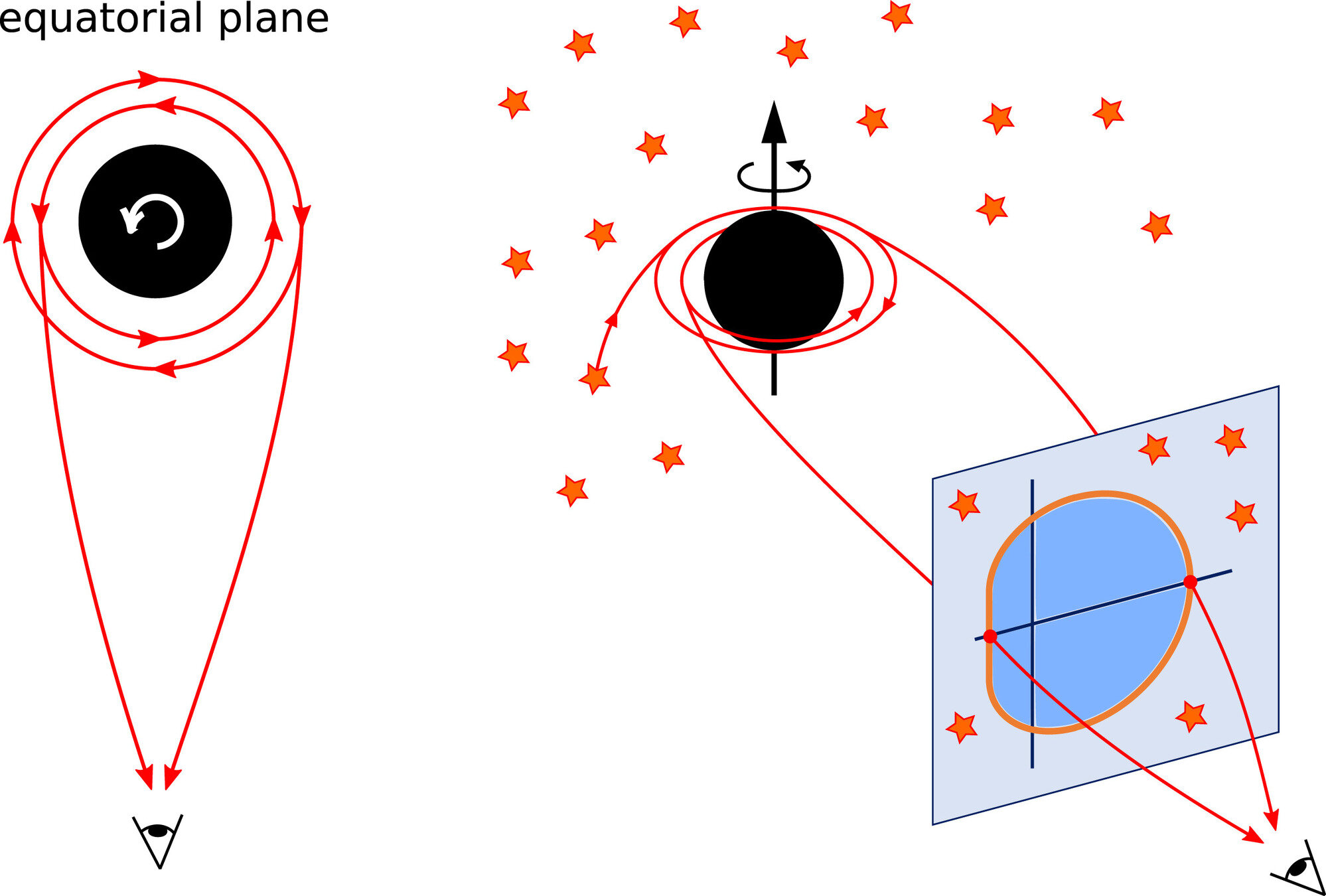
\xi=\xi(r, M, a), \, \, \, \, \eta=\eta(r, M, a)
T-REX
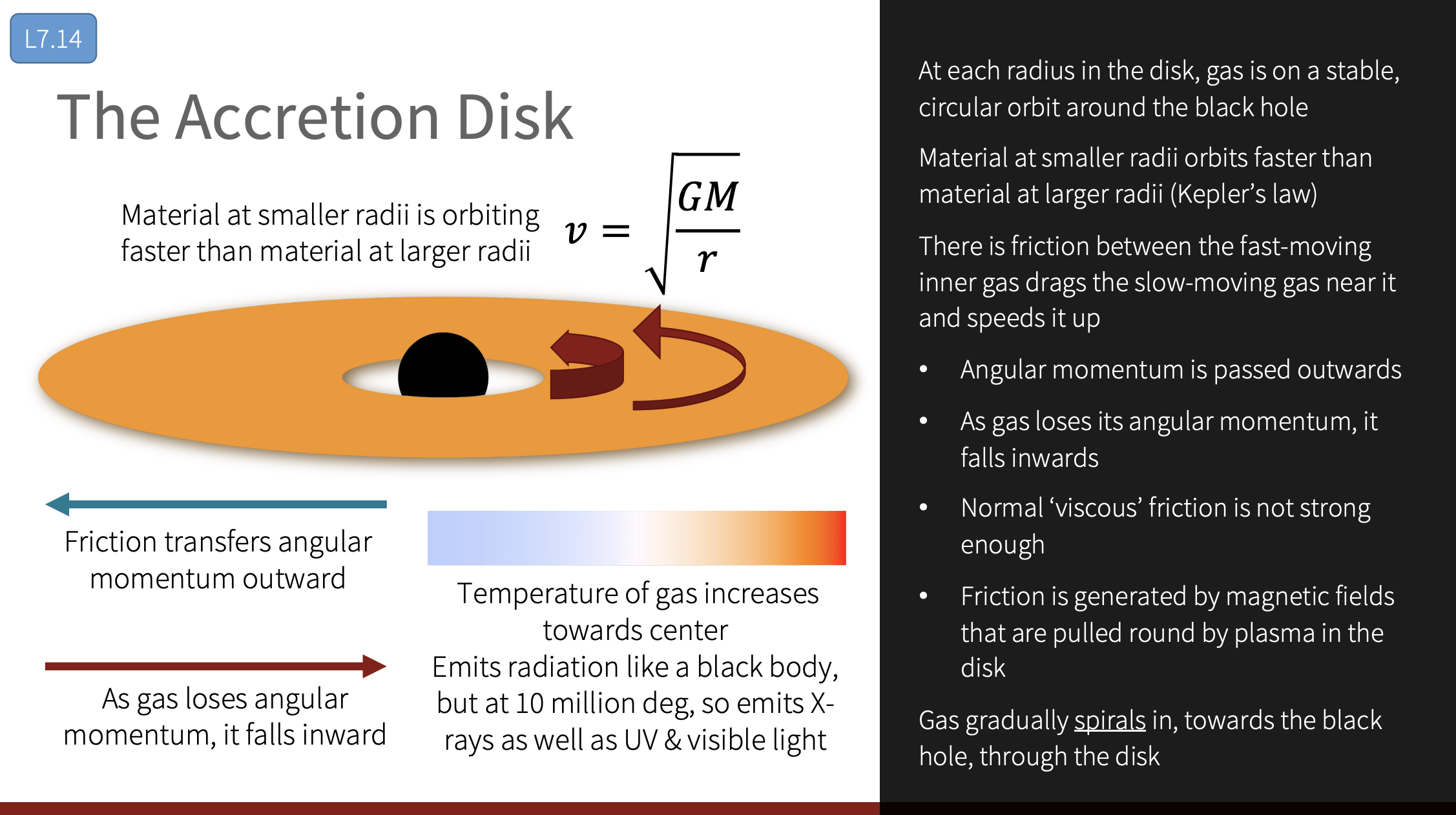
\dot{M} = -2\pi R \rho u_R
T(R) = 2\pi \nu \rho R^3 \frac{d\Omega}{dR}
\Omega(R) = \sqrt{\frac{GM}{R^3}}
T-REX
Supplement (u,v) coverage at 86 GHz
Enable parameter estimation of Sgr A*/M87
Achieve Space-Space VLBI
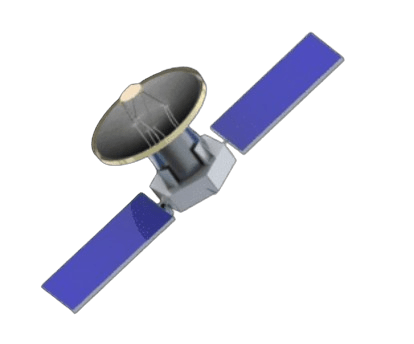
20,200\text{ km}
400\text{ km}
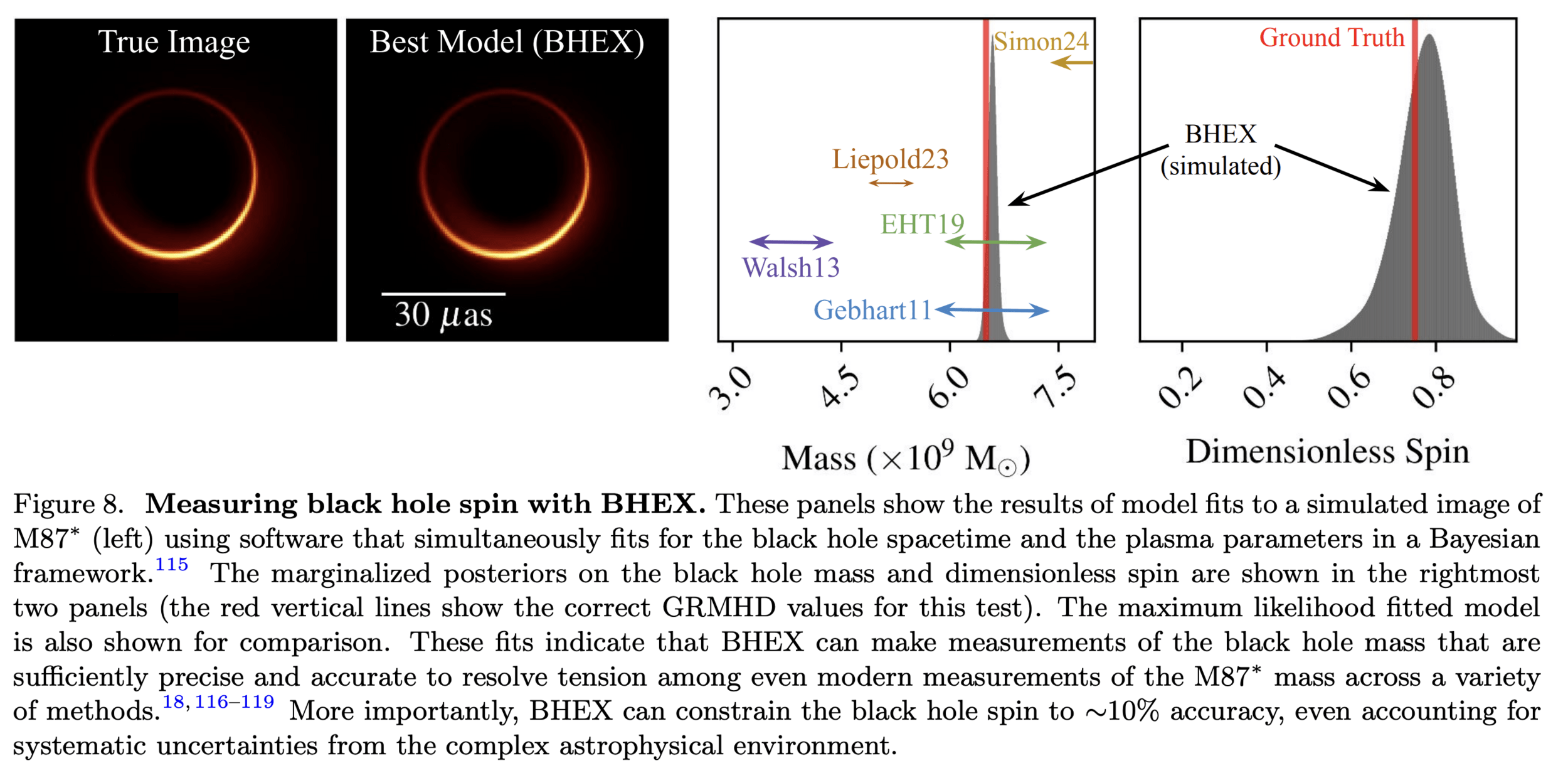
Videos of M87 & Sgr A*
"The Black Hole Explorer: Motivation and Vision" Johnson et. al. arXiv 2024
T-REX
Capture Time-Resolved Videos of M87 & Sgr A*
Time-Resolve Binary Black Hole Systems
Conduct VLBI Survey of AGN targets at 86 GHz
T-REX
Time-Resolve Binary Black Hole Systems
T-REX
Time-Resolve Binary Black Hole Systems
T-REX
Time-Resolve Binary Black Hole Systems
T-REX
Capture Time-Resolved Videos of M87 & Sgr A*
Time-Resolve Binary Black Hole Systems
Conduct VLBI Survey of AGN targets at 86 GHz
T-REX
Conduct VLBI Survey of AGN targets at 86 GHz
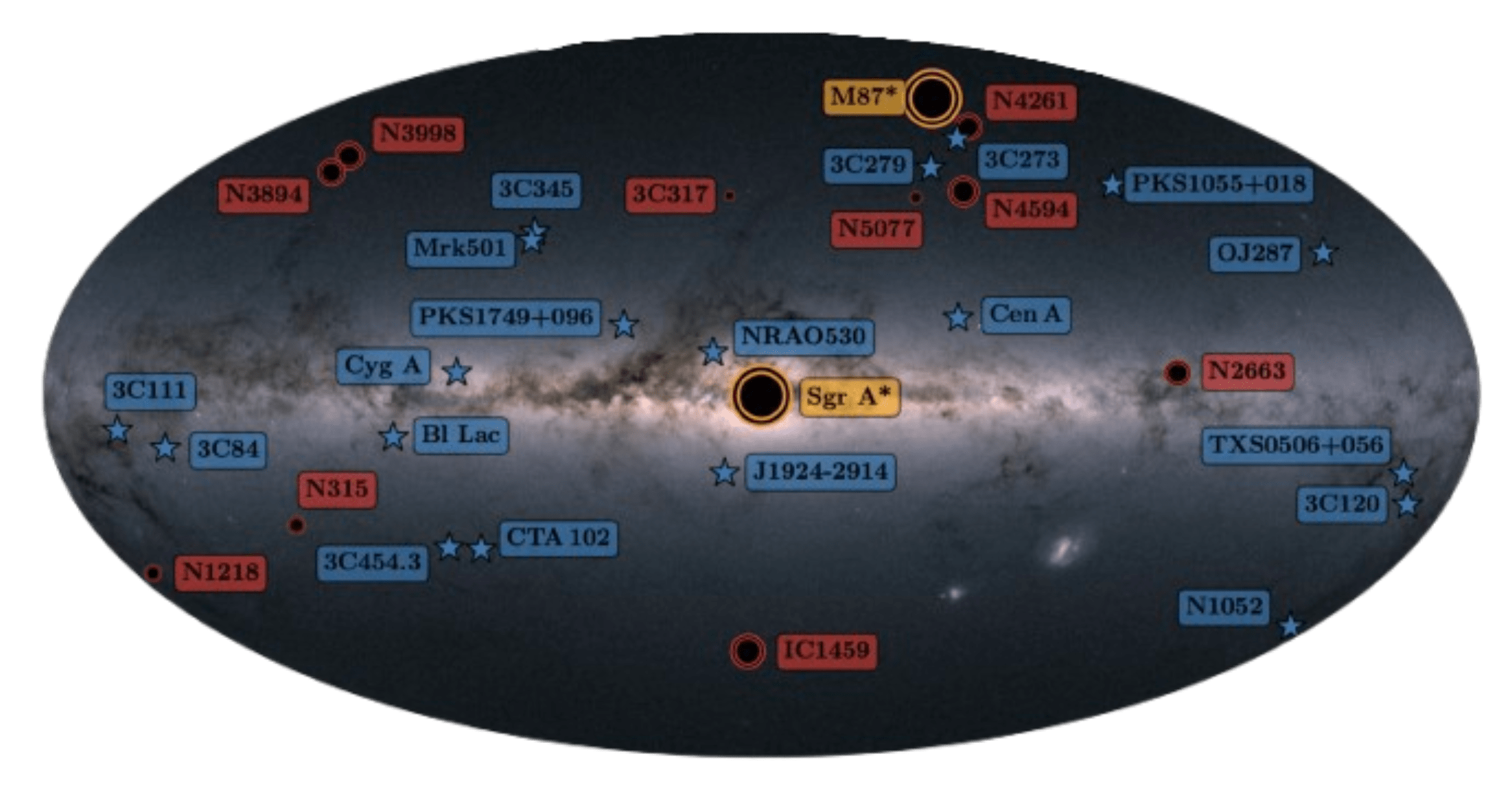
"The Black Hole Explorer: Motivation and Vision" Johnson et. al. arXiv 2024
T-REX
- Introduction
- What is a black hole?
- How do you image a black hole?
- How do you record a black hole?
- T-REX Primary Science Objectives
- T-REX (u,v) Coverage
- T-REX Engineering Challenges
- T-REX SWaPC Requirements
- T-REX Concept of Operations
- T-REX Timeline & Funding Deadlines
T-REX
20000\text{ km}
400\text{ km}
\text{MEO Satellite}
\text{T-REX}
"Metrics and Motivations for Earth–Space VLBI: Time-resolving Sgr A* with the Event Horizon Telescope" Palumbo et. al. ApJ 2019
\text{T-REX}
\text{EHT}
\text{T-REX}
\text{EHT}
\text{LEO}
\text{MEO}
T-REX
\text{MEO Satellite}
M87
Sgr A*
10:15
11:00
8:00
Sgr A*
10:15
11:00
8:00
T-REX
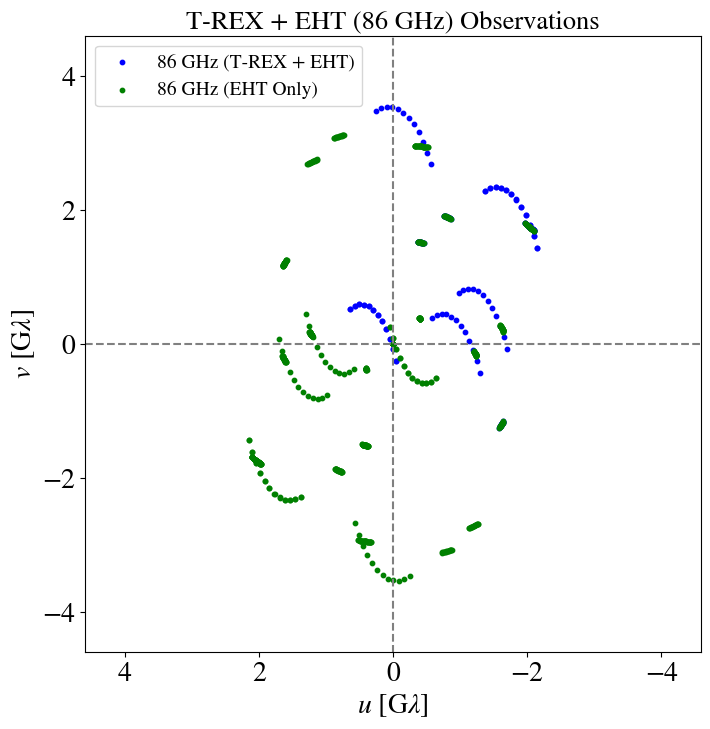
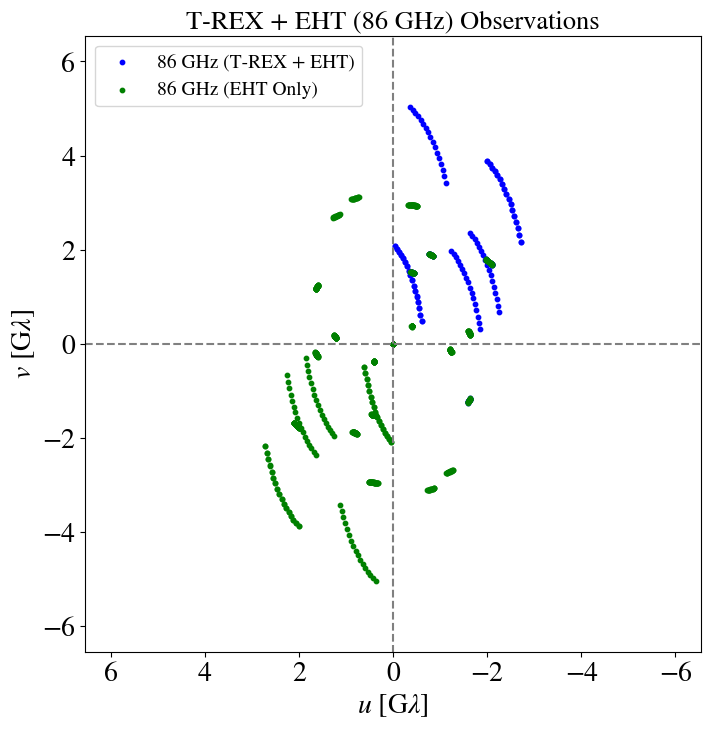
a=13,000 \text{ km}
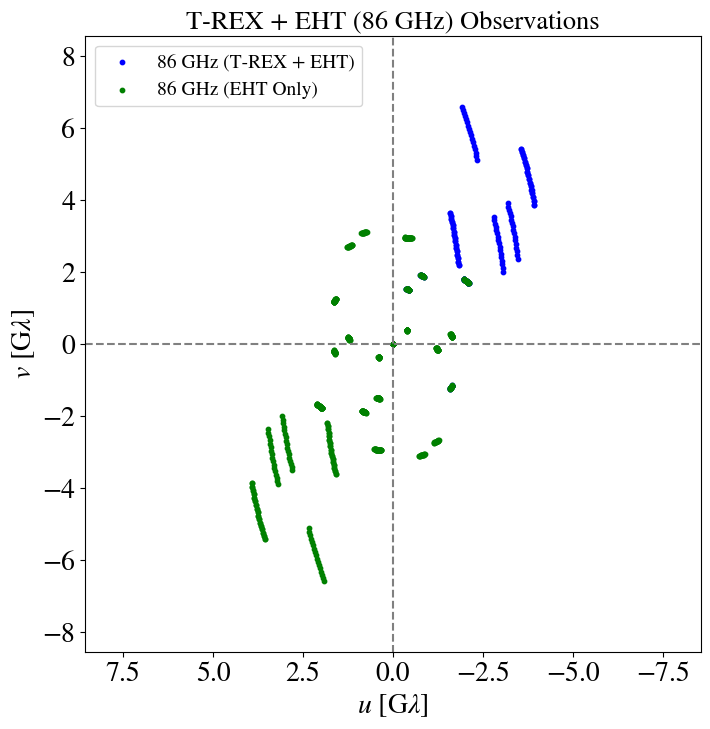
a=26,000 \text{ km}
a=6,000 \text{ km}
t_{\text{res}}\sim22.5 min
\theta_{\text{res}}\sim 35 \mu as
t_{\text{res}}\sim1 hr
\theta_{\text{res}}\sim 10 \mu as
t_{\text{res}}\sim3 hr
\theta_{\text{res}}\sim 6 \mu as
a=13,000 \text{ km}
a=26,000 \text{ km}
a=6,000 \text{ km}
t_{\text{res}}\sim22.5 min
\theta_{\text{res}}\sim 35 \mu as
t_{\text{res}}\sim1 hr
\theta_{\text{res}}\sim 10 \mu as
t_{\text{res}}\sim3 hr
\theta_{\text{res}}\sim 6 \mu as
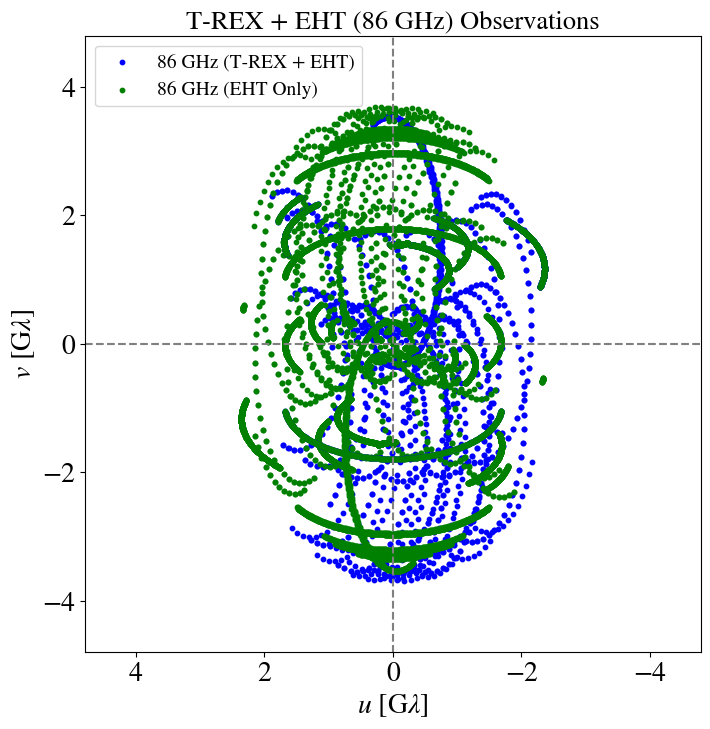
a=13,000 \text{ km}
a=26,000 \text{ km}
a=6,000 \text{ km}
t_{\text{res}}\sim22.5 min
\theta_{\text{res}}\sim 35 \mu as
t_{\text{res}}\sim1 hr
\theta_{\text{res}}\sim 10 \mu as
t_{\text{res}}\sim3 hr
\theta_{\text{res}}\sim 6 \mu as
T-REX
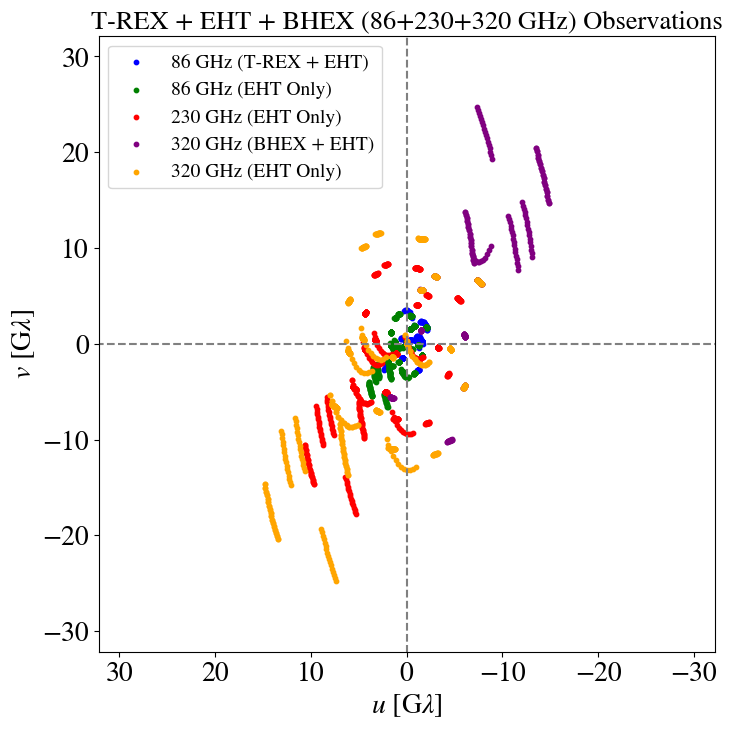
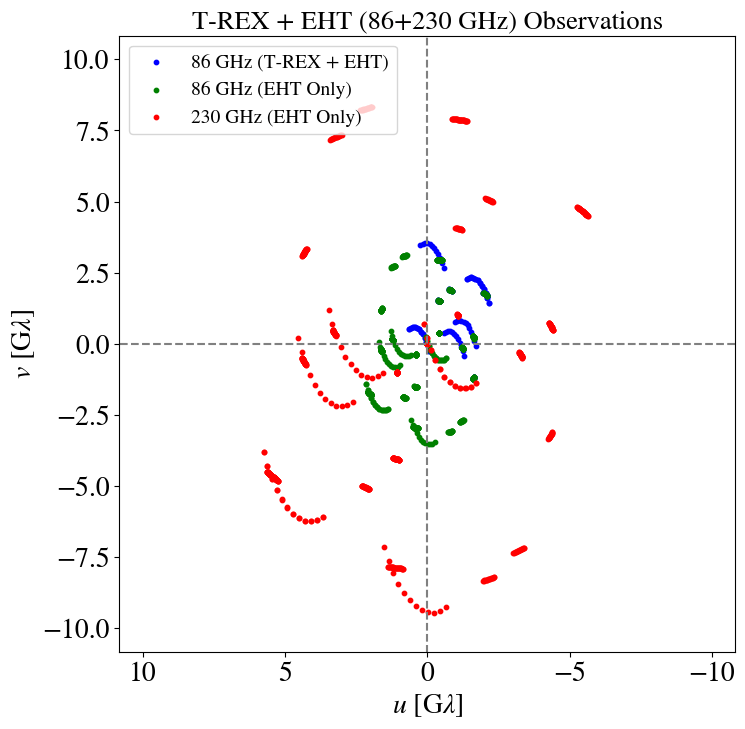
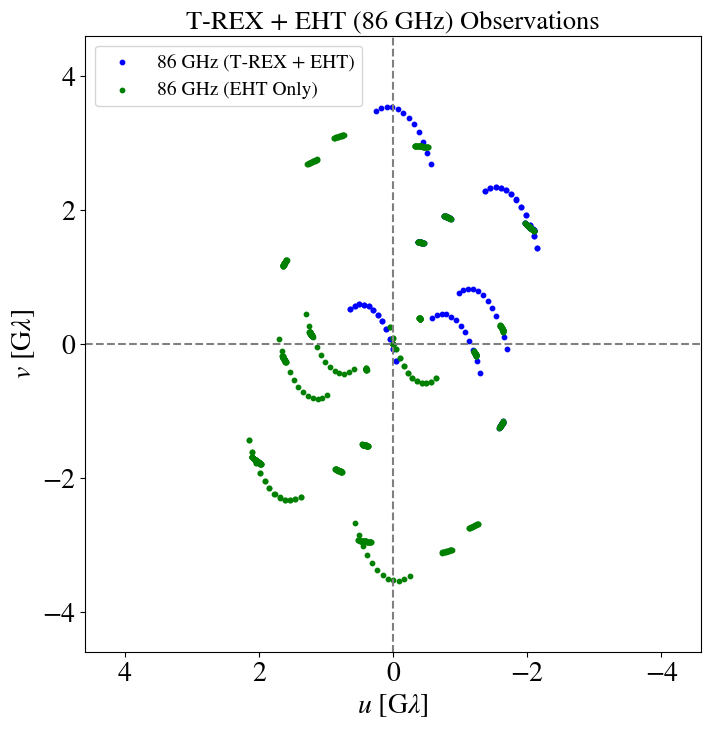
T-REX
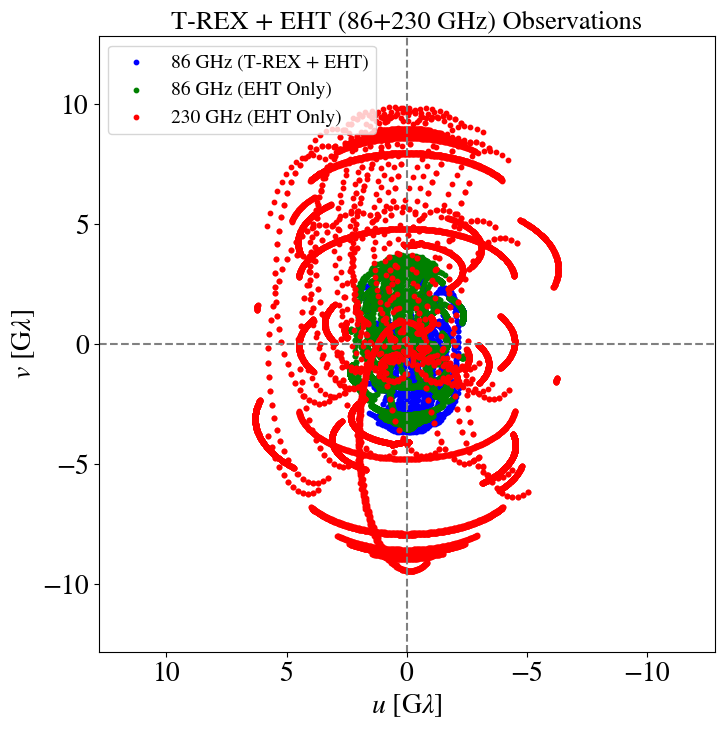
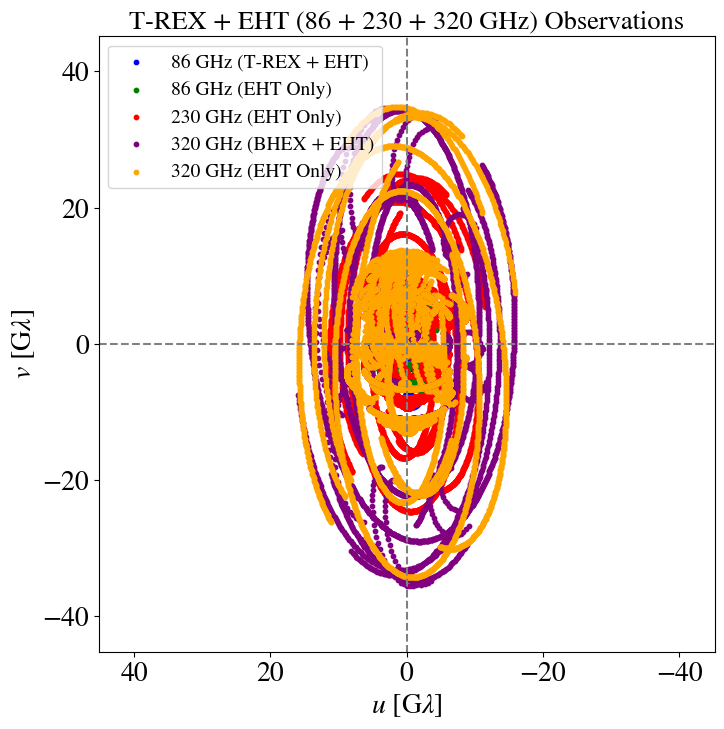
t=30\min
t=60\min
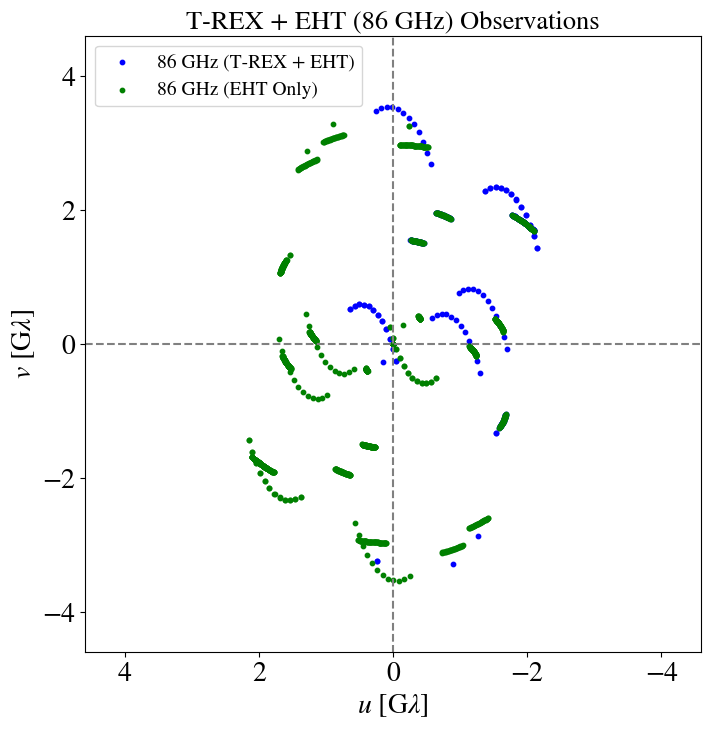
t=24 \text{ hr}
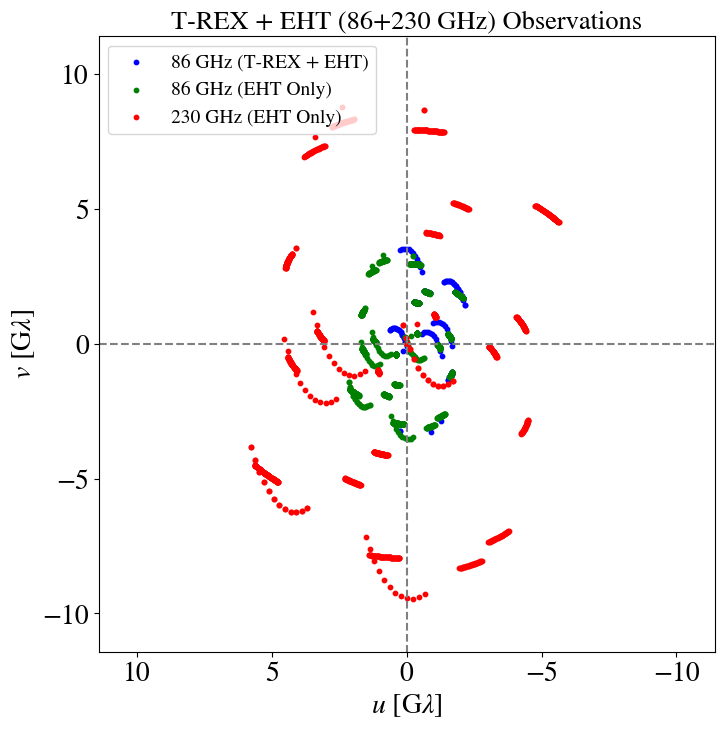
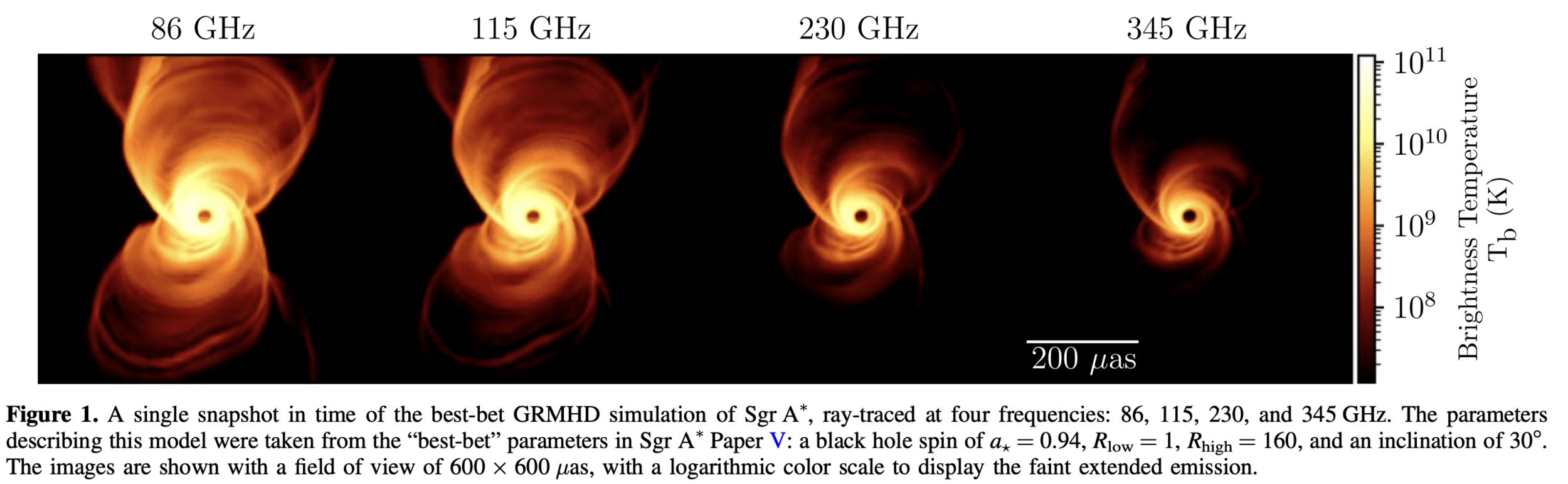
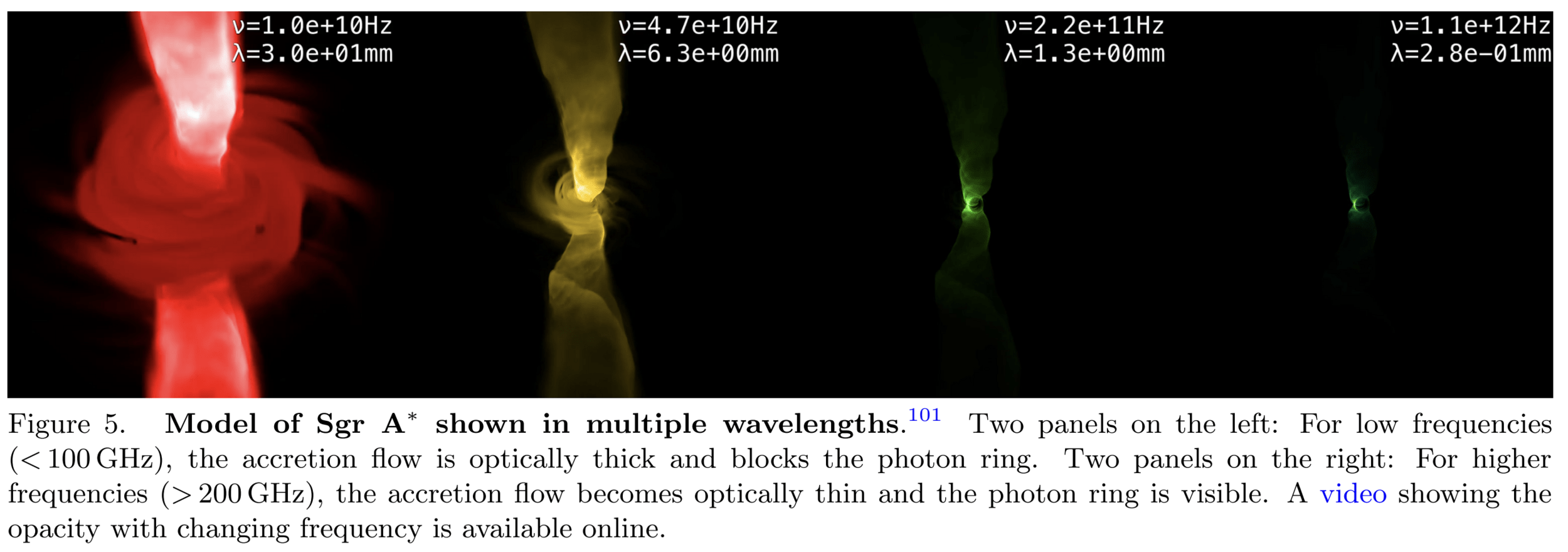
86 \text{ GHz}
230 \text{ GHz}
320 \text{ GHz}
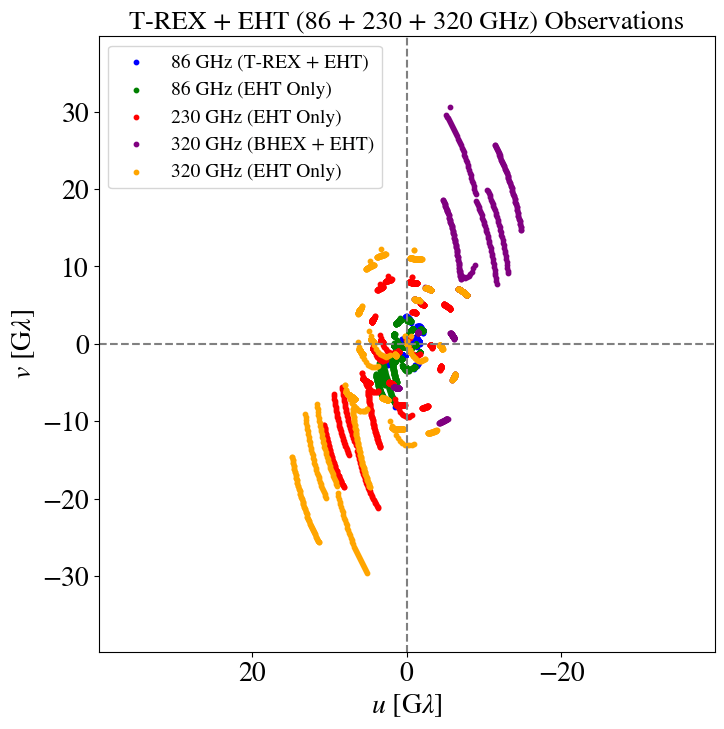
"Imaging the event horizon of M87* from space on different timescales" Shlentsova et. al. ApJ 2024
- Introduction
- What is a black hole?
- How do you image a black hole?
- How do you record a black hole?
- T-REX Primary Science Objectives
- T-REX (u,v) Coverage
- T-REX Engineering Challenges
- T-REX SWaPC Requirements
- T-REX Concept of Operations
- T-REX Timeline & Funding Deadlines
T-REX
T-REX
\text{T-REX}
\text{EHT}
Rapid (u,v) coverage
Decreased signal loss
Decreased radiation environment
Infrared Thermal Emissions
Limited Ground Coverage
Aggressive Slew Rate Required
Potential Reduced ISM Scattering

mm-wavelength angular resolution
Dual-baseline capability
T-REX
\text{T-REX}
\text{EHT}
Rapid (u,v) coverage
Decreased signal loss
Decreased radiation environment
Infrared Thermal Emissions
Limited Ground Coverage
Aggressive Slew Rate Required
Potential Reduced ISM Scattering
mm-wavelength angular resolution
Dual-baseline capability
T-REX
\text{T-REX}
\text{EHT}
Rapid (u,v) coverage
a=6,000 \text{ km}
\text{M}87
\text{Sgr} A^*
T-REX
\text{T-REX}
\text{EHT}
Rapid (u,v) coverage
T-REX
\text{T-REX}
\text{EHT}
Rapid (u,v) coverage
T-REX
\text{T-REX}
\text{EHT}
Rapid (u,v) coverage
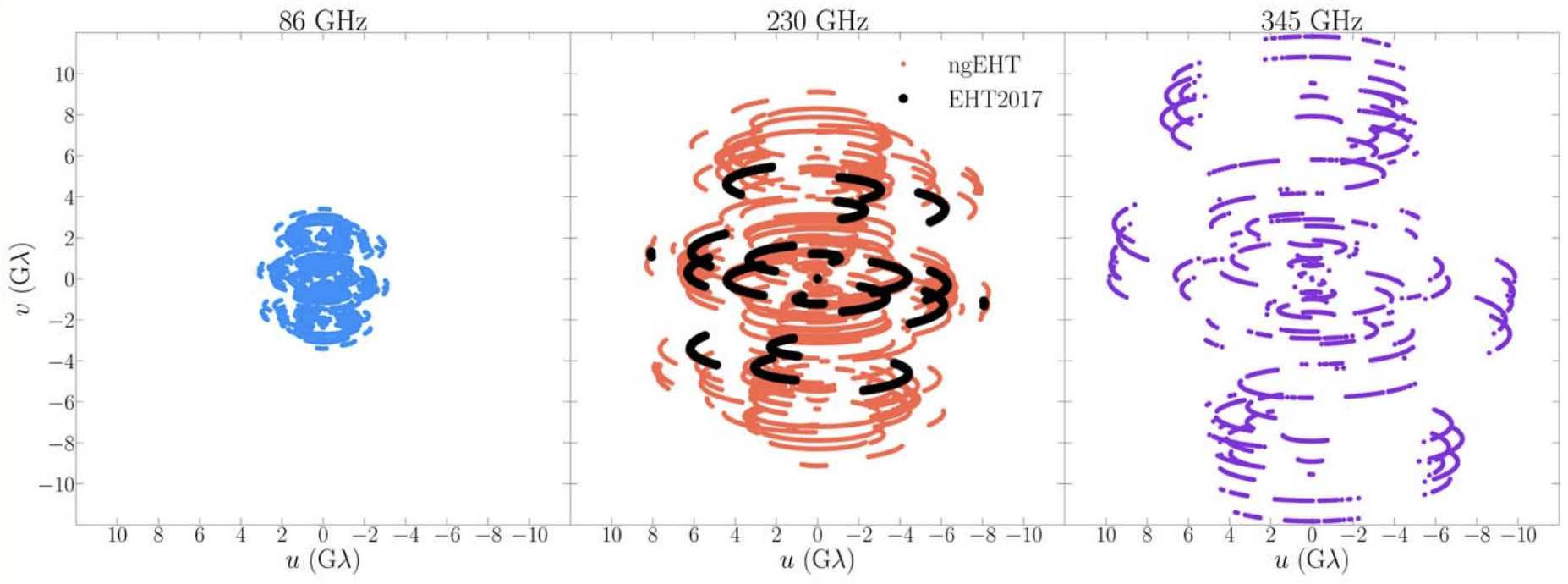
Multifrequency Black Hole Imaging for the Next-generation Event Horizon Telescope (Chael et. al., 2023, ApJ)
T-REX
\text{T-REX}
\text{EHT}
Rapid (u,v) coverage
Decreased signal loss
Decreased radiation environment
Infrared Thermal Emissions
Limited Ground Coverage
Aggressive Slew Rate Required
Potential Reduced ISM Scattering
mm-wavelength angular resolution
Dual-baseline capability
T-REX
\text{T-REX}
\text{EHT}
Decreased signal loss
R_{\max } \approx \frac{P_t G_t G_r \eta}{k T_b B}\left(N_{\bmod }\right)
Distance: How much distance did the signal travel through free space? (LEO vs. MEO!)
P_r = P_tG_tG_r \left( \frac{\lambda}{4\pi R}\right)^2 \cdot \eta
T-REX
\text{T-REX}
\text{EHT}
Rapid (u,v) coverage
Decreased signal loss
Decreased radiation environment
Infrared Thermal Emissions
Limited Ground Coverage
Aggressive Slew Rate Required
Potential Reduced ISM Scattering
mm-wavelength angular resolution
Dual-baseline capability
T-REX
\text{T-REX}
\text{EHT}
Rapid (u,v) coverage
Decreased signal loss
Decreased radiation environment
Infrared Thermal Emissions
Limited Ground Coverage
Aggressive Slew Rate Required
Potential Reduced ISM Scattering
mm-wavelength angular resolution
Dual-baseline capability
T-REX
\text{T-REX}
\text{EHT}
Potential Reduced ISM Scattering
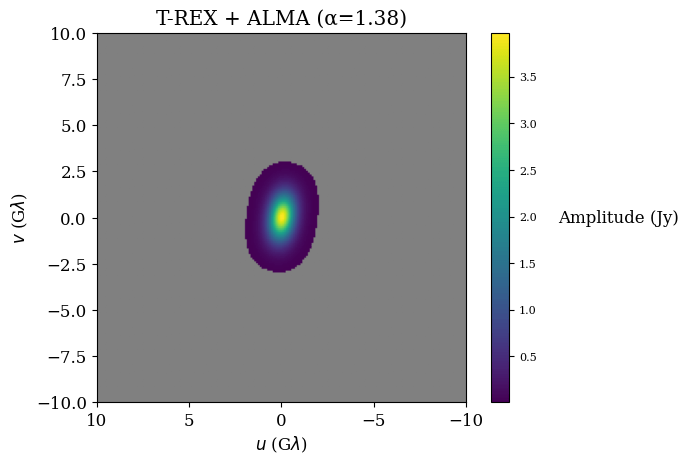
Prospects of Detecting a Jet in Sagittarius A* with VLBI (Chavez et. al., ApJ 2024)
T-REX
T-REX
\text{T-REX}
\text{EHT}
Potential Reduced ISM Scattering
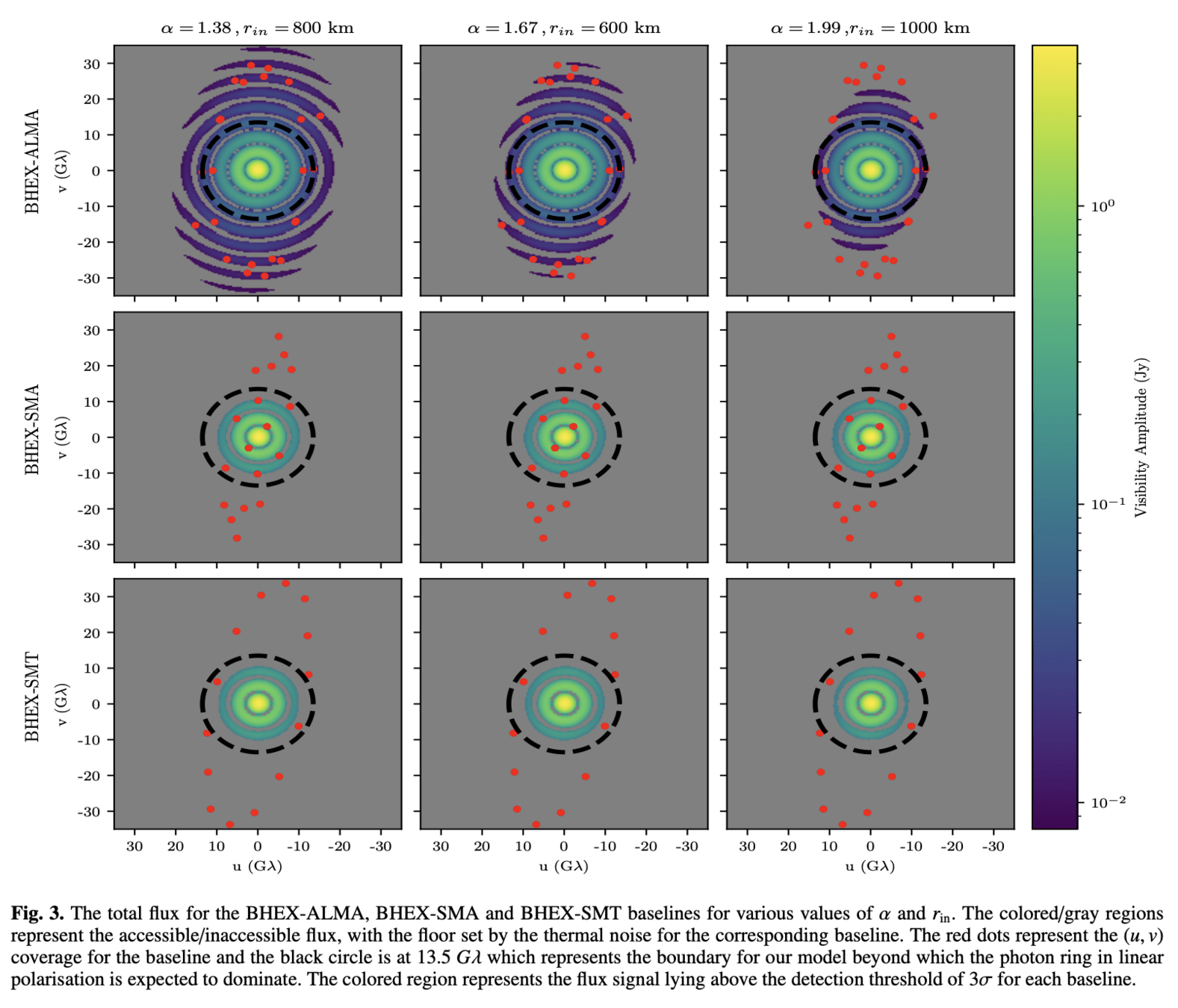
Orbit design for mitigating interstellar scattering effects in Earth-space VLBI observations of Sgr A* (Aditya Tamar, Ben Hudson, Daniel C.M. Palumbo, A&A, 2025)
T-REX
\text{T-REX}
\text{EHT}
Potential Reduced ISM Scattering
T-REX
\text{T-REX}
\text{EHT}
Rapid (u,v) coverage
Decreased signal loss
Decreased radiation environment
Infrared Thermal Emissions
Limited Ground Coverage
Aggressive Slew Rate Required
Potential Reduced ISM Scattering
mm-wavelength resolution
Dual-baseline capability
T-REX
\text{T-REX}
\text{EHT}
Rapid (u,v) coverage
Decreased signal loss
Decreased radiation environment
Infrared Thermal Emissions
Limited Ground Coverage
Aggressive Slew Rate Required
Potential Reduced ISM Scattering
mm-wavelength resolution
32\mu as<\theta_{\text{T-REX}} < 1800 \mu as
T-REX
\text{T-REX}
\text{EHT}
Rapid (u,v) coverage
Decreased signal loss
Decreased radiation environment
Infrared Thermal Emissions
Limited Ground Coverage
Aggressive Slew Rate Required
Potential Reduced ISM Scattering
mm-wavelength resolution
Dual-baseline capability
T-REX
\text{T-REX}
\text{EHT}
Dual-baseline capability
\text{BHEX}
Rapid coverage of (u,v) plane
Decreased signal loss from LEO
Decreased radiation environment in LEO vs. MEO
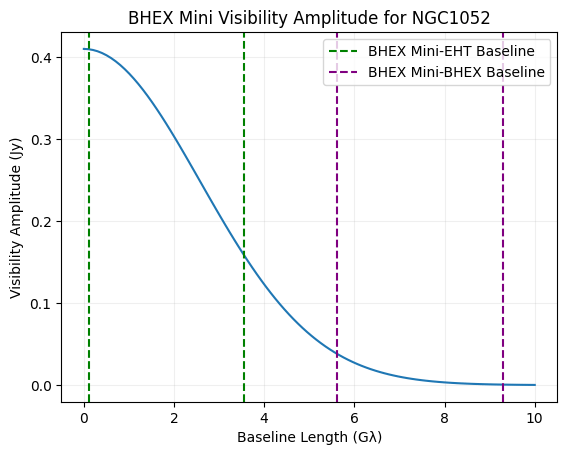
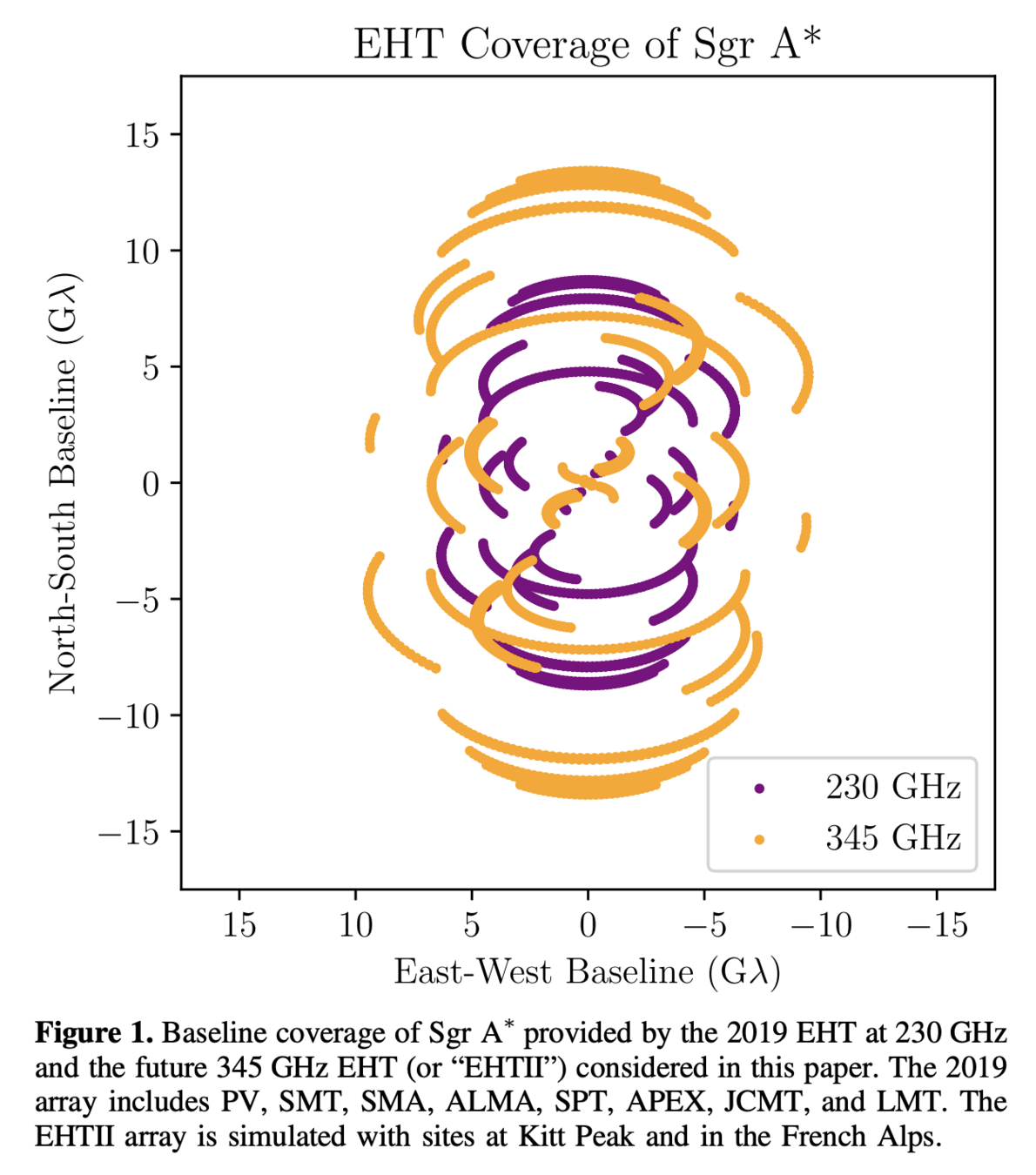
Metrics and Motivations for Earth–Space VLBI: Time-resolving Sgr A* with the Event Horizon Telescope (Palumbo et. al., ApJ 2019)
T-REX
\text{T-REX}
\text{EHT}
Dual-baseline capability
\text{BHEX}
Decreased signal loss from LEO
Decreased radiation environment in LEO vs. MEO
Metrics and Motivations for Earth–Space VLBI: Time-resolving Sgr A* with the Event Horizon Telescope (Palumbo et. al., ApJ 2019)
T-REX
\text{T-REX}
\text{EHT}
Dual-baseline capability
\text{BHEX}
\tau<\frac{1}{\omega D_\lambda \theta_{\mathrm{FOV}}}
\sigma=\frac{1}{\eta_{\mathrm{Q}}} \sqrt{\frac{\mathrm{SEFD}_1 \mathrm{SEFD}_2}{2 \Delta \nu \tau}}
\text{Coherence Time}
\text{Thermal Noise}
T-REX
\text{T-REX}
\text{EHT}
Rapid (u,v) coverage
Decreased signal loss
Decreased radiation environment
Infrared Thermal Emissions
Limited Ground Coverage
Aggressive Slew Rate Required
Potential Reduced ISM Scattering
mm-wavelength resolution
Dual-baseline capability
T-REX
\text{T-REX}
\text{EHT}
Infrared Thermal Emissions
T-REX
\text{T-REX}
\text{EHT}
Rapid (u,v) coverage
Decreased signal loss
Decreased radiation environment
Infrared Thermal Emissions
Limited Ground Coverage
Aggressive Slew Rate Required
Potential Reduced ISM Scattering
mm-wavelength resolution
Dual-baseline capability
T-REX
\text{T-REX}
\text{EHT}
Limited Ground Coverage
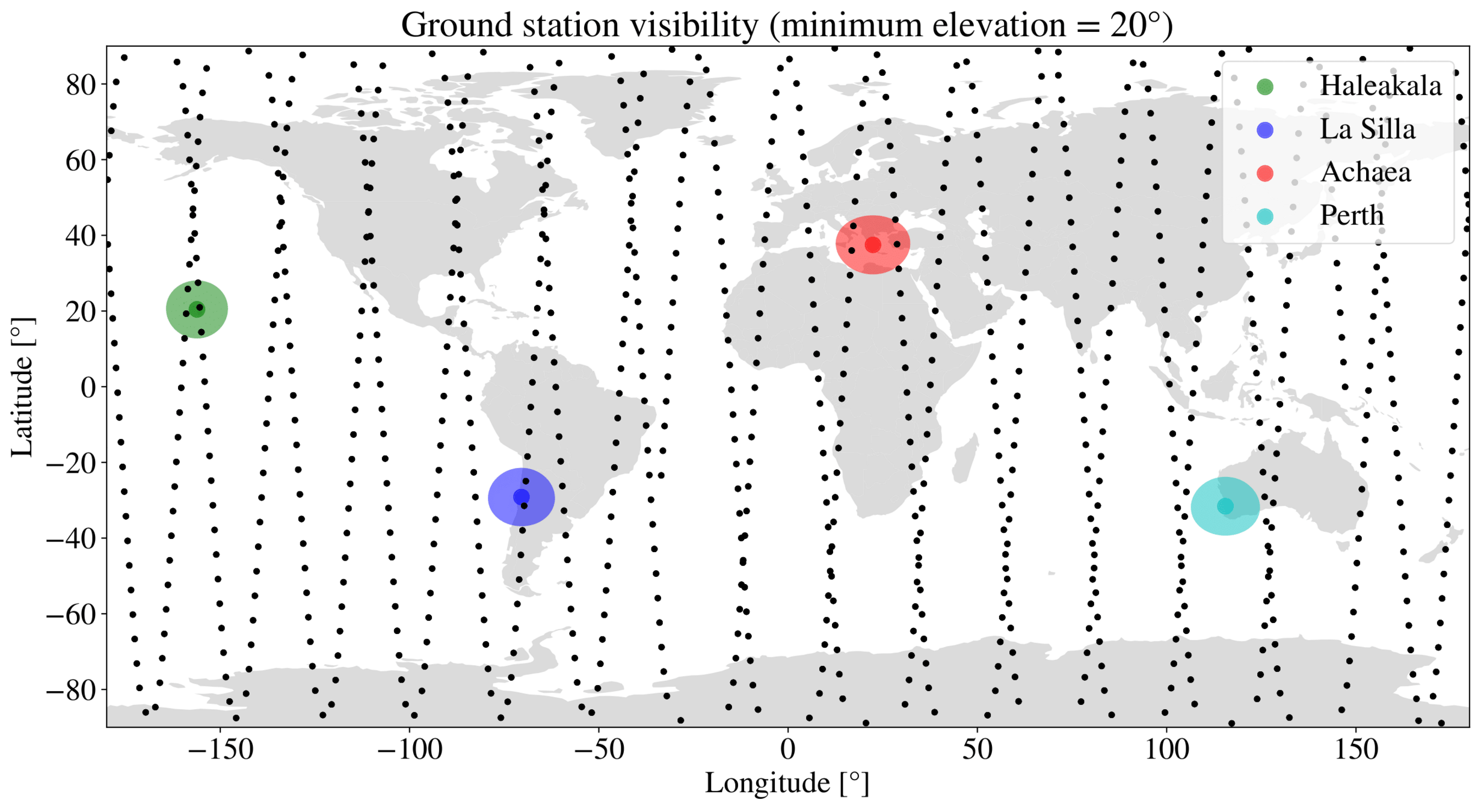
T-REX
\text{T-REX}
\text{EHT}
Limited Ground Coverage
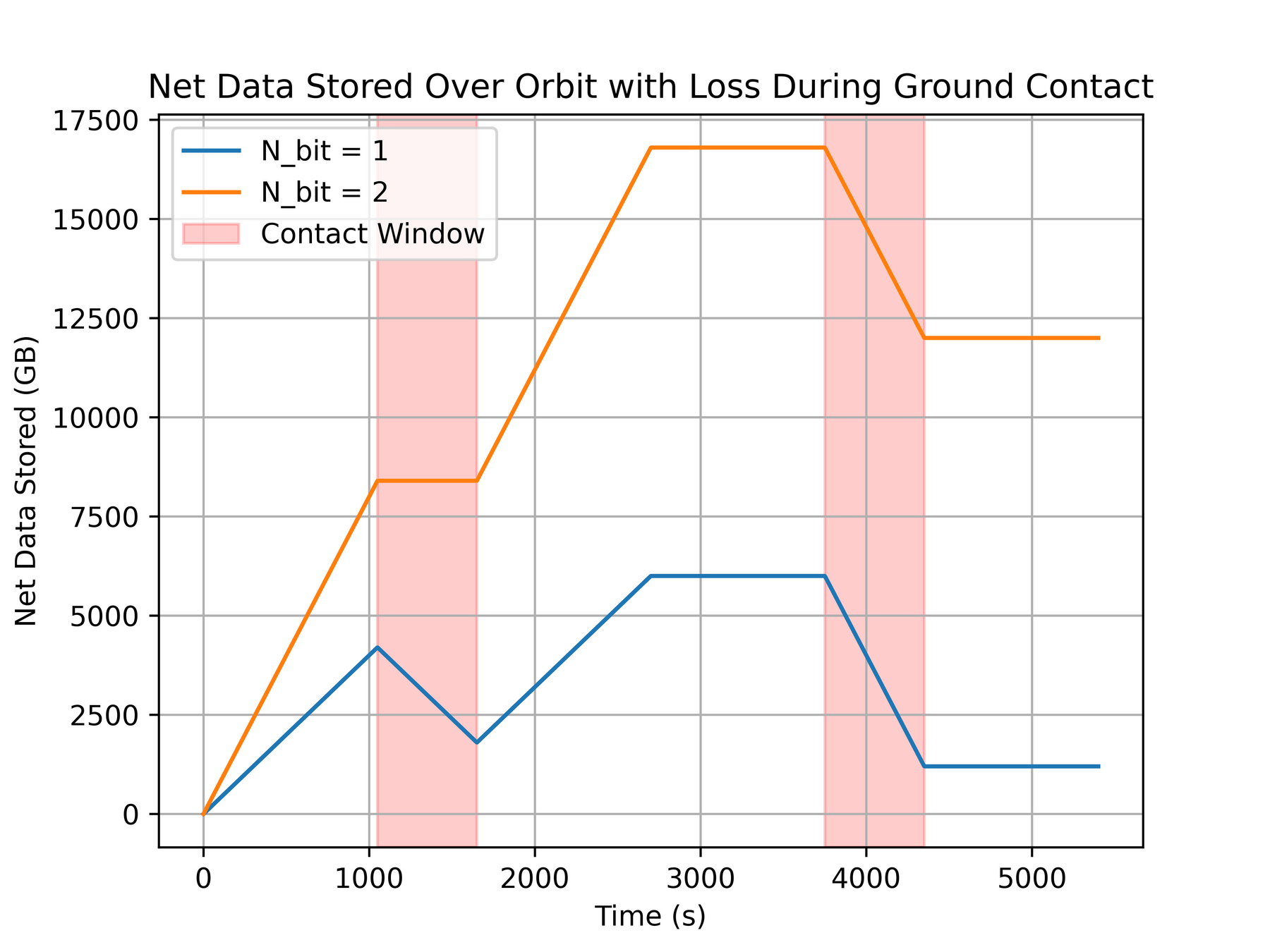
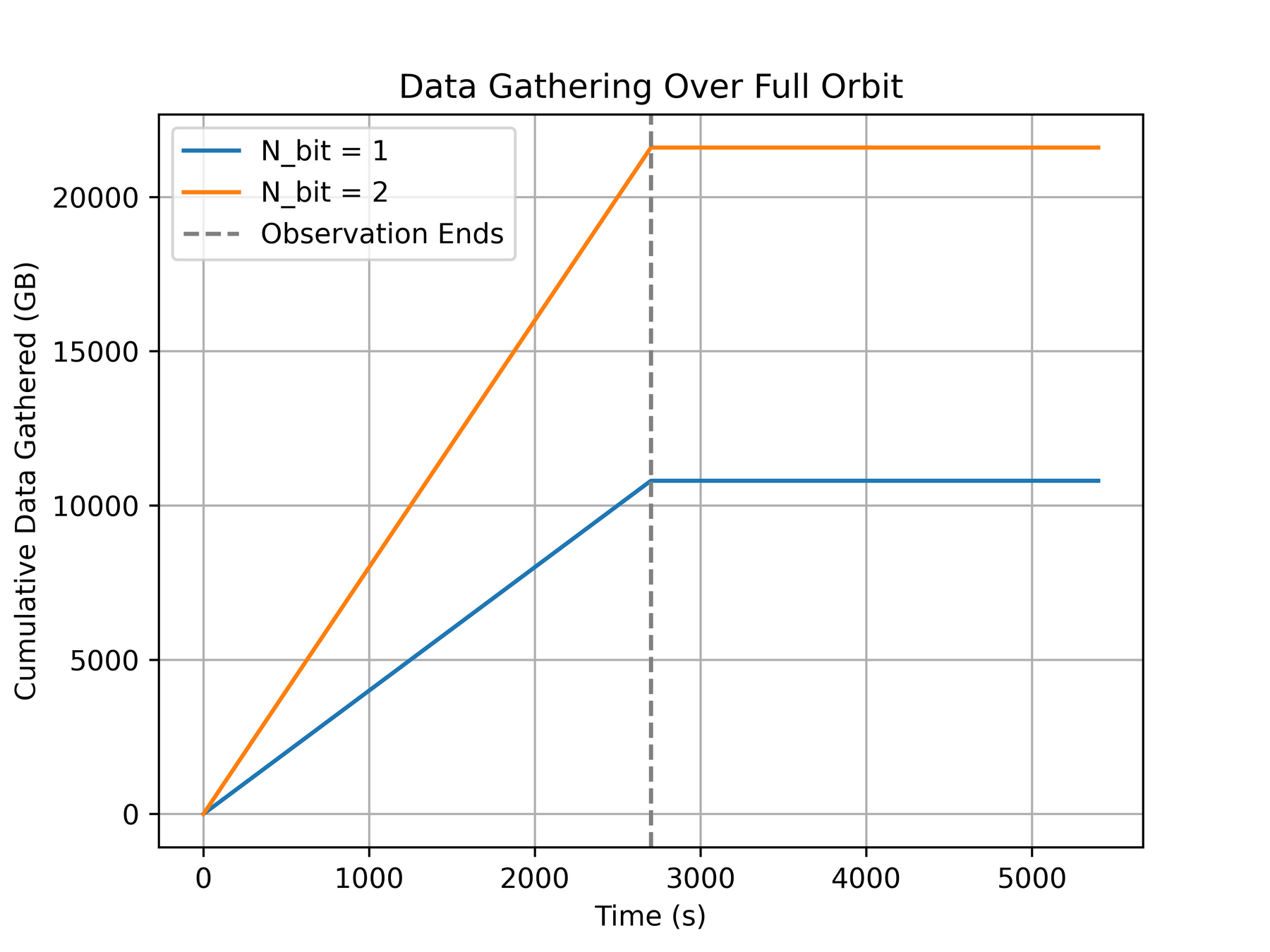
T-REX
\text{T-REX}
\text{EHT}
Limited Ground Coverage
T-REX
\text{T-REX}
\text{EHT}
Rapid (u,v) coverage
Decreased signal loss
Decreased radiation environment
Infrared Thermal Emissions
Limited Ground Coverage
Aggressive Slew Rate Required
Potential Reduced ISM Scattering
mm-wavelength resolution
Dual-baseline capability
T-REX
\text{T-REX}
\text{EHT}
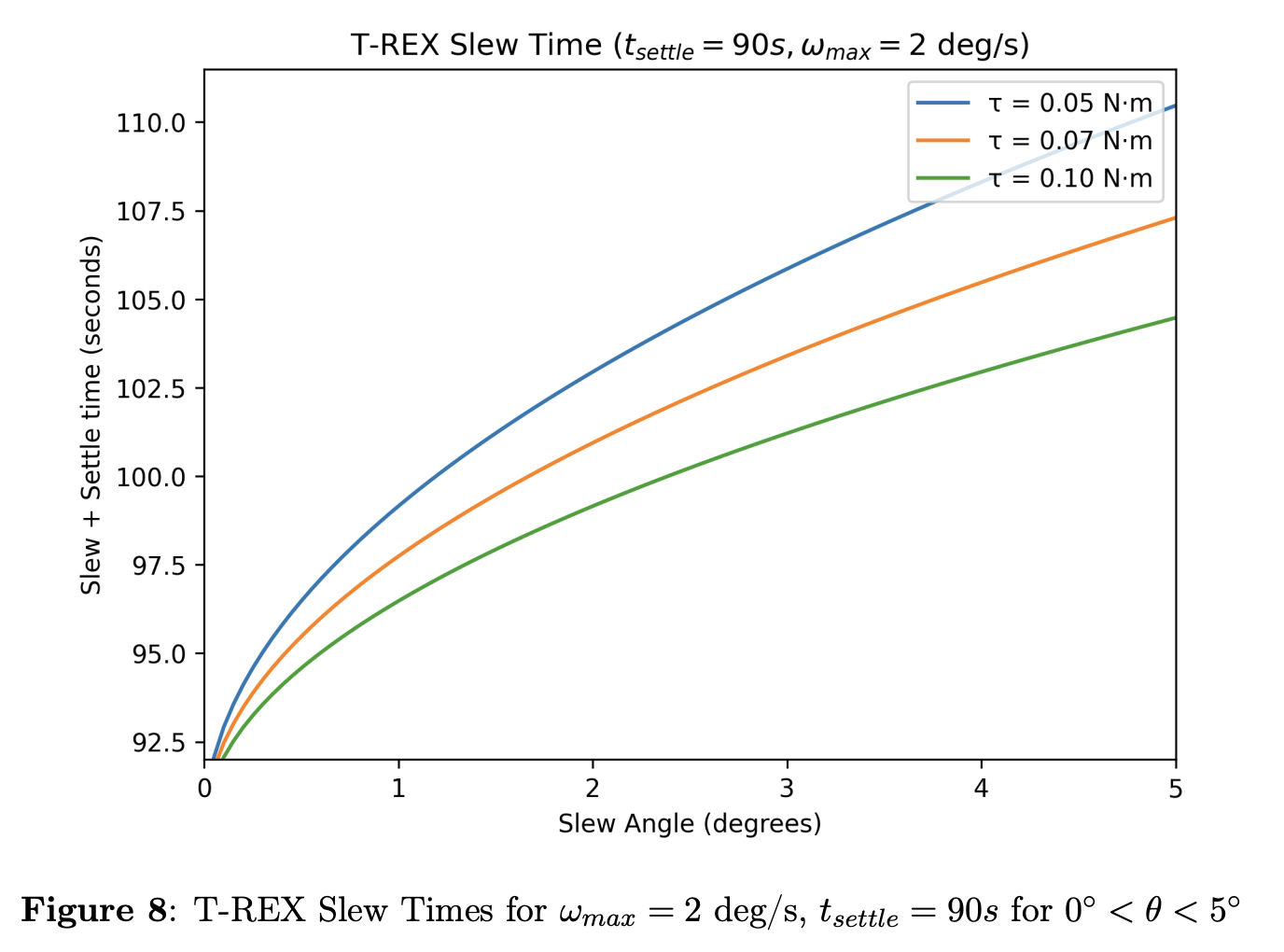
Aggressive Slew Rate Required
- Introduction
- What is a black hole?
- How do you image a black hole?
- How do you record a black hole?
- T-REX Primary Science Objectives
- T-REX (u,v) Coverage
- T-REX Engineering Challenges
- T-REX SWaPC Requirements
- T-REX Concept of Operations
- T-REX Timeline & Funding Deadlines
T-REX
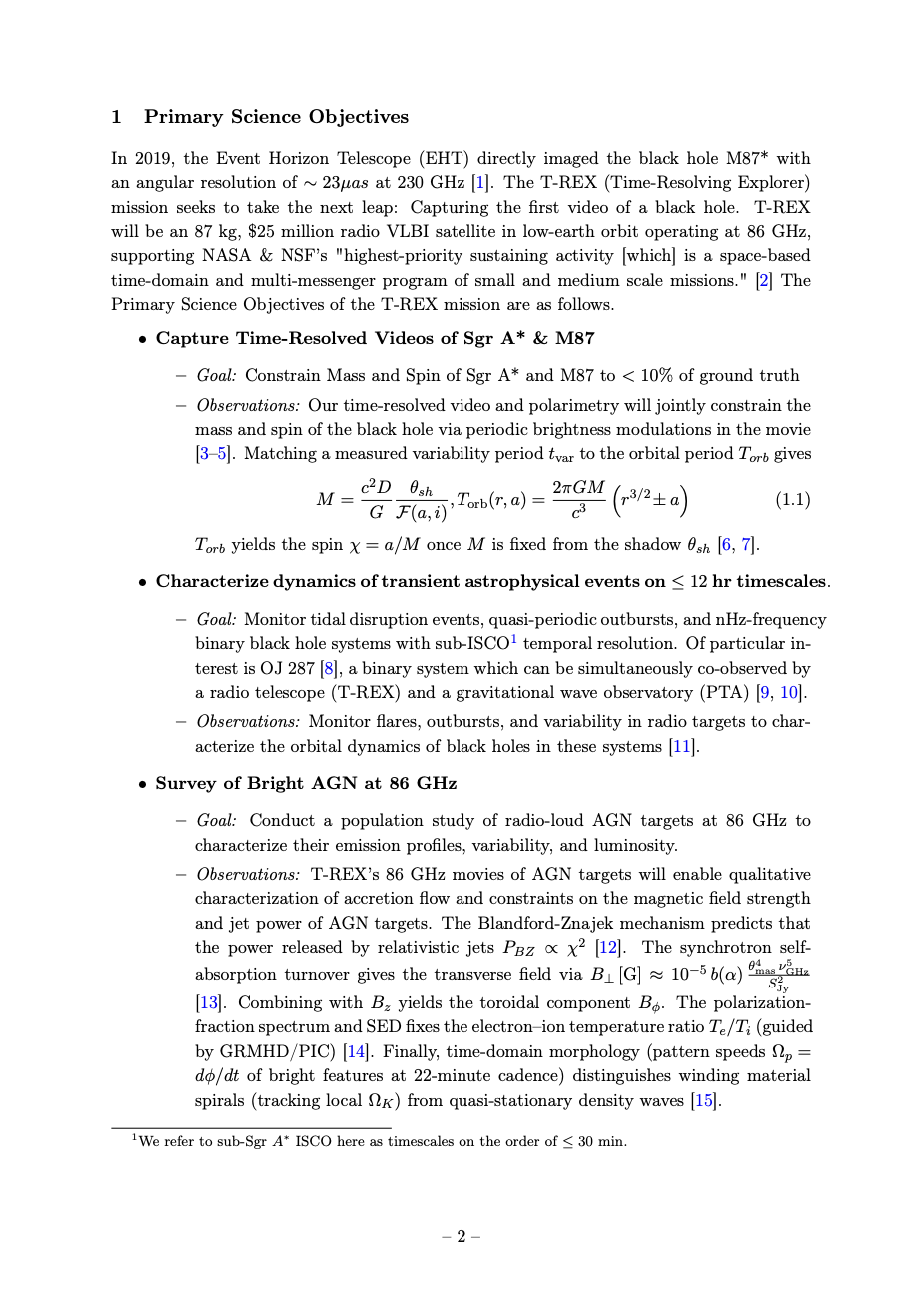
T-REX SWaPC
Size
Weight
Power
Power
Cost
\sim 2.5m
\sim 25-50kg
22 kg
300W
400mW @15^{\circ}K
\$10 \text{mln}
754 mm \times \\ 146 mm \times \\ 300 mm
\$2-5 \text{Mln}
\$4-11 \text{Mln}
10-20W
\text{(deployment)}
5-7 kg
\sim 10W
\sim \$ 1 \text{mln}
\sim0.02m^3
\sim 1 kg
\sim 3W
\sim \$1\text{mln}^*
60 mm\times \\60mm \times \\32 mm
1U (100 mm\times \\100 mm \times \\100 mm)
1.2 kg
1.2 kg
100W\\\text{generated}
\sim \$100\text{k}
3U (300 mm\times \\300 mm \times \\300 mm)
100W
3 kg
\sim \$1\text{mln}^*
\sim 4W
\sim 1 kg^*
12 mm \times \\12 mm
\sim \$1\text{mln}^*
\sim85.3 kg
\sim 437 W
\sim \$25\text{ million}
N/A
NASA Pioneers
Aspera
Pandora
StarBurst
PUEO
(Galaxy Evolution via UV)
(Exoplanet Explorer)
(Neutron Stars via Gamma Rays)
(Particle Physics via High-Energy Neutrinos)
Mission Parameters
T^*_{sys} = [T_{rx}+\eta_{ff}T_{b, inc}](1+r)\sim 30K
T_{b,inc}=\frac{F_{tot}A_{eff}}{2k}\sim 3\cdot 10^{-3} K
T_{rx}=15K, \eta_{ff}=0.95, \eta_{A}=0.85, r= 1, F_{tot}\sim 2\pm 0.2 Jy
SEFD
USO
Data
\theta_{\text{Res}}
Orbit
\sigma_{\text{Noise}}
\tau_{\text{max}}
\Delta \phi = 4.3\cdot 10^{-3} \text{ rad } (\text{LISA USO})
L\sim 1\% \text{ (JUICE USO)}
\operatorname{Rate}(\mathrm{bps})\sim 8,750 \text{ GB }(T_{obs}=.5T_{orb}) \text{ over 1 orbit}
\theta_{\text{T-REX -BHEX}}\sim 35 \mu as
\theta_{\text{T-REX - EHT}} \sim 1800 \mu as
\text{Circular Highly-Inclined Polar LEO}, r\sim 400 km, e \sim 0, i>78^{\circ}
\tau_{\text{Coherence, T-REX}}\lessapprox 2 \text{ min} \sim 120 s
\text{SEFD}_{\text{T-REX}}=\frac{2kT^*_{sys}}{\eta_A A}\sim 32,000 \text{ Jy}
\sigma_{\text{T-REX - BHEX}}\sim 12.65 \text{ mJy}
\sigma_{\text{T-REX - EHT}}\sim 40 \text{ mJy}
Systems Design
SEFD
\sim85.3 kg
\sim 437 W
\sim \$25\text{ million}
N/A
USO
Data
\theta_{\text{Res}}
Orbit
\sigma_{\text{Noise}}
\tau_{\text{max}}
\text{SEFD}_{\text{T-REX}}=\frac{2kT^*_{sys}}{\eta_A A}\sim 32,000 \text{ Jy}
Systems Design
\sim85.3 kg
\sim 437 W
\sim \$25\text{ million}
N/A
\text{SEFD}_{\text{T-REX}}=\frac{2kT^*_{sys}}{\eta_A A}\sim 32,000 \text{ Jy}
T^*_{sys} = [T_{rx}+\eta_{ff}T_{b, inc}](1+r)\sim 100K
SEFD
USO
Data
\theta_{\text{Res}}
Orbit
\sigma_{\text{Noise}}
\tau_{\text{max}}
Systems Design
\sim85.3 kg
\sim 437 W
\sim \$25\text{ million}
N/A
\text{SEFD}_{\text{T-REX}}=\frac{2kT^*_{sys}}{\eta_A A}\sim 32,000 \text{ Jy}
T^*_{sys} = [T_{rx}+\eta_{ff}T_{b, inc}](1+r)\sim 100K
T_{b,inc}=\frac{F_{tot}A_{eff}}{2k}\sim 3\cdot 10^{-3} K
T_{rx}=15K, \eta_{ff}=0.95, \eta_{A}=0.85, r= 1, F_{tot}\sim 2\pm 0.2 Jy
SEFD
USO
Data
\theta_{\text{Res}}
Orbit
\sigma_{\text{Noise}}
\tau_{\text{max}}
Systems Design
\sim85.3 kg
\sim 437 W
\sim \$25\text{ million}
N/A
\text{SEFD}_{\text{T-REX}}=\frac{2kT^*_{sys}}{\eta_A A}\sim 32,000 \text{ Jy}
T^*_{sys} = [T_{rx}+\eta_{ff}T_{b, inc}](1+r)\sim 100K
T_{b,inc}=\frac{F_{tot}A_{eff}}{2k}\sim 3\cdot 10^{-3} K
T_{rx}=15K, \eta_{ff}=0.95, \eta_{A}=0.85, r= 1, F_{tot}\sim 2\pm 0.2 Jy
SEFD
USO
Data
\theta_{\text{Res}}
Orbit
\sigma_{\text{Noise}}
\tau_{\text{max}}
\text{SEFD}_{\text{BHEX}}\sim 18,000 \text{ Jy}
\text{SEFD}_{\text{ALMA}}\sim 74 \text{ Jy}
\text{SEFD}_{\text{SMA}}\sim 6700 \text{ Jy}
\text{SEFD}_{\text{SMT}}\sim 10,500 \text{ Jy}
Systems Design
\sim85.3 kg
\sim 437 W
\sim \$25\text{ million}
N/A
\text{SEFD}_{\text{T-REX}}=\frac{2kT^*_{sys}}{\eta_A A}\sim 32,000 \text{ Jy}
T^*_{sys} = [T_{rx}+\eta_{ff}T_{b, inc}](1+r)\sim 30K
T_{b,inc}=\frac{F_{tot}A_{eff}}{2k}\sim 3\cdot 10^{-3} K
T_{rx}=15K, \eta_{ff}=0.95, \eta_{A}=0.85, r= 1, F_{tot}\sim 2\pm 0.2 Jy
SEFD
USO
Data
\theta_{\text{Res}}
Orbit
\sigma_{\text{Noise}}
\tau_{\text{max}}
Systems Design
\sim85.3 kg
\sim 437 W
\sim \$25\text{ million}
N/A
\text{SEFD}_{\text{T-REX}}=\frac{2kT^*_{sys}}{\eta_A A}\sim 32,000 \text{ Jy}
T^*_{sys} = [T_{rx}+\eta_{ff}T_{b, inc}](1+r)\sim 30K
T_{b,inc}=\frac{F_{tot}A_{eff}}{2k}\sim 3\cdot 10^{-3} K
T_{rx}=15K, \eta_{ff}=0.95, \eta_{A}=0.85, r= 1, F_{tot}\sim 2\pm 0.2 Jy
SEFD
USO
Data
\theta_{\text{Res}}
Orbit
\sigma_{\text{Noise}}
\tau_{\text{max}}
\sigma_{\text{T-REX - BHEX}}=\frac{1}{\eta_{\mathrm{Q}}} \sqrt{\frac{\mathrm{SEFD}_{\mathrm{BHEX}} \mathrm{SEFD}_{\text{T-REX}}}{2 \Delta \nu \Delta t}}
Systems Design
\sim85.3 kg
\sim 437 W
\sim \$25\text{ million}
N/A
T^*_{sys} = [T_{rx}+\eta_{ff}T_{b, inc}](1+r)\sim 30K
T_{b,inc}=\frac{F_{tot}A_{eff}}{2k}\sim 3\cdot 10^{-3} K
T_{rx}=15K, \eta_{ff}=0.95, \eta_{A}=0.85, r= 1, F_{tot}\sim 2\pm 0.2 Jy
SEFD
USO
Data
\theta_{\text{Res}}
Orbit
\sigma_{\text{Noise}}
\tau_{\text{max}}
\sigma_{\text{T-REX - BHEX}}=\frac{1}{\eta_{\mathrm{Q}}} \sqrt{\frac{\mathrm{SEFD}_{\mathrm{BHEX}} \mathrm{SEFD}_{\text{T-REX}}}{2 \Delta \nu \Delta t}}
\sigma_{\text{T-REX - EHT}}=\frac{1}{\eta_{\mathrm{Q}}} \sqrt{\frac{\mathrm{SEFD}_{\mathrm{EHT}} \mathrm{SEFD}_{\text{T-REX}}}{2 \Delta \nu \Delta t}}
\text{SEFD}_{\text{T-REX}}=\frac{2kT^*_{sys}}{\eta_A A}\sim 32,000 \text{ Jy}
Systems Design
\sim85.3 kg
\sim 437 W
\sim \$25\text{ million}
N/A
T^*_{sys} = [T_{rx}+\eta_{ff}T_{b, inc}](1+r)\sim 30K
T_{b,inc}=\frac{F_{tot}A_{eff}}{2k}\sim 3\cdot 10^{-3} K
T_{rx}=15K, \eta_{ff}=0.95, \eta_{A}=0.85, r= 1, F_{tot}\sim 2\pm 0.2 Jy
SEFD
USO
Data
\theta_{\text{Res}}
Orbit
\sigma_{\text{Noise}}
\tau_{\text{max}}
\sigma_{\text{T-REX - BHEX}}=\frac{1}{0.75} \sqrt{\frac{(18,000 \text{ Jy})(32,000 \text{Jy})}{2 (32 \text{GHz}) (100s)}}
\sigma_{\text{T-REX - EHT}}=\frac{1}{0.75} \sqrt{\frac{(6000 \text{ Jy})(32,000 \text{Jy})}{2 (32 \text{GHz}) (10s)}}
\text{SEFD}_{\text{T-REX}}=\frac{2kT^*_{sys}}{\eta_A A}\sim 32,000 \text{ Jy}
Systems Design
\sim85.3 kg
\sim 437 W
\sim \$25\text{ million}
N/A
T^*_{sys} = [T_{rx}+\eta_{ff}T_{b, inc}](1+r)\sim 30K
T_{b,inc}=\frac{F_{tot}A_{eff}}{2k}\sim 3\cdot 10^{-3} K
T_{rx}=15K, \eta_{ff}=0.95, \eta_{A}=0.85, r= 1, F_{tot}\sim 2\pm 0.2 Jy
SEFD
USO
Data
\theta_{\text{Res}}
Orbit
\sigma_{\text{Noise}}
\tau_{\text{max}}
\sigma_{\text{T-REX - BHEX}}\sim 12.65 \text{ mJy}
\sigma_{\text{T-REX - EHT}}\sim 40 \text{ mJy}
\text{SEFD}_{\text{T-REX}}=\frac{2kT^*_{sys}}{\eta_A A}\sim 32,000 \text{ Jy}
Systems Design
\sim85.3 kg
\sim 437 W
\sim \$25\text{ million}
N/A
T^*_{sys} = [T_{rx}+\eta_{ff}T_{b, inc}](1+r)\sim 30K
T_{b,inc}=\frac{F_{tot}A_{eff}}{2k}\sim 3\cdot 10^{-3} K
T_{rx}=15K, \eta_{ff}=0.95, \eta_{A}=0.85, r= 1, F_{tot}\sim 2\pm 0.2 Jy
SEFD
USO
Data
\theta_{\text{Res}}
Orbit
\sigma_{\text{Noise}}
\tau_{\text{max}}
\Delta \phi = 2\pi \cdot f \cdot \sigma_t
\sigma_t = \sigma_f \cdot \Delta t
\text{SEFD}_{\text{T-REX}}=\frac{2kT^*_{sys}}{\eta_A A}\sim 32,000 \text{ Jy}
\sigma_{\text{T-REX - BHEX}}\sim 12.65 \text{ mJy}
\sigma_{\text{T-REX - EHT}}\sim 40 \text{ mJy}
Systems Design
\sim85.3 kg
\sim 437 W
\sim \$25\text{ million}
N/A
T^*_{sys} = [T_{rx}+\eta_{ff}T_{b, inc}](1+r)\sim 30K
T_{b,inc}=\frac{F_{tot}A_{eff}}{2k}\sim 3\cdot 10^{-3} K
T_{rx}=15K, \eta_{ff}=0.95, \eta_{A}=0.85, r= 1, F_{tot}\sim 2\pm 0.2 Jy
SEFD
USO
Data
\theta_{\text{Res}}
Orbit
\sigma_{\text{Noise}}
\tau_{\text{max}}
\Delta \phi = 2\pi \cdot f \cdot \sigma_t
\sigma_t = \sigma_f \cdot \Delta t
\sigma_t = 8\cdot 10^{-15} (\text{LISA USO})
\Delta \phi = 2\pi \cdot (86\cdot 10^9 \text{ Hz}) \cdot 8\cdot 10^{-15}s\sim 10^{-3} \text{ rad}<1 \text{ rad}
\text{SEFD}_{\text{T-REX}}=\frac{2kT^*_{sys}}{\eta_A A}\sim 32,000 \text{ Jy}
\sigma_{\text{T-REX - BHEX}}\sim 12.65 \text{ mJy}
\sigma_{\text{T-REX - EHT}}\sim 40 \text{ mJy}
Systems Design
\sim85.3 kg
\sim 437 W
\sim \$25\text{ million}
N/A
T^*_{sys} = [T_{rx}+\eta_{ff}T_{b, inc}](1+r)\sim 30K
T_{b,inc}=\frac{F_{tot}A_{eff}}{2k}\sim 3\cdot 10^{-3} K
T_{rx}=15K, \eta_{ff}=0.95, \eta_{A}=0.85, r= 1, F_{tot}\sim 2\pm 0.2 Jy
SEFD
USO
Data
\theta_{\text{Res}}
Orbit
\sigma_{\text{Noise}}
\tau_{\text{max}}
\Delta \phi = 4.3\cdot 10^{-3} \text{ rad } (\Delta t = \text{10 s})
\text{SEFD}_{\text{T-REX}}=\frac{2kT^*_{sys}}{\eta_A A}\sim 32,000 \text{ Jy}
\sigma_{\text{T-REX - BHEX}}\sim 12.65 \text{ mJy}
\sigma_{\text{T-REX - EHT}}\sim 40 \text{ mJy}
Systems Design
\sim85.3 kg
\sim 437 W
\sim \$25\text{ million}
N/A
T^*_{sys} = [T_{rx}+\eta_{ff}T_{b, inc}](1+r)\sim 30K
T_{b,inc}=\frac{F_{tot}A_{eff}}{2k}\sim 3\cdot 10^{-3} K
T_{rx}=15K, \eta_{ff}=0.95, \eta_{A}=0.85, r= 1, F_{tot}\sim 2\pm 0.2 Jy
SEFD
USO
Data
\theta_{\text{Res}}
Orbit
\sigma_{\text{Noise}}
\tau_{\text{max}}
\Delta \phi = 4.3\cdot 10^{-3} \text{ rad } (\Delta t = \text{10 s})
L = 1-\exp\left(-2\pi^{2}f^{2}t^{2}\sigma_y^{2}\right)
L = 1-\exp\left[-2\pi^{2}(86\cdot 10^9)^{2}(10)^{2}(5\cdot 10^{-11})^{2}\right]\sim 1\%
\text{SEFD}_{\text{T-REX}}=\frac{2kT^*_{sys}}{\eta_A A}\sim 32,000 \text{ Jy}
\sigma_{\text{T-REX - BHEX}}\sim 12.65 \text{ mJy}
\sigma_{\text{T-REX - EHT}}\sim 40 \text{ mJy}
Systems Design
\sim85.3 kg
\sim 437 W
\sim \$25\text{ million}
N/A
T^*_{sys} = [T_{rx}+\eta_{ff}T_{b, inc}](1+r)\sim 30K
T_{b,inc}=\frac{F_{tot}A_{eff}}{2k}\sim 3\cdot 10^{-3} K
T_{rx}=15K, \eta_{ff}=0.95, \eta_{A}=0.85, r= 1, F_{tot}\sim 2\pm 0.2 Jy
SEFD
USO
Data
\theta_{\text{Res}}
Orbit
\sigma_{\text{Noise}}
\tau_{\text{max}}
\Delta \phi = 4.3\cdot 10^{-3} \text{ rad } (\text{LISA USO})
L\sim 1\% \text{ (JUICE USO)}
\text{SEFD}_{\text{T-REX}}=\frac{2kT^*_{sys}}{\eta_A A}\sim 32,000 \text{ Jy}
\sigma_{\text{T-REX - BHEX}}\sim 12.65 \text{ mJy}
\sigma_{\text{T-REX - EHT}}\sim 40 \text{ mJy}
Systems Design
\sim85.3 kg
\sim 437 W
\sim \$25\text{ million}
N/A
T^*_{sys} = [T_{rx}+\eta_{ff}T_{b, inc}](1+r)\sim 30K
T_{b,inc}=\frac{F_{tot}A_{eff}}{2k}\sim 3\cdot 10^{-3} K
T_{rx}=15K, \eta_{ff}=0.95, \eta_{A}=0.85, r= 1, F_{tot}\sim 2\pm 0.2 Jy
SEFD
USO
Data
\theta_{\text{Res}}
Orbit
\sigma_{\text{Noise}}
\tau_{\text{max}}
\Delta \phi = 4.3\cdot 10^{-3} \text{ rad } (\text{LISA USO})
L\sim 1\% \text{ (JUICE USO)}
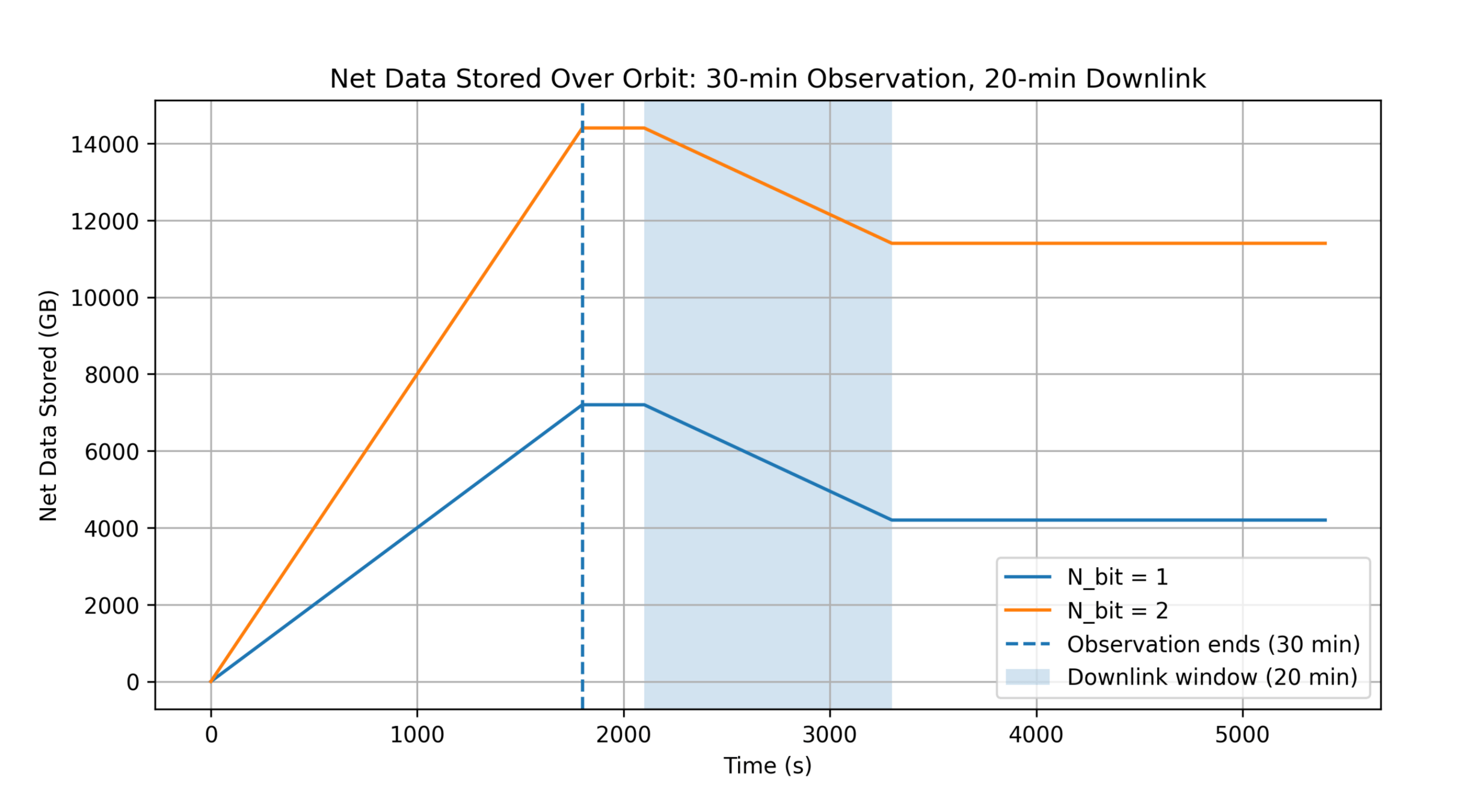
\operatorname{Rate}(\mathrm{bps})=N_{\text {bits }} \times \Delta \nu \times 2_{\text {pol }} \times 2_{\text {Nyquist }}
\text{SEFD}_{\text{T-REX}}=\frac{2kT^*_{sys}}{\eta_A A}\sim 32,000 \text{ Jy}
\sigma_{\text{T-REX - BHEX}}\sim 12.65 \text{ mJy}
\sigma_{\text{T-REX - EHT}}\sim 40 \text{ mJy}
Systems Design
\sim85.3 kg
\sim 437 W
\sim \$25\text{ million}
N/A
T^*_{sys} = [T_{rx}+\eta_{ff}T_{b, inc}](1+r)\sim 30K
T_{b,inc}=\frac{F_{tot}A_{eff}}{2k}\sim 3\cdot 10^{-3} K
T_{rx}=15K, \eta_{ff}=0.95, \eta_{A}=0.85, r= 1, F_{tot}\sim 2\pm 0.2 Jy
SEFD
USO
Data
\theta_{\text{Res}}
Orbit
\sigma_{\text{Noise}}
\tau_{\text{max}}
\Delta \phi = 4.3\cdot 10^{-3} \text{ rad } (\text{LISA USO})
L\sim 1\% \text{ (JUICE USO)}
\operatorname{Rate}(\mathrm{bps})=N_{\text {bits }} \times \Delta \nu \times 2_{\text {pol }} \times 2_{\text {Nyquist }}
\text{Rate}\times T_{orb} \times \text{Duty Cycle} = \text{Total Data (GB)}
\text{SEFD}_{\text{T-REX}}=\frac{2kT^*_{sys}}{\eta_A A}\sim 32,000 \text{ Jy}
\sigma_{\text{T-REX - BHEX}}\sim 12.65 \text{ mJy}
\sigma_{\text{T-REX - EHT}}\sim 40 \text{ mJy}
Systems Design
\sim85.3 kg
\sim 437 W
\sim \$25\text{ million}
N/A
T^*_{sys} = [T_{rx}+\eta_{ff}T_{b, inc}](1+r)\sim 30K
T_{b,inc}=\frac{F_{tot}A_{eff}}{2k}\sim 3\cdot 10^{-3} K
T_{rx}=15K, \eta_{ff}=0.95, \eta_{A}=0.85, r= 1, F_{tot}\sim 2\pm 0.2 Jy
SEFD
USO
Data
\theta_{\text{Res}}
Orbit
\sigma_{\text{Noise}}
\tau_{\text{max}}
\Delta \phi = 4.3\cdot 10^{-3} \text{ rad } (\text{LISA USO})
L\sim 1\% \text{ (JUICE USO)}
\operatorname{Rate}(\mathrm{bps})\sim 8,750 \text{ GB }(T_{obs}=.5T_{orb}) \text{ over 1 orbit}
\theta_{S-S} \sim \frac{\lambda}{D}
\text{SEFD}_{\text{T-REX}}=\frac{2kT^*_{sys}}{\eta_A A}\sim 32,000 \text{ Jy}
\sigma_{\text{T-REX - BHEX}}\sim 12.65 \text{ mJy}
\sigma_{\text{T-REX - EHT}}\sim 40 \text{ mJy}
Systems Design
\sim85.3 kg
\sim 437 W
\sim \$25\text{ million}
N/A
T^*_{sys} = [T_{rx}+\eta_{ff}T_{b, inc}](1+r)\sim 30K
T_{b,inc}=\frac{F_{tot}A_{eff}}{2k}\sim 3\cdot 10^{-3} K
T_{rx}=15K, \eta_{ff}=0.95, \eta_{A}=0.85, r= 1, F_{tot}\sim 2\pm 0.2 Jy
SEFD
USO
Data
\theta_{\text{Res}}
Orbit
\sigma_{\text{Noise}}
\tau_{\text{max}}
\Delta \phi = 4.3\cdot 10^{-3} \text{ rad } (\text{LISA USO})
L\sim 1\% \text{ (JUICE USO)}
\operatorname{Rate}(\mathrm{bps})\sim 8,750 \text{ GB }(T_{obs}=.5T_{orb}) \text{ over 1 orbit}
\theta_{S-S} \sim \frac{\lambda}{D}=\frac{3.5mm}{20,000 km}
\theta_{S-G} \sim \frac{\lambda}{D}=\frac{3.5mm}{400 km}
\text{SEFD}_{\text{T-REX}}=\frac{2kT^*_{sys}}{\eta_A A}\sim 32,000 \text{ Jy}
\sigma_{\text{T-REX - BHEX}}\sim 12.65 \text{ mJy}
\sigma_{\text{T-REX - EHT}}\sim 40 \text{ mJy}
Systems Design
\sim85.3 kg
\sim 437 W
\sim \$25\text{ million}
N/A
T^*_{sys} = [T_{rx}+\eta_{ff}T_{b, inc}](1+r)\sim 30K
T_{b,inc}=\frac{F_{tot}A_{eff}}{2k}\sim 3\cdot 10^{-3} K
T_{rx}=15K, \eta_{ff}=0.95, \eta_{A}=0.85, r= 1, F_{tot}\sim 2\pm 0.2 Jy
SEFD
USO
Data
\theta_{\text{Res}}
Orbit
\sigma_{\text{Noise}}
\tau_{\text{max}}
\Delta \phi = 4.3\cdot 10^{-3} \text{ rad } (\text{LISA USO})
L\sim 1\% \text{ (JUICE USO)}
\operatorname{Rate}(\mathrm{bps})\sim 8,750 \text{ GB }(T_{obs}=.5T_{orb}) \text{ over 1 orbit}
\text{SEFD}_{\text{T-REX}}=\frac{2kT^*_{sys}}{\eta_A A}\sim 32,000 \text{ Jy}
\sigma_{\text{T-REX - BHEX}}\sim 12.65 \text{ mJy}
\sigma_{\text{T-REX - EHT}}\sim 40 \text{ mJy}
\theta_{\text{T-REX -BHEX}}\sim 35 \mu as
\theta_{\text{T-REX - EHT}} \sim 1800 \mu as
Systems Design
\sim85.3 kg
\sim 437 W
\sim \$25\text{ million}
N/A
T^*_{sys} = [T_{rx}+\eta_{ff}T_{b, inc}](1+r)\sim 30K
T_{b,inc}=\frac{F_{tot}A_{eff}}{2k}\sim 3\cdot 10^{-3} K
T_{rx}=15K, \eta_{ff}=0.95, \eta_{A}=0.85, r= 1, F_{tot}\sim 2\pm 0.2 Jy
SEFD
USO
Data
\theta_{\text{Res}}
Orbit
\sigma_{\text{Noise}}
\tau_{\text{max}}
\Delta \phi = 4.3\cdot 10^{-3} \text{ rad } (\text{LISA USO})
L\sim 1\% \text{ (JUICE USO)}
\operatorname{Rate}(\mathrm{bps})\sim 8,750 \text{ GB }(T_{obs}=.5T_{orb}) \text{ over 1 orbit}
\text{Circular Highly-Inclined Polar LEO}, r\sim 400 km, e \sim 0, i>78^{\circ}
\text{SEFD}_{\text{T-REX}}=\frac{2kT^*_{sys}}{\eta_A A}\sim 32,000 \text{ Jy}
\sigma_{\text{T-REX - BHEX}}\sim 12.65 \text{ mJy}
\sigma_{\text{T-REX - EHT}}\sim 40 \text{ mJy}
\theta_{\text{T-REX -BHEX}}\sim 35 \mu as
\theta_{\text{T-REX - EHT}} \sim 1800 \mu as
Systems Design
T^*_{sys} = [T_{rx}+\eta_{ff}T_{b, inc}](1+r)\sim 30K
T_{b,inc}=\frac{F_{tot}A_{eff}}{2k}\sim 3\cdot 10^{-3} K
T_{rx}=15K, \eta_{ff}=0.95, \eta_{A}=0.85, r= 1, F_{tot}\sim 2\pm 0.2 Jy
SEFD
USO
Data
\theta_{\text{Res}}
Orbit
\sigma_{\text{Noise}}
\tau_{\text{max}}
\Delta \phi = 4.3\cdot 10^{-3} \text{ rad } (\text{LISA USO})
L\sim 1\% \text{ (JUICE USO)}
\operatorname{Rate}(\mathrm{bps})\sim 8,750 \text{ GB }(T_{obs}=.5T_{orb}) \text{ over 1 orbit}
\text{Circular Highly-Inclined Polar LEO}, r\sim 400 km, e \sim 0, i>78^{\circ}
\tau<\frac{1}{\omega D_\lambda \theta_{\mathrm{FOV}}}
\text{SEFD}_{\text{T-REX}}=\frac{2kT^*_{sys}}{\eta_A A}\sim 32,000 \text{ Jy}
\sigma_{\text{T-REX - BHEX}}\sim 12.65 \text{ mJy}
\sigma_{\text{T-REX - EHT}}\sim 40 \text{ mJy}
\theta_{\text{T-REX -BHEX}}\sim 35 \mu as
\theta_{\text{T-REX - EHT}} \sim 1800 \mu as
Systems Design
T^*_{sys} = [T_{rx}+\eta_{ff}T_{b, inc}](1+r)\sim 30K
T_{b,inc}=\frac{F_{tot}A_{eff}}{2k}\sim 3\cdot 10^{-3} K
T_{rx}=15K, \eta_{ff}=0.95, \eta_{A}=0.85, r= 1, F_{tot}\sim 2\pm 0.2 Jy
SEFD
USO
Data
\theta_{\text{Res}}
Orbit
\sigma_{\text{Noise}}
\tau_{\text{max}}
\Delta \phi = 4.3\cdot 10^{-3} \text{ rad } (\text{LISA USO})
L\sim 1\% \text{ (JUICE USO)}
\operatorname{Rate}(\mathrm{bps})\sim 8,750 \text{ GB }(T_{obs}=.5T_{orb}) \text{ over 1 orbit}
\theta_{\text{T-REX -BHEX}}\sim 35 \mu as
\theta_{\text{T-REX - EHT}} \sim 1800 \mu as
\text{Circular Highly-Inclined Polar LEO}, r\sim 400 km, e \sim 0, i>78^{\circ}
\tau<\frac{1}{\omega D_\lambda \theta_{\mathrm{FOV}}}
\omega=\frac{2\pi}{P} = \frac{2\pi}{1.5 \text{ hr}\cdot \frac{3600 s}{1 \text{hr}}}=1.16\times 10^{-3} rad/s
\text{SEFD}_{\text{T-REX}}=\frac{2kT^*_{sys}}{\eta_A A}\sim 32,000 \text{ Jy}
\sigma_{\text{T-REX - BHEX}}\sim 12.65 \text{ mJy}
\sigma_{\text{T-REX - EHT}}\sim 40 \text{ mJy}
Systems Design
T^*_{sys} = [T_{rx}+\eta_{ff}T_{b, inc}](1+r)\sim 30K
T_{b,inc}=\frac{F_{tot}A_{eff}}{2k}\sim 3\cdot 10^{-3} K
T_{rx}=15K, \eta_{ff}=0.95, \eta_{A}=0.85, r= 1, F_{tot}\sim 2\pm 0.2 Jy
SEFD
USO
Data
\theta_{\text{Res}}
Orbit
\sigma_{\text{Noise}}
\tau_{\text{max}}
\Delta \phi = 4.3\cdot 10^{-3} \text{ rad } (\text{LISA USO})
L\sim 1\% \text{ (JUICE USO)}
\operatorname{Rate}(\mathrm{bps})\sim 8,750 \text{ GB }(T_{obs}=.5T_{orb}) \text{ over 1 orbit}
\text{Circular Highly-Inclined Polar LEO}, r\sim 400 km, e \sim 0, i>78^{\circ}
\tau<\frac{1}{\omega D_\lambda \theta_{\mathrm{FOV}}}
0.11 G \lambda < b_{s g}<3.5 G \lambda
\text{SEFD}_{\text{T-REX}}=\frac{2kT^*_{sys}}{\eta_A A}\sim 32,000 \text{ Jy}
\sigma_{\text{T-REX - BHEX}}\sim 12.65 \text{ mJy}
\sigma_{\text{T-REX - EHT}}\sim 40 \text{ mJy}
\theta_{\text{T-REX -BHEX}}\sim 35 \mu as
\theta_{\text{T-REX - EHT}} \sim 1800 \mu as
Systems Design
T^*_{sys} = [T_{rx}+\eta_{ff}T_{b, inc}](1+r)\sim 30K
T_{b,inc}=\frac{F_{tot}A_{eff}}{2k}\sim 3\cdot 10^{-3} K
T_{rx}=15K, \eta_{ff}=0.95, \eta_{A}=0.85, r= 1, F_{tot}\sim 2\pm 0.2 Jy
SEFD
USO
Data
\theta_{\text{Res}}
Orbit
\sigma_{\text{Noise}}
\tau_{\text{max}}
\Delta \phi = 4.3\cdot 10^{-3} \text{ rad } (\text{LISA USO})
L\sim 1\% \text{ (JUICE USO)}
\operatorname{Rate}(\mathrm{bps})\sim 8,750 \text{ GB }(T_{obs}=.5T_{orb}) \text{ over 1 orbit}
\text{Circular Highly-Inclined Polar LEO}, r\sim 400 km, e \sim 0, i>78^{\circ}
\tau<\frac{1}{\omega D_\lambda \theta_{\mathrm{FOV}}}
\theta_{FOV} = 180 \mu as
\text{SEFD}_{\text{T-REX}}=\frac{2kT^*_{sys}}{\eta_A A}\sim 32,000 \text{ Jy}
\sigma_{\text{T-REX - BHEX}}\sim 12.65 \text{ mJy}
\sigma_{\text{T-REX - EHT}}\sim 40 \text{ mJy}
\theta_{\text{T-REX -BHEX}}\sim 35 \mu as
\theta_{\text{T-REX - EHT}} \sim 1800 \mu as
Systems Design
T^*_{sys} = [T_{rx}+\eta_{ff}T_{b, inc}](1+r)\sim 30K
T_{b,inc}=\frac{F_{tot}A_{eff}}{2k}\sim 3\cdot 10^{-3} K
T_{rx}=15K, \eta_{ff}=0.95, \eta_{A}=0.85, r= 1, F_{tot}\sim 2\pm 0.2 Jy
SEFD
USO
Data
\theta_{\text{Res}}
Orbit
\sigma_{\text{Noise}}
\tau_{\text{max}}
\Delta \phi = 4.3\cdot 10^{-3} \text{ rad } (\text{LISA USO})
L\sim 1\% \text{ (JUICE USO)}
\operatorname{Rate}(\mathrm{bps})\sim 8,750 \text{ GB }(T_{obs}=.5T_{orb}) \text{ over 1 orbit}
\text{Circular Highly-Inclined Polar LEO}, r\sim 400 km, e \sim 0, i>78^{\circ}
\tau<\frac{1}{\omega D_\lambda \theta_{\mathrm{FOV}}}=\frac{1}{(1.16\times 10^{-3} \frac{rad}{s}) (3.5 G\lambda)(1.6\cdot 10^{-7}s)}
\text{SEFD}_{\text{T-REX}}=\frac{2kT^*_{sys}}{\eta_A A}\sim 32,000 \text{ Jy}
\theta_{\text{T-REX -BHEX}}\sim 35 \mu as
\theta_{\text{T-REX - EHT}} \sim 1800 \mu as
\sigma_{\text{T-REX - BHEX}}\sim 12.65 \text{ mJy}
\sigma_{\text{T-REX - EHT}}\sim 40 \text{ mJy}
Systems Design
T^*_{sys} = [T_{rx}+\eta_{ff}T_{b, inc}](1+r)\sim 30K
T_{b,inc}=\frac{F_{tot}A_{eff}}{2k}\sim 3\cdot 10^{-3} K
T_{rx}=15K, \eta_{ff}=0.95, \eta_{A}=0.85, r= 1, F_{tot}\sim 2\pm 0.2 Jy
SEFD
USO
Data
\theta_{\text{Res}}
Orbit
\sigma_{\text{Noise}}
\tau_{\text{max}}
\Delta \phi = 4.3\cdot 10^{-3} \text{ rad } (\text{LISA USO})
L\sim 1\% \text{ (JUICE USO)}
\operatorname{Rate}(\mathrm{bps})\sim 8,750 \text{ GB }(T_{obs}=.5T_{orb}) \text{ over 1 orbit}
\text{Circular Highly-Inclined Polar LEO}, r\sim 400 km, e \sim 0, i>78^{\circ}
\tau_{\text{T-REX}}\lessapprox \frac{15G\lambda}{3.5 G\lambda}\lessapprox 4.2 \text{ min}, \tau_{\text{Coherence, T-REX}}\sim 275 s
\text{SEFD}_{\text{T-REX}}=\frac{2kT^*_{sys}}{\eta_A A}\sim 32,000 \text{ Jy}
\theta_{\text{T-REX -BHEX}}\sim 35 \mu as
\theta_{\text{T-REX - EHT}} \sim 1800 \mu as
\sigma_{\text{T-REX - BHEX}}\sim 12.65 \text{ mJy}
\sigma_{\text{T-REX - EHT}}\sim 40 \text{ mJy}
Systems Design
T^*_{sys} = [T_{rx}+\eta_{ff}T_{b, inc}](1+r)\sim 30K
T_{b,inc}=\frac{F_{tot}A_{eff}}{2k}\sim 3\cdot 10^{-3} K
T_{rx}=15K, \eta_{ff}=0.95, \eta_{A}=0.85, r= 1, F_{tot}\sim 2\pm 0.2 Jy
SEFD
USO
Data
\theta_{\text{Res}}
Orbit
\sigma_{\text{Noise}}
\tau_{\text{max}}
\Delta \phi = 4.3\cdot 10^{-3} \text{ rad } (\text{LISA USO})
L\sim 1\% \text{ (JUICE USO)}
\operatorname{Rate}(\mathrm{bps})\sim 8,750 \text{ GB }(T_{obs}=.5T_{orb}) \text{ over 1 orbit}
\text{Circular Highly-Inclined Polar LEO}, r\sim 400 km, e \sim 0, i>78^{\circ}
66.93s<\tau_{GS}<275s
\text{SEFD}_{\text{T-REX}}=\frac{2kT^*_{sys}}{\eta_A A}\sim 32,000 \text{ Jy}
\theta_{\text{T-REX -BHEX}}\sim 35 \mu as
\theta_{\text{T-REX - EHT}} \sim 1800 \mu as
\sigma_{\text{T-REX - BHEX}}\sim 12.65 \text{ mJy}
\sigma_{\text{T-REX - EHT}}\sim 40 \text{ mJy}
T-REX
T-REX
Antenna
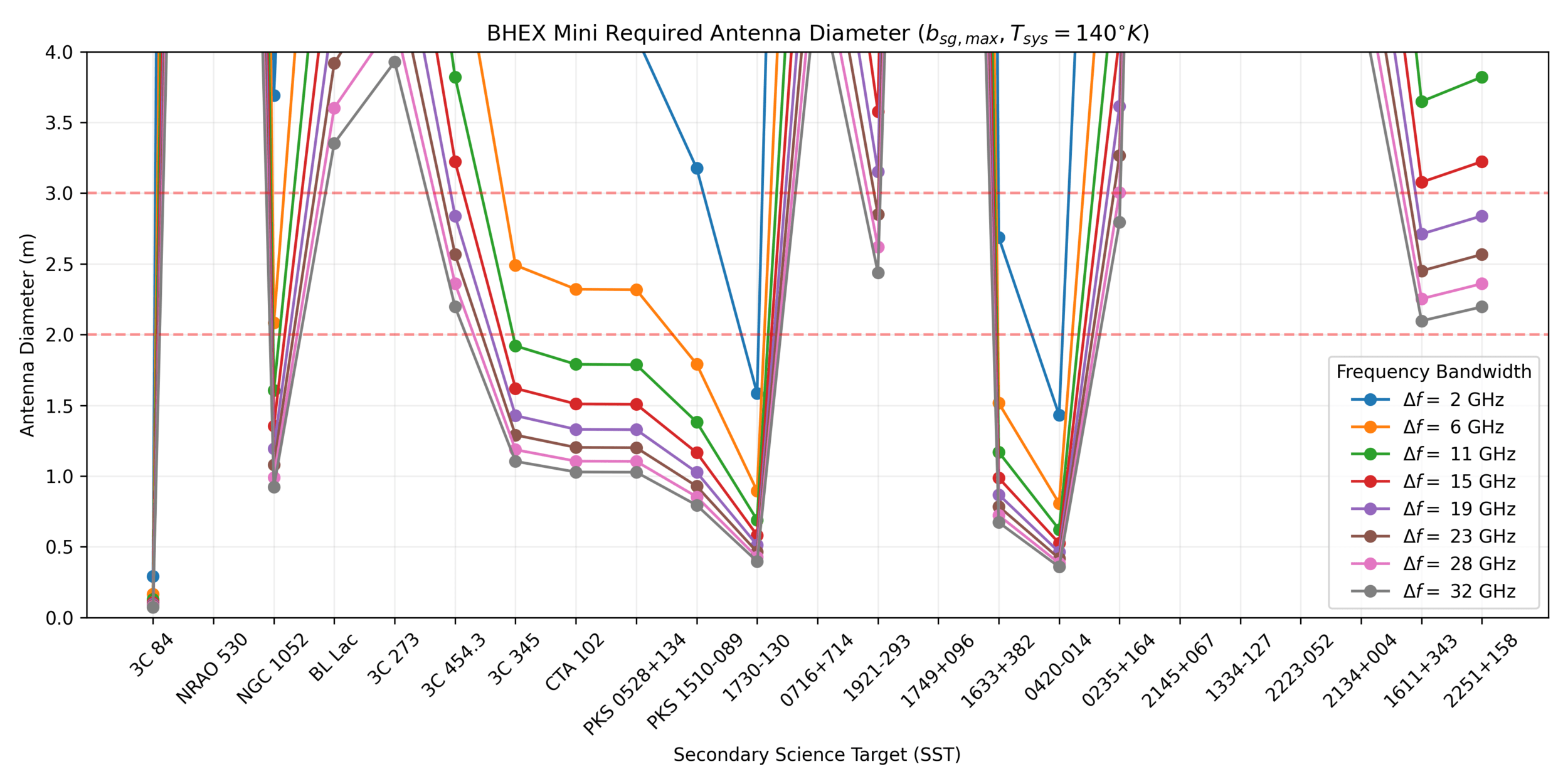
T-REX
Antenna
T-REX
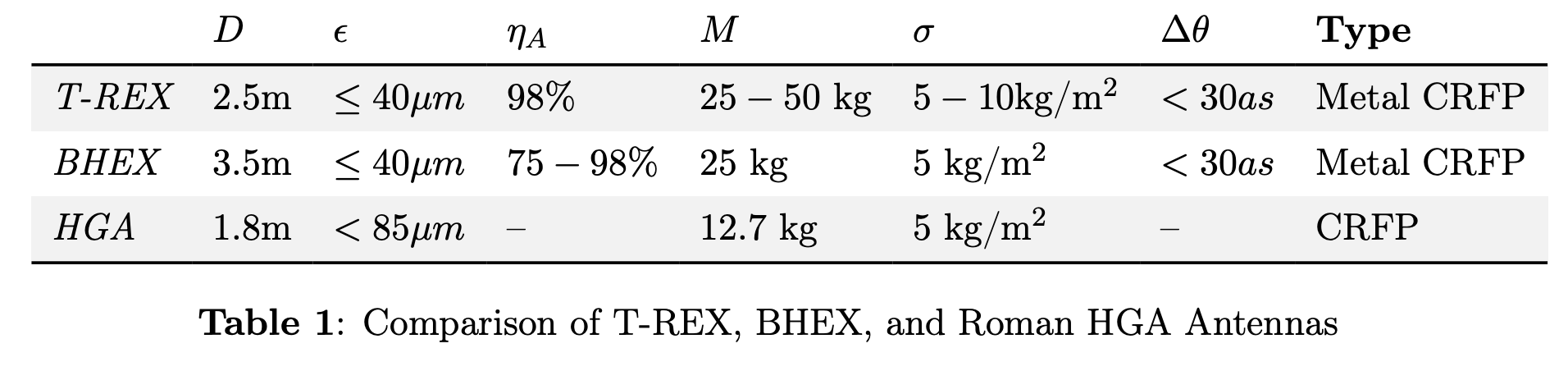
Antenna
T-REX
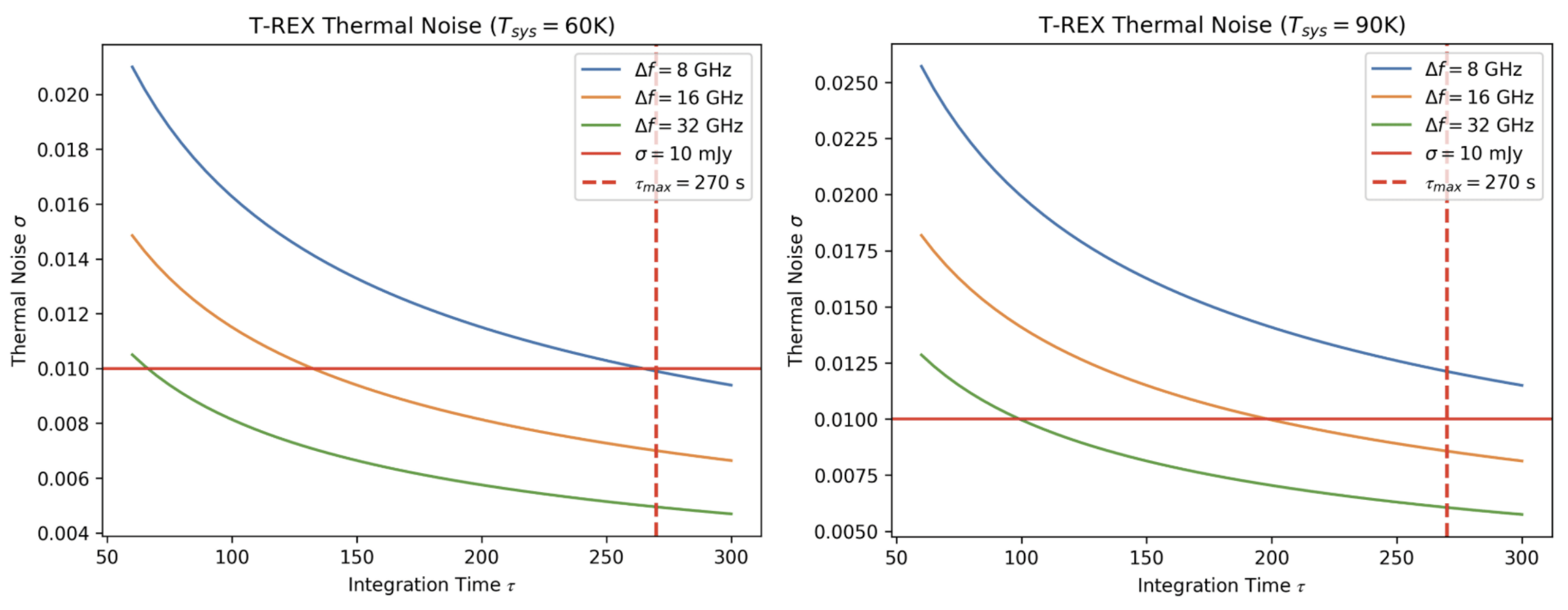
T-REX
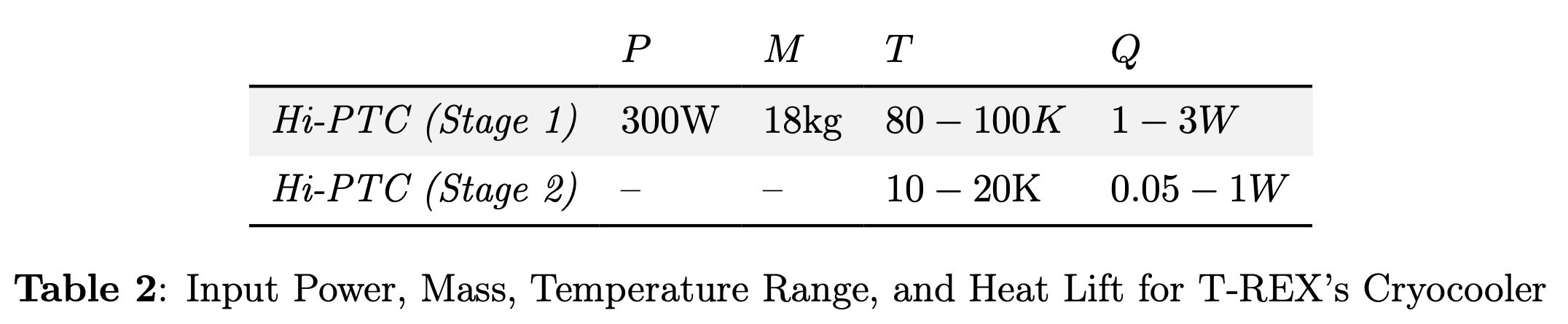
Cryocooler
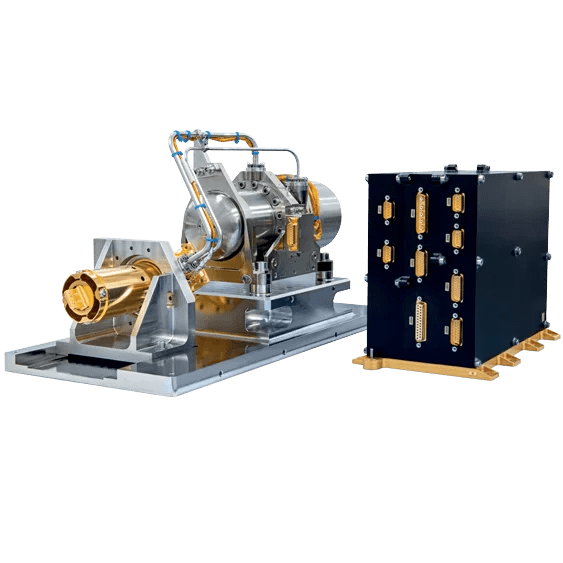
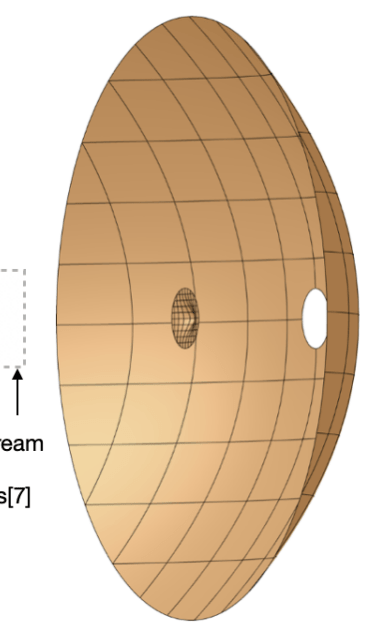
HiPTC Heat Intercepted Pulse Tube Cooler
T-REX
T-REX
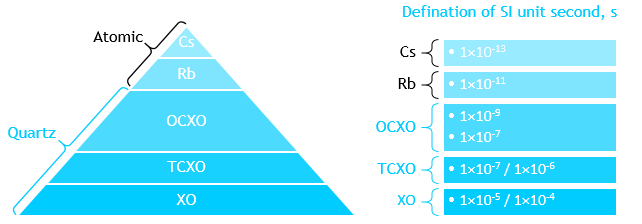
Ultra-Stable Oscillator
T-REX
Ultra-Stable Oscillator
\Delta \phi = 2\pi \cdot f \cdot \sigma_t
\sigma_t = \sigma_f \cdot \Delta t
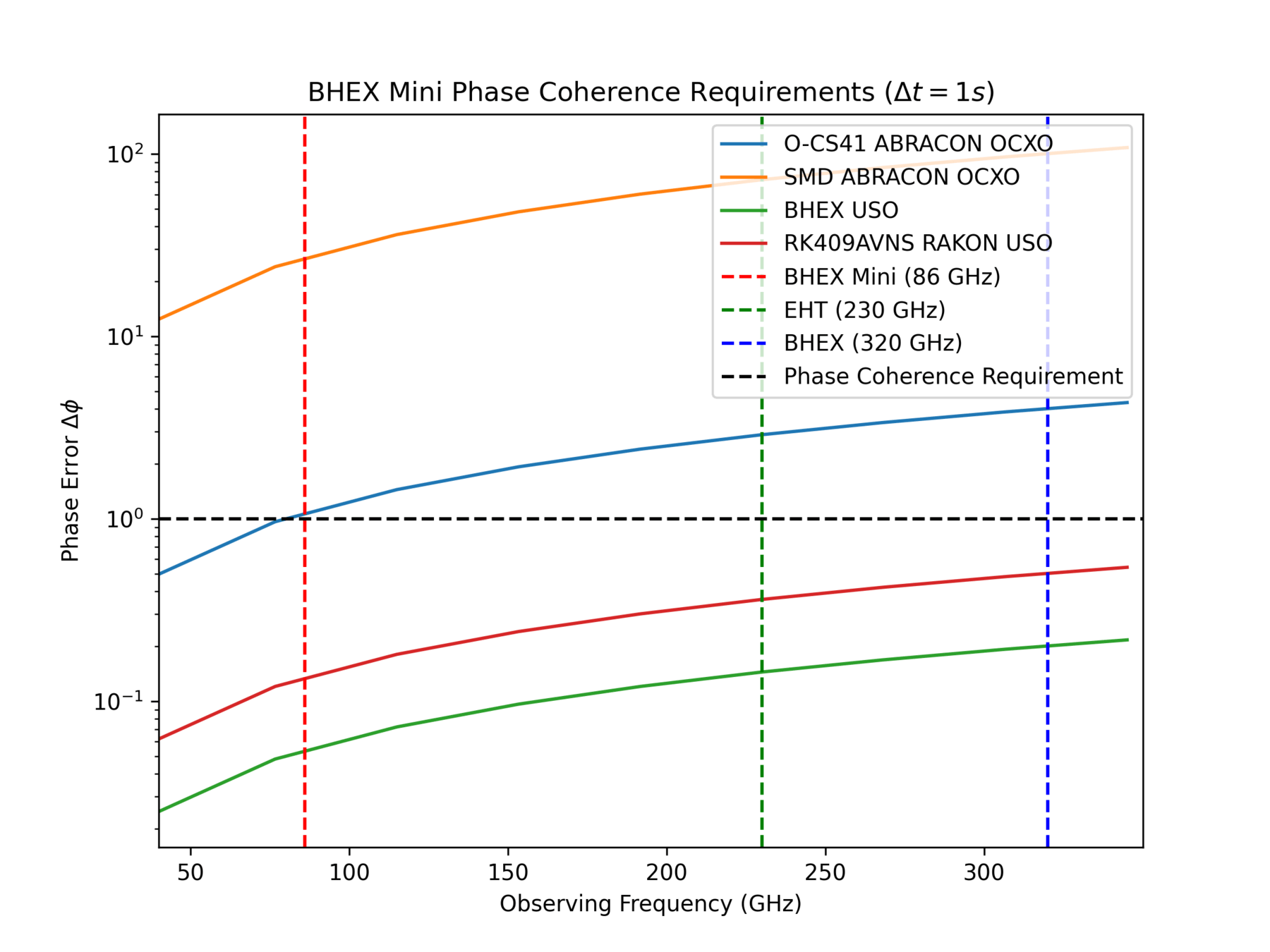
Phase Error
T-REX
Ultra-Stable Oscillator
\sigma_f = 5\cdot 10^{-11}, f_{obs}=86 \text{ GHz}
\Delta t = 1s:
\sigma_t = 5\cdot 10^{-11} \cdot 1s = 5\cdot 10^{-11} s
\Delta \phi = 2\pi \cdot (86\cdot 10^9 \text{ Hz}) \cdot 5\cdot 10^{-11} s=27.01 \text{ rad}
\Delta t = 10s:
\sigma_t = 5\cdot 10^{-11} \cdot 10s = 50\cdot 10^{-11} s
\Delta \phi = 2\pi \cdot (86\cdot 10^9 \text{ Hz}) \cdot 50\cdot 10^{-11} s=270.01 \text{ rad}
\Delta \phi<1 \text{ rad for Phase Coherence}
T-REX
Ultra-Stable Oscillator
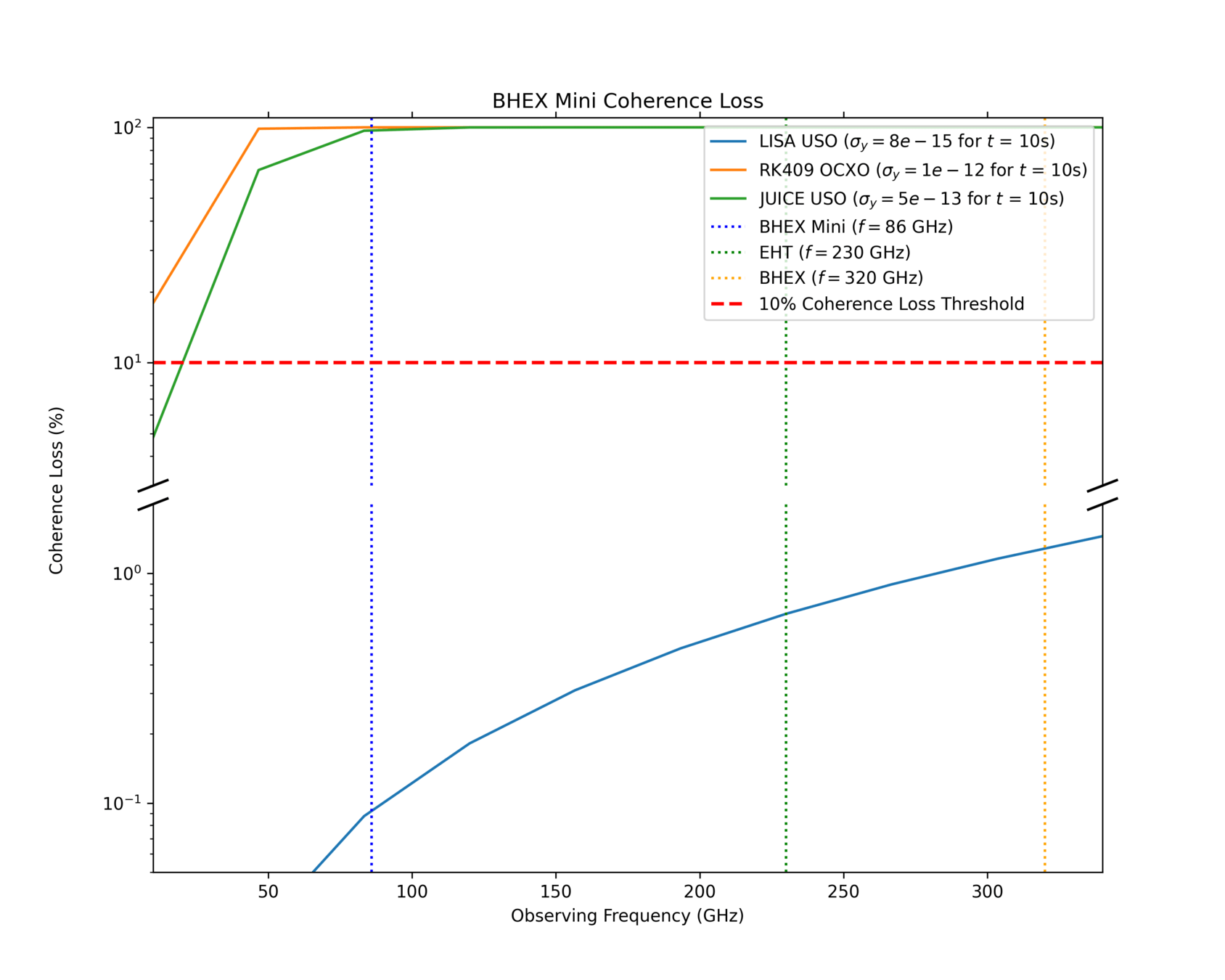
Allan Deviation
f=86 \text{ GHz}, t=10s, \sigma_y = 5\cdot 10^{-11}
L = 1-\exp\left[-2\pi^{2}(86\cdot 10^9)^{2}(10)^{2}(5\cdot 10^{-11})^{2}\right]
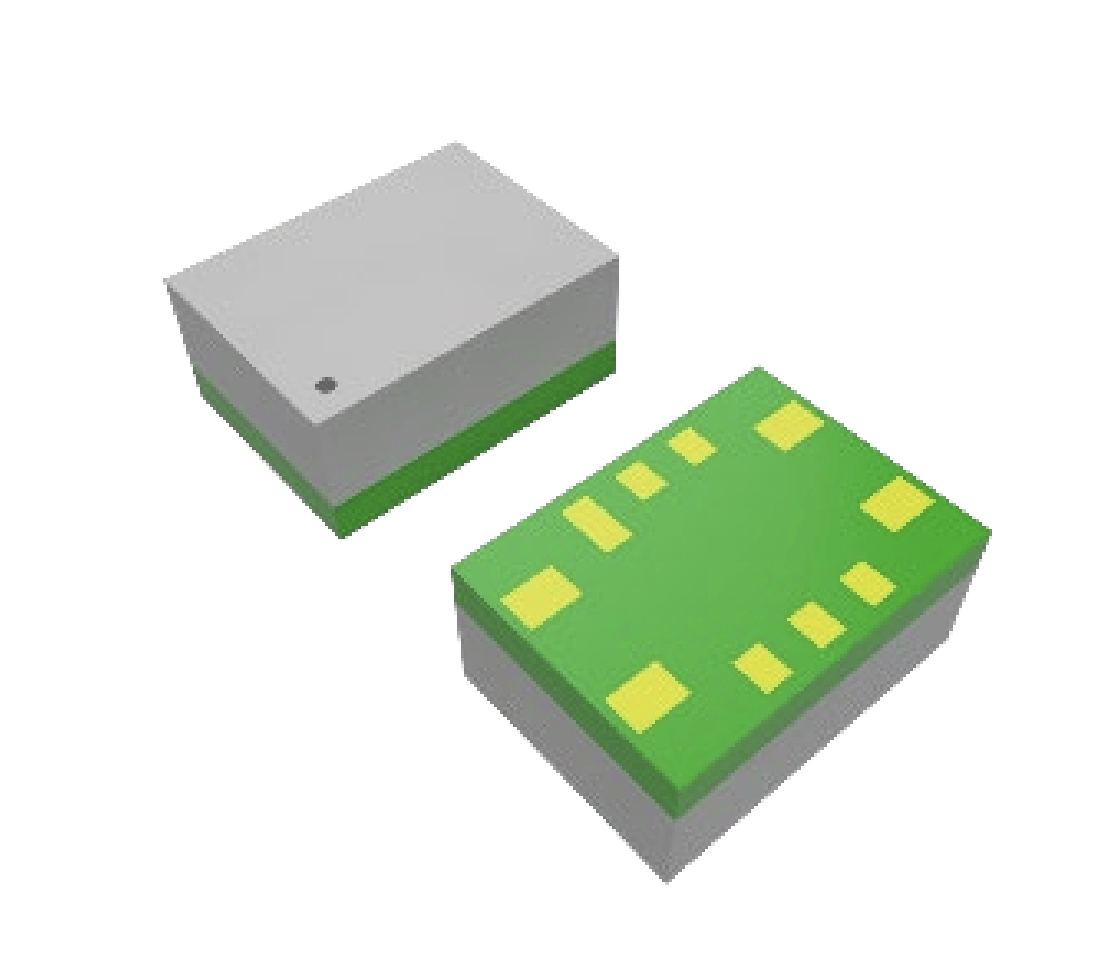
ABRACON SMD OCXO
L = 1-\exp\left(-2\pi^{2}f^{2}t^{2}\sigma_y^{2}\right)
L\sim 1\%<10\% \text{ required for Phase Coherence}
T-REX
Digital Backend
T-REX
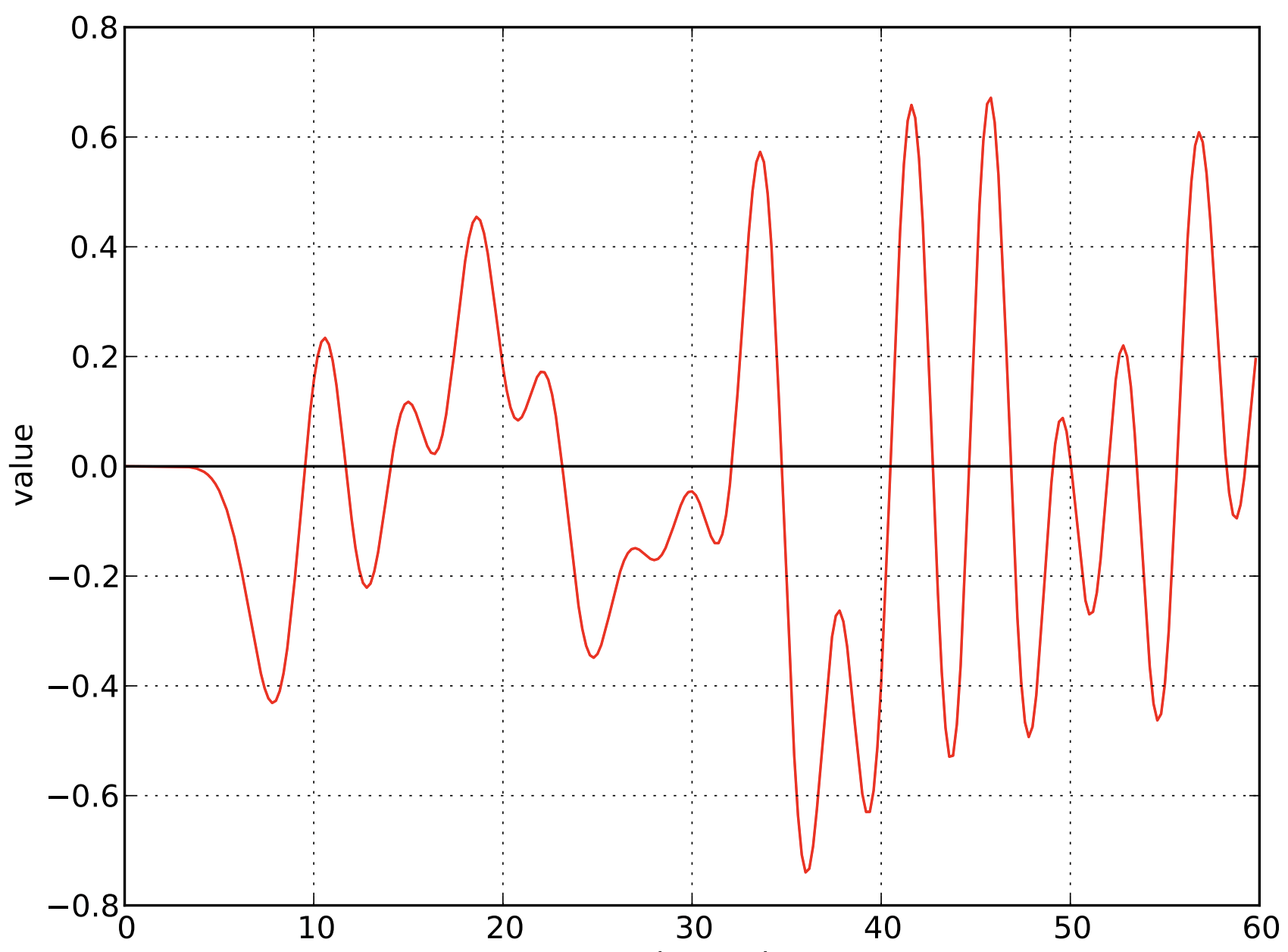
Original Analog Radio Signal
T-REX
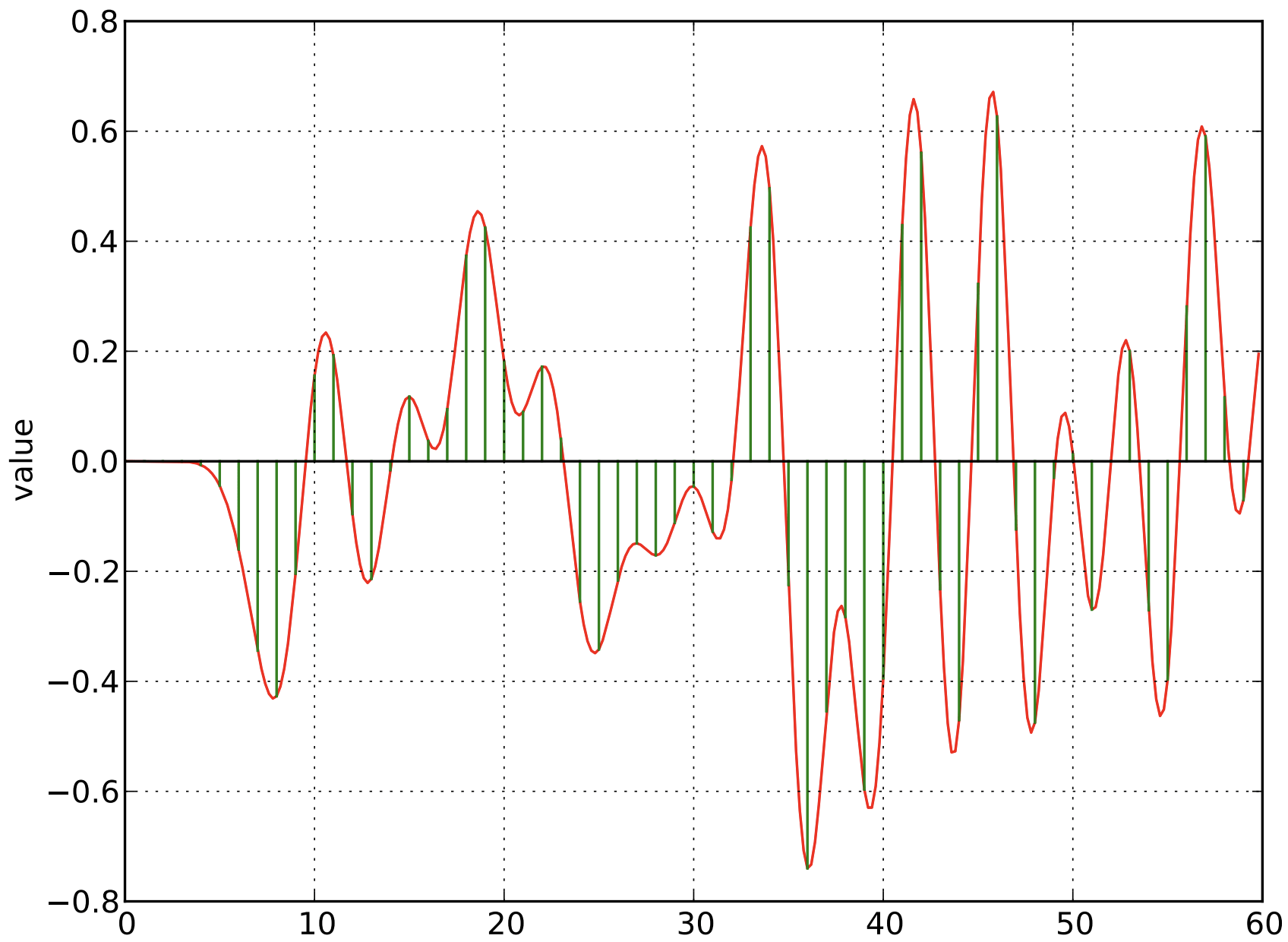
Sample the Signal every Unit Interval
f_s\geq 2f
Nyquist-Shannon Sampling Theorem
T-REX
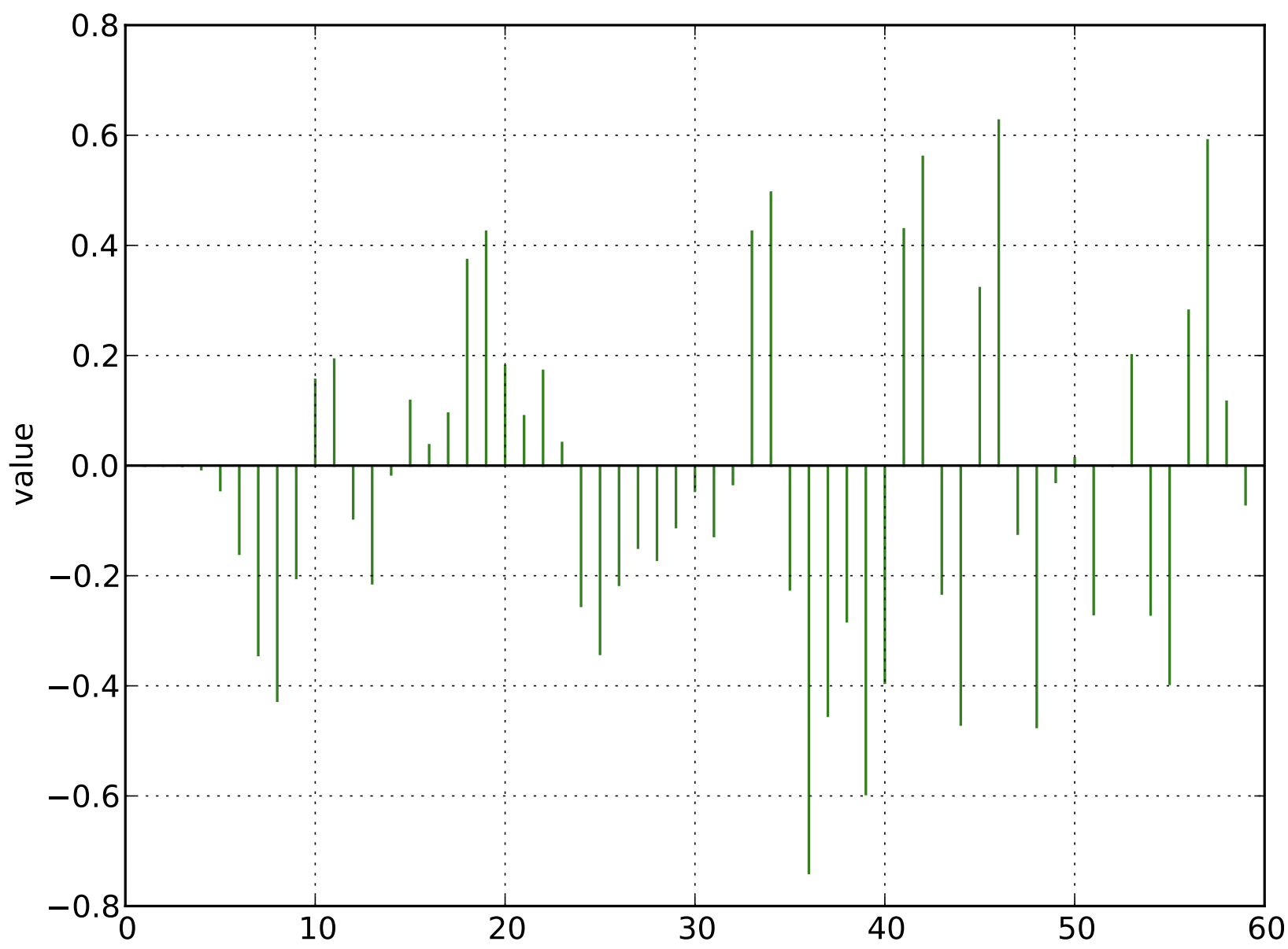
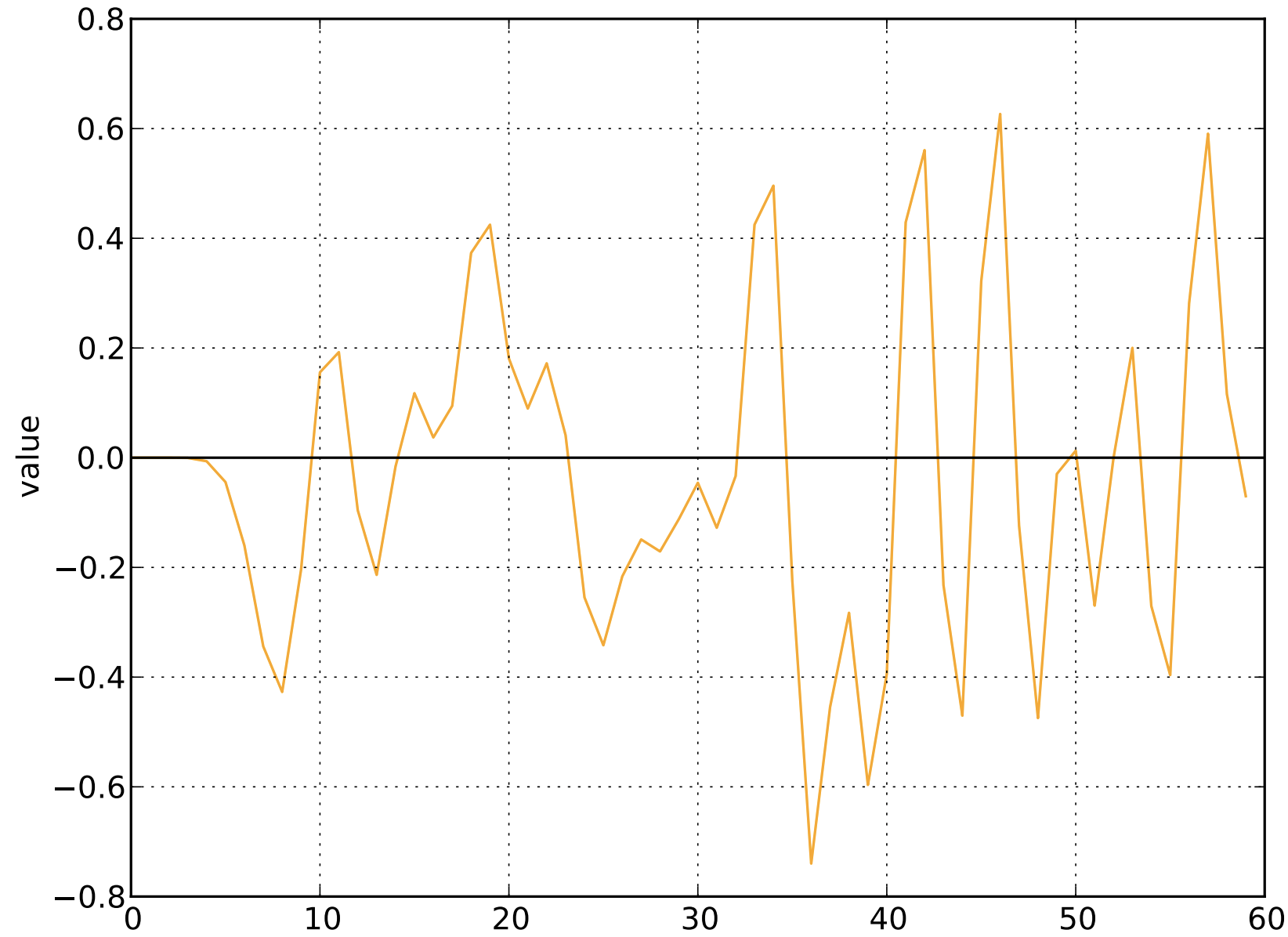
Retain only the samples and record the sign of the voltage for each sample
T-REX
Reconstruct the original signal
T-REX
T-REX
T-REX
- Introduction
- What is a black hole?
- How do you image a black hole?
- How do you record a black hole?
- T-REX Primary Science Objectives
- T-REX (u,v) Coverage
- T-REX Engineering Challenges
- T-REX SWaPC Requirements
- T-REX Concept of Operations
- T-REX Timeline & Funding Deadlines
T-REX
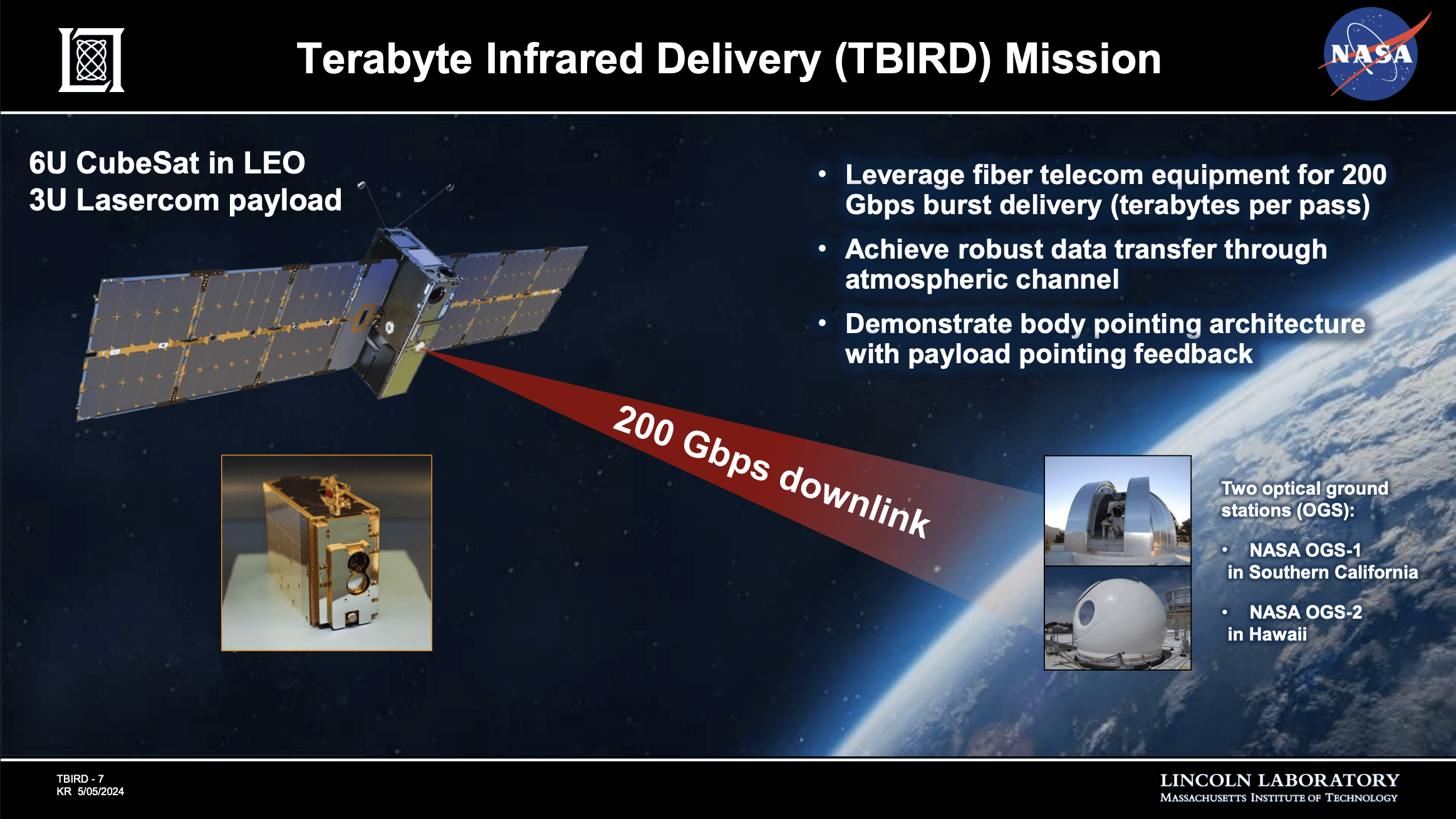
T-REX ConOps
Optical Terminals
RF Tracking Stations
VLBI Ground Stations
\text{T-REX}
T-REX Data Center
T-REX ConOps
- Introduction
- What is a black hole?
- How do you image a black hole?
- How do you record a black hole?
- T-REX Primary Science Objectives
- T-REX (u,v) Coverage
- T-REX Engineering Challenges
- T-REX SWaPC Requirements
- T-REX Concept of Operations
- T-REX Timeline & Funding Deadlines
T-REX
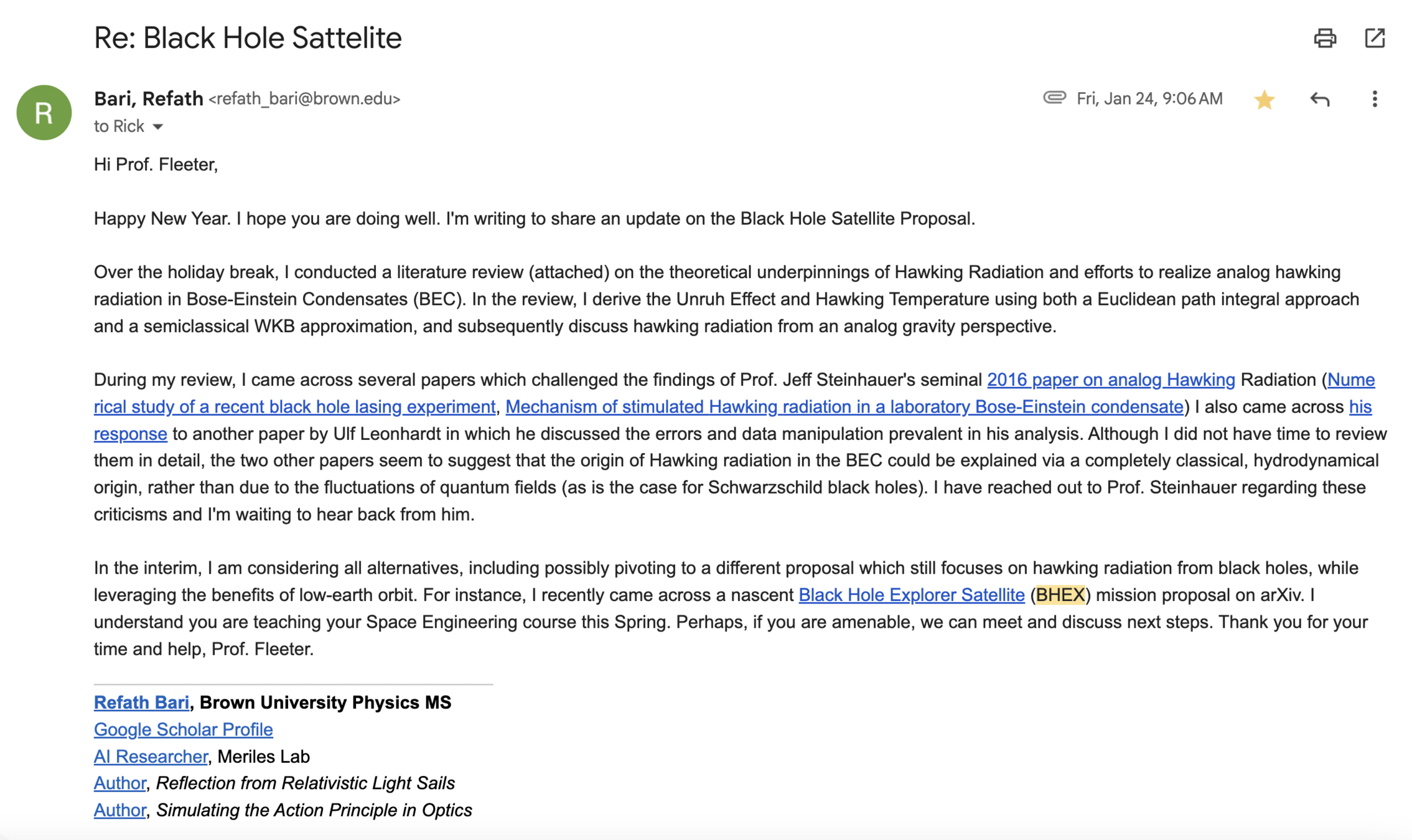
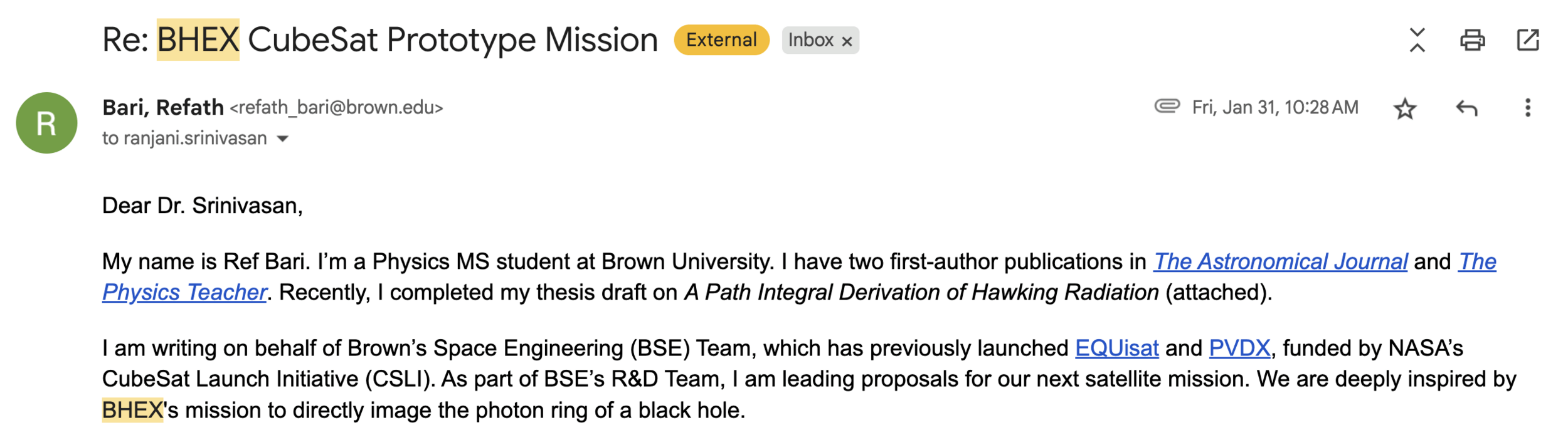
- Email BHEX Team
Jan 2025
T-REX
- Email BHEX Team
Jan 2025
T-REX
- Email BHEX Team
Jan 2025
T-REX
- Email BHEX Team
Jan 2025
Feb 2025
- Literature Review


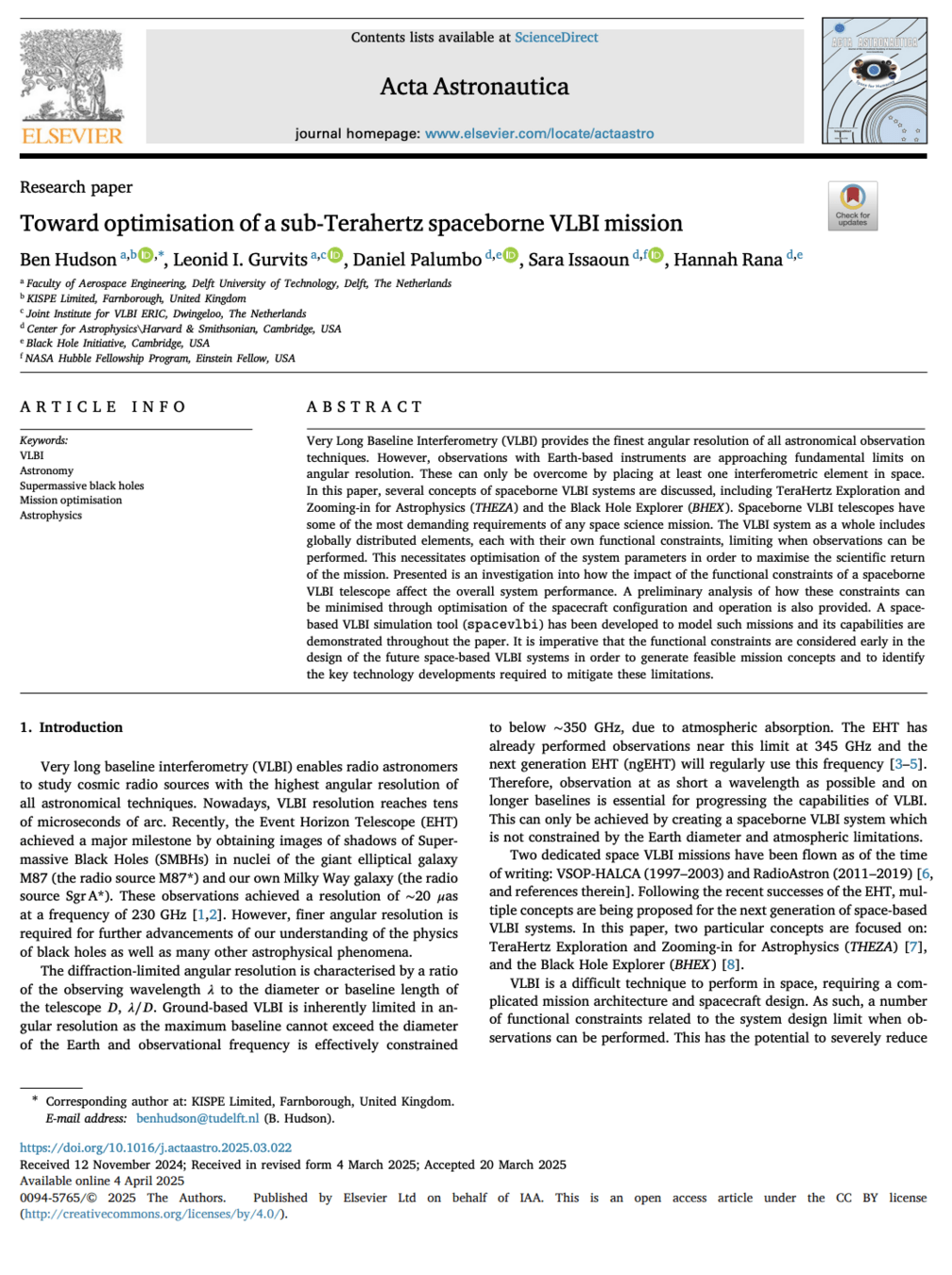
T-REX
- Email BHEX Team
Jan 2025
Feb 2025
Mar 2025
- Literature Review
- Advised on BHEX Mini by Prof. Rick Fleeter
- Submit to Rhode Island Space Grant
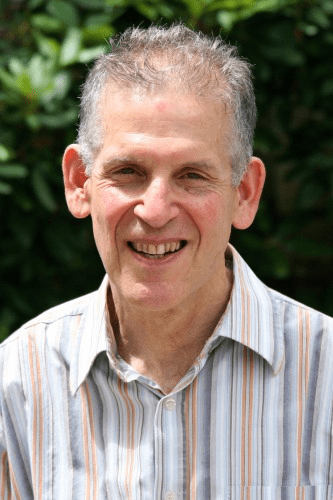
Rick Fleeter
T-REX
- Email BHEX Team
Jan 2025
Feb 2025
Mar 2025
- Literature Review
Apr 2025
- Ivy Space Conference
- Ben Hudson (BHEX, KISPE)
- Luke Anderson (Orion Space Systems)

Ben Hudson
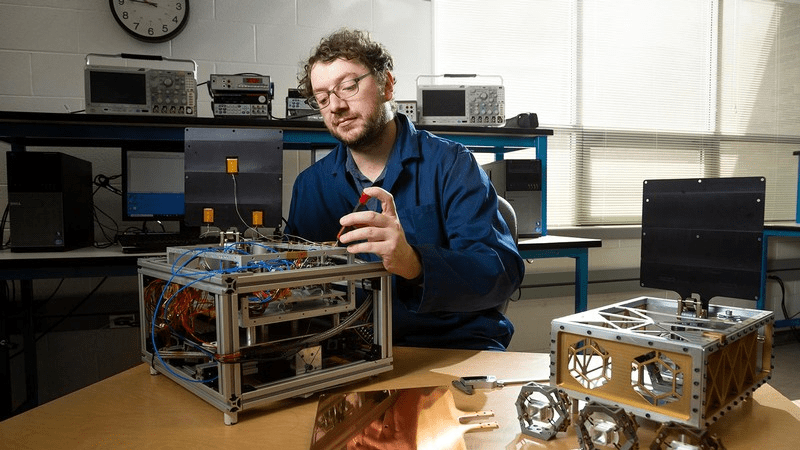
Luke Anderson
- Advised on BHEX Mini by Prof. Rick Fleeter
- Submit to Rhode Island Space Grant
T-REX
- Email BHEX Team
Jan 2025
Feb 2025
Mar 2025
- Literature Review
Apr 2025
May 2025
- Ivy Space Conference
- Ben Hudson (BHEX, KISPE)
- Luke Anderson (Orion Space Systems)
- Trained ~6 undergraduates to run simulations on BHEX Mini
- Jeffrey Olson (Cryocooler Engineer, Lockheed Martin

Jeffrey Olson
- Advised on BHEX Mini by Prof. Rick Fleeter
- Submit to Rhode Island Space Grant
T-REX
Jun 2025
Jul 2025
- Completed Antenna SWaPC Requirements
- Obtained Preliminary Grant Funding from Nelson Center
- Began correspondence with NASA JPL on Ultrastable Oscillators
- Constrained BHEX Mini SWaPC Requirements
- Approved by Brown Division of Research as PI for BHEX Mini
- Submitted to NASA NIAC Phase I Solicitation
- Accepted to SmallSat Europe 2026


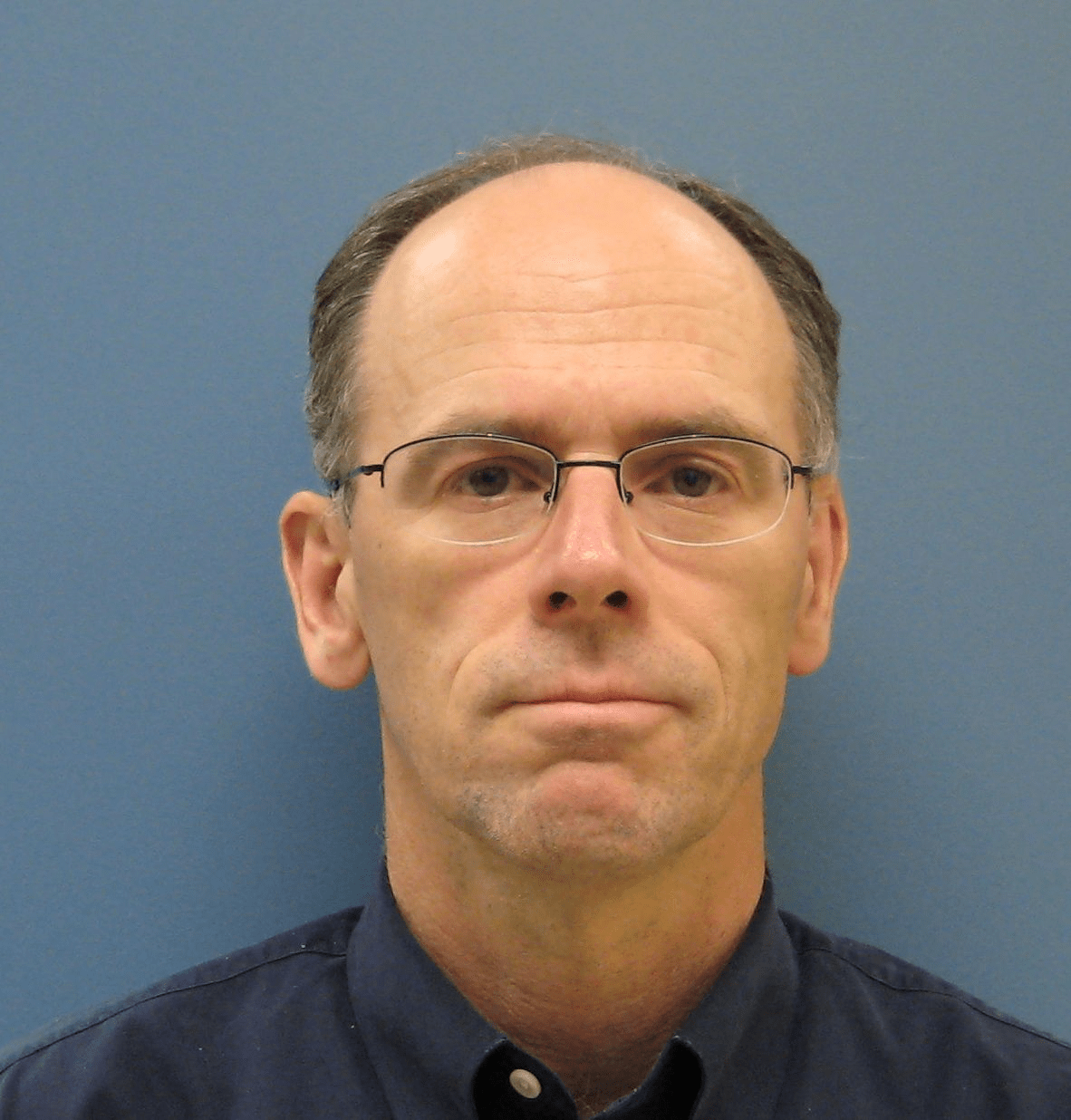

Todd Ely
Joseph Lazio
Eric Burt
- Email BHEX Team
Jan 2025
Feb 2025
Mar 2025
- Literature Review
Apr 2025
May 2025
Jun 2025
Jul 2025
- Ivy Space Conference
- Ben Hudson (BHEX, KISPE)
- Luke Anderson (Orion Space Systems)
- Trained ~6 undergraduates to run simulations on BHEX Mini
- Jeffrey Olson (Cryocooler Engineer, Lockheed Martin)
- Rejected from RISG
- Completed Antenna SWaPC Requirements
- Obtained Preliminary Grant Funding from Nelson Center
- Began correspondence with NASA JPL on Space-Space VLBI
- Constrained BHEX Mini SWaPC Requirements
- Approved by Brown Division of Research as PI for BHEX Mini
- Submitted to NASA NIAC Phase I Solicitation
- Accepted to SmallSat Europe 2026
- Advised on BHEX Mini by Prof. Rick Fleeter
- Submit to Rhode Island Space Grant
Feb 2025
Mar 2025
- Literature Review
Apr 2025
May 2025
Jun 2025
Jul 2025
- Ivy Space Conference
- Ben Hudson (BHEX, KISPE)
- Luke Anderson (Orion Space Systems)
- Trained ~6 undergraduates to run simulations on BHEX Mini
- Jeffrey Olson (Cryocooler Engineer, Lockheed Martin)
- Rejected from RISG
- Completed Antenna SWaPC Requirements
- Obtained Preliminary Grant Funding from Nelson Center
- Began correspondence with NASA JPL on Space-Space VLBI
- Rejected from International Astronautical Congress
- Constrained BHEX Mini SWaPC Requirements
- Approved by Brown Division of Research as PI for BHEX Mini
- Submitted to NASA NIAC Phase I Solicitation
- Accepted to SmallSat Europe 2026
- Advised on BHEX Mini by Prof. Rick Fleeter
- Submit to Rhode Island Space Grant
- Meeting with MIT Lincoln Labs (8/15)
- Colloquium at Princeton IAS (9/04)
- Michael Johnson Colloquium at Brown (PI, BHEX) (9/22)
- Assemble Science/Engineering Leadership Team for NASA / CSA
Aug 2025
Sep 2025
- Accepted as NASA NIAC Finalist
- Accepted to 10th International VLBI Conference (Sweden)
- Accepted to Gravitational Wave Conference (Georgia Tech)
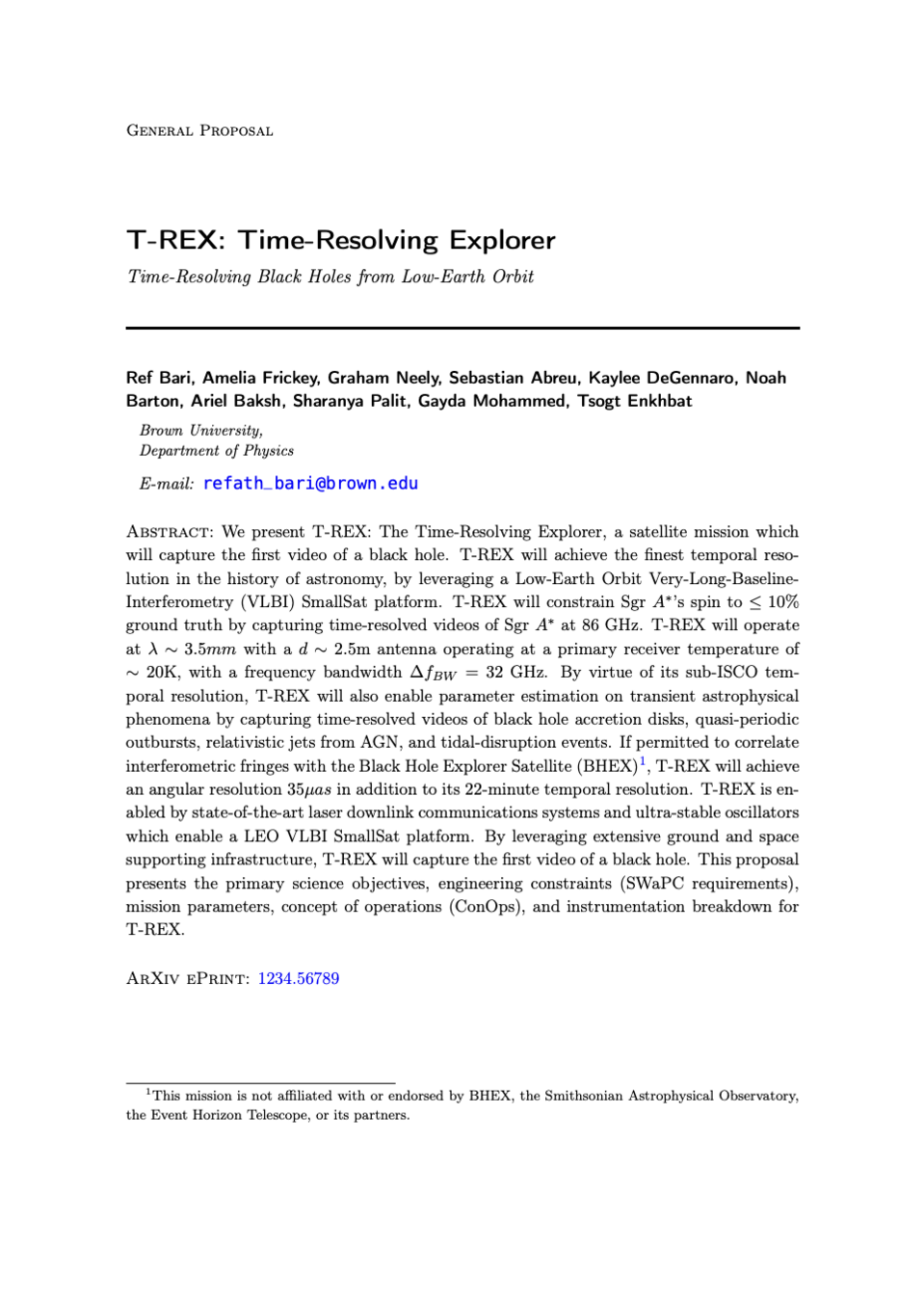
💰Funding Deadlines
June
💰Funding Deadlines
$5,000
-
Brown Nelson Grants
- Submitted: June 30
- Decision: Sep 15
July
💰Funding Deadlines
$5,000
$175,000
-
Brown Nelson Grants
- Submitted: June 30
- Decision: Sep 15
-
NASA NIAC Phase I
- Submitted: July 15
- Decision: Sep 6
Aug
💰Funding Deadlines
$5,000
$175,000
>$4M
-
Brown Nelson Grants
- Submitted: June 30
- Decision: Sep 15
-
NASA NIAC Phase I
- Submitted: July 15
- Decision: Sep 6
-
Templeton Grant
- Submitted: Aug 15
- Decision: Oct 10
Sep
💰Funding Deadlines
$5,000
$175,000
>$4M
-
Brown Nelson Grants
- Submitted: June 30
- Decision: Sep 15
-
NASA NIAC Phase I
- Submitted: July 15
- Decision: Sep 6
-
Templeton Grant
- Submitted: Aug 15
- Decision: Oct 10
-
AAS Splinter Meeting
- Submitted: Sep 25
- Decision: Oct 30
Oct
💰Funding Deadlines
$5,000
-
NASA NIAC Phase I
- Submitted: July 15
- Decision: Sep 6
$175,000
-
Brown Nelson Grants
- Submitted: June 30
- Decision: Sep 15
>$4M
-
Templeton Grant
- Submitted: Aug 15
- Decision: Oct 10
-
AAS Abstracts
- Submitted: Sep 25
- Decision: Oct 30
-
CSA FAST Grant
- Submitted: Oct 26
- Decision: Dec 15
>$400,000
- Introduction
- What is a black hole?
- How do you image a black hole?
- How do you record a black hole?
- T-REX Primary Science Objectives
- T-REX (u,v) Coverage
- T-REX Engineering Challenges
- T-REX SWaPC Requirements
- T-REX Concept of Operations
- The Request
T-REX
T-REX | Princeton Space Physics Lab
By Ref Bari