A Glimpse Under the Hood
- A simplified diagram showing three commit objects, each pointing to a "tree" object.
- The "tree" object points to "blob" objects (files) and other "tree" objects (directories).
- Arrows show the parent-child relationship between commits, forming a Directed Acyclic Graph (DAG).
- Text: "Git is a content-addressable filesystem with a version control UI on top."
Where Do Hooks Fit In?
-
The same DAG diagram from the previous slide.
-
An animated "PAUSE" icon appears between the developer action (
git commit) and the creation of the final "commit" object on the graph. -
A callout from the "PAUSE" icon says:
pre-commit: "Should I proceed?" -
Another animated "EDIT" icon appears on the commit message text file before it's finalized, with a callout:
prepare-commit-msg: "Let me add some info."
A Tour of the .git/hooks Directory
-
A screenshot of a terminal showing the output of
ls -l.git/hooks. -
The list shows files like
pre-commit.sample,commit-msg.sample,pre-push.sample, etc. -
Highlight the
.sampleextension.
Key Hooks by Category
-
Category 1: Client-Side: Local Workflow
-
pre-commit: Runs before a commit is created. Use for linting, formatting, security scans. -
prepare-commit-msg: Runs before the commit message editor opens. Use for templating messages. -
commit-msg: Runs after the message is written. Use for validating the message format. -
post-commit: Runs after a commit is successfully created. Use for notifications.
-
-
Category 2: Client-Side: Pushing Code
-
pre-push: Runs beforegit push. Use for running tests, ensuring you're not pushing broken code.
-
-
Category 3: Client-Side: Workflow Events
-
post-merge: Runs after a successful merge. Use for installing dependencies, rebuilding caches.
-
Lab 1 - Hello, Hook!
-
Objective: Create a basic
pre-commithook that blocks a commit based on a simple condition. -
Link:
github.com/your-repo/LAB-1.md -
A timer pre-set to 25:00.
The Hook Lifecycle Diagram
- A clear, left-to-right workflow diagram.
Developer Action: git add files->[HOOK: pre-commit]->Developer Action: git commit->[HOOK: prepare-commit-msg]->Commit Editor Opens->[HOOK: commit-msg]->Commit is created->Developer Action: git push->[HOOK: pre-push]->Code sent to Remote->Developer Action: git merge other-branch->[HOOK: post-merge]->Workspace updated.
The Commit Lifecycle
-
Focus on the commit portion of the diagram.
-
pre-commit: The Guardian. Asks "Is this code good enough to commit?" Perfect for automated checks that should be fast: linters, formatters, syntax checkers, credential scanners. -
prepare-commit-msg: The Assistant. Asks "Can I help you write a better message?" It can auto-insert information, like a JIRA ticket number from the branch name, before you even start typing. -
commit-msg: The Inspector. Asks "Does this message meet our team's standards?" It validates the message you've written against a specific format (e.g., conventional commits).
The Network Lifecycle
-
Focus on the push portion of the diagram.
-
pre-push: The Final Gateway. Asks "Are we absolutely sure this is ready to be shared with the team?" This is your last chance to stop a mistake on your local machine. -
Use Case: Since it runs less frequently than
pre-commit, it's the perfect place for slightly slower checks, like running a critical subset of unit tests.
The Workflow Lifecycle
-
Focus on the merge portion of the diagram.
-
post-merge: The Janitor. Asks "Now that we've brought in new code, does our environment need any cleanup or setup?" It runs after a successful merge. -
Use Case: Automatically run
npm installifpackage.jsonchanged, orpip install -r requirements.txtifrequirements.txtchanged. A huge quality-of-life improvement.
Lab 2 - The Guardian
-
Objective: Write a
pre-commithook that runs a linter on staged files and blocks the commit if errors are found. -
Link:
github.com/your-repo/LAB-2.md -
A timer pre-set to 30:00.
Lab 3 - The Automator
-
Objective: Build a two-part hook system to enforce policy and automate chores.
-
Part 1 (
commit-msg): Enforce that commit messages contain a JIRA-style ID based on the current branch name. -
Part 2 (
post-merge): Automatically run a dependency installer if a package file has changed after a merge. -
Link:
github.com/your-repo/LAB-3.md -
A timer pre-set to 35:00.
Real-World Impact
Module 3: The Case for Frameworks & The "Common Problems Bingo" (20 mins)
The Honeymoon is Over...
-
A simple, text-only slide.
-
"So, manual hooks are great, right? They're powerful, flexible, and have no dependencies."
-
"...what happens when you try to share them with your team?"
The "Common Hook Problems" Bingo Card
-
A visual 3x2 bingo card grid.
-
Each square contains one of the common problems:
-
"It works on my machine!" (macOS
sedvs. Linuxsed) -
"I forgot to run
chmod +x" -
"New dev joined, forgot to install the hooks"
-
"Our hooks aren't even in version control!"
-
"I just used
--no-verifyto bypass it..." -
"Managing Python, Node, and Ruby hooks is a nightmare"
-
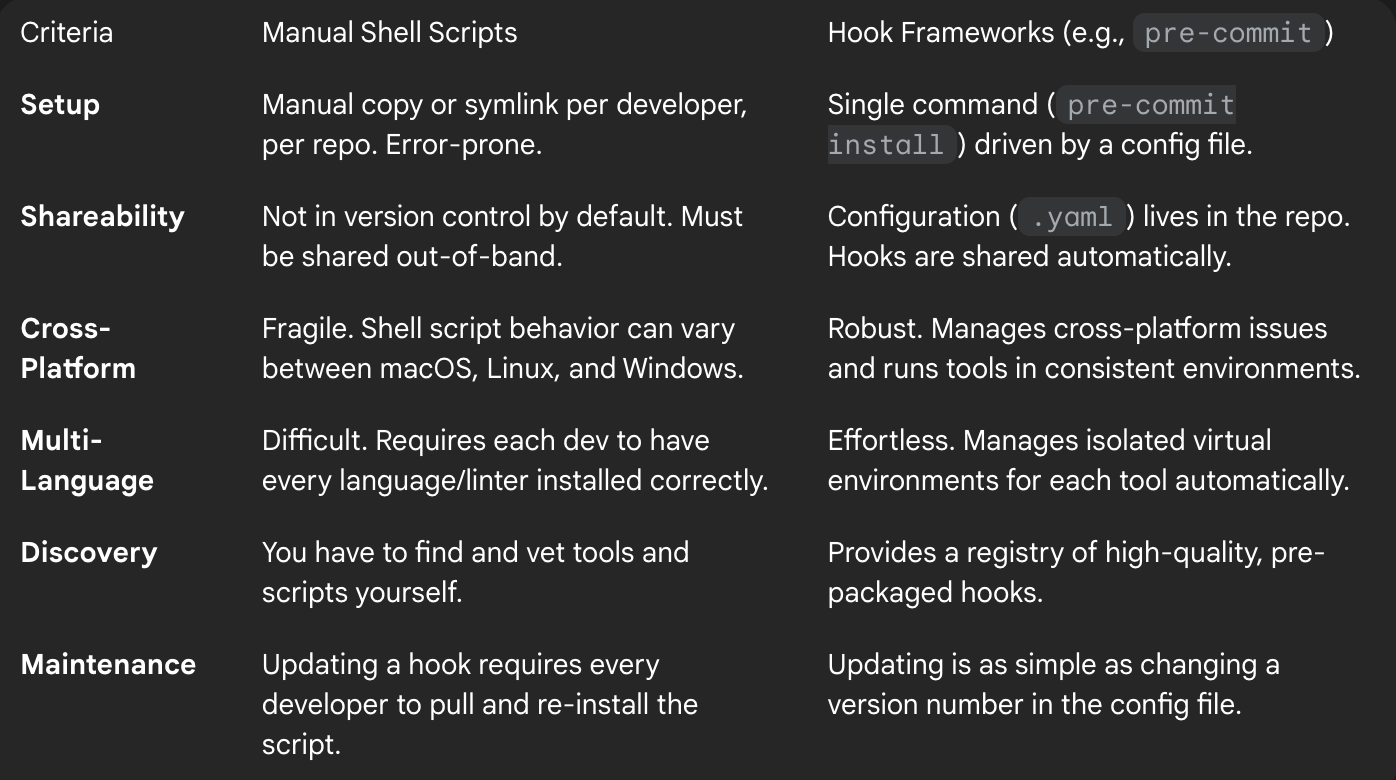
Manual Hooks vs. Frameworks: The Trade-Offs
Introducing: pre-commit
-
Logo for the
pre-commitframework. -
Tagline: "A framework for managing and maintaining multi-language pre-commit hooks."
-
Website: pre-commit.com
How pre-commit Works
-
A simple three-step diagram:
-
-
You write a
.pre-commit-config.yamlfile. (Shows a snippet of the YAML).
-
-
-
You run
pre-commit install. This installs a tiny, smart script into.git/hooks/pre-commit.
-
-
-
On commit, the script reads the YAML. It then downloads the specified tools into isolated, cached environments and runs them against your staged files.
-
Anatomy of the.pre-commit-config.yaml
A code block with a well-annotated example YAML file.
Lab 4 - The Great Migration
-
Objective: Replace the manual linter hook from Lab 2 with a framework-managed hook using
pre-commit -
Link:
github.com/your-repo/LAB-4.md - A timer pre-set to 25:00.
The Onboarding Document
- A screenshot of a
CONTRIBUTING.mdfile on GitHub. - A highlighted section titled "Developer Setup".
- The highlighted text contains only two commands:
-
pre-commit install -
pip install pre-commit
-
Pinning for Sanity: The rev Field
-
The YAML example from before, with a large red arrow pointing to
rev: v4.3.0. -
Text: "Always pin to a specific tag or SHA. Avoid using
masterormainto prevent unexpected updates and ensure reproducible builds for all developers."
My Professional "Aha!" Moment
A simple slide with a lightbulb icon.
Title: "The Story of the Skeptical Team"
What About JavaScript? Introducing Husky
-
The Husky logo.
-
A code block showing a sample
package.jsonconfiguration for Husky.
-
Text: "Husky is the go-to hook manager for the Node.js ecosystem. It leverages
package.jsonand npm scripts for configuration."
Hooks and CI: Better Together
A diagram with two columns.
-
Column 1: Git Hooks (Your Laptop)
-
Icon: Laptop
-
Fast, Individual Feedback
-
Runs on every commit
-
Jobs: Linting, Formatting, Secret Scanning, Syntax Checks
-
-
Column 2: CI/CD Pipeline (The Server)
-
Icon: Server/Cloud
-
Slower, Authoritative Team Feedback
-
Runs on every pull request
-
Jobs: Full Unit/Integration Test Suites, Building Artifacts, Deploying
-
-
An arrow connects them, labeled "Partners in Quality".
Hooks Aren't Just for Saying 'No'
-
A transition slide with a large, bold statement:
-
"So far, we've used hooks to prevent bad things."
-
"Now, let's use them to create good things."
Productivity Hacks
-
The Automatic Ticket Inserter (
prepare-commit-msg)-
Reads branch name
feature/PROJ-451-login -
Automatically prepends
PROJ-451:to the commit message. -
"Turns a manual chore into an invisible, automated process."
-
-
The Automatic Dependency Installer (
post-merge)-
Detects changes to
package.jsonafter a merge. -
Automatically runs
npm install. -
"Handles a common follow-up task without any user intervention."
-
Workflow Enhancements
-
The "Did you run migrations?" Reminder (
post-merge)-
Detects changes in the
db/migrate/directory. -
Prints a big, bold, colorful message to the console: "ATTENTION: New migrations were pulled. Remember to run
rails db:migrate!" -
"A low-effort, high-impact nudge at the perfect moment."
-
Fun & Quirky Hooks!
-
The Commit-Triggered Sound Effect (
post-commit)-
On successful commit, runs
afplay level-up.mp3. -
"Provides positive, ambient feedback."
-
-
The ASCII Art Signature (
prepare-commit-msg)-
Appends a block of ASCII art to the end of every commit message.
-
"Adds a bit of personality and fun."
-
-
(Optional: A short screen recording demonstrating one of these).
The Call to Action
-
A large question on the screen:
-
"What is a repetitive, annoying, or manual task in your personal workflow that a simple script could solve?"
A 4-Step Strategy for Your Team
-
A numbered list of actionable steps.
-
1. Start Small & Provide Value: Don't boil the ocean. Introduce a single, undeniably useful hook first. An auto-formatter like Black or Prettier is a perfect start because its value is immediately obvious.
-
2. Get Buy-In, Don't Mandate: Share a success story (like the secret-scanning one). Show, don't just tell. Frame it as a tool that helps everyone, not a process that is forced upon them.
-
3. Use a Framework for Consistency: Once you have more than one hook or more than one developer, adopt a framework like
pre-commitor Husky. This is non-negotiable for team success. -
4. Document the Setup: Add the two-line installation guide to your
CONTRIBUTING.mdor team wiki. Make it the path of least resistance.
Thank You & Q&A
- Title: Q&A
- Instructor Name
- Email / Twitter / LinkedIn
- Link to GitHub Repo
- Link to Workshop Feedback Form
A Glimpse Under the Hood
By Shagun Tyagi